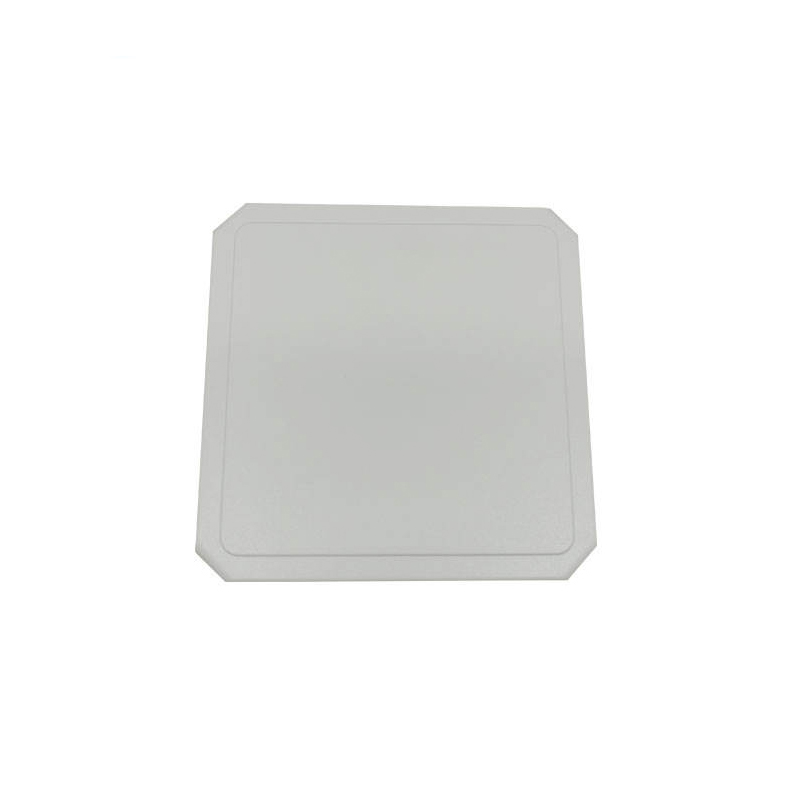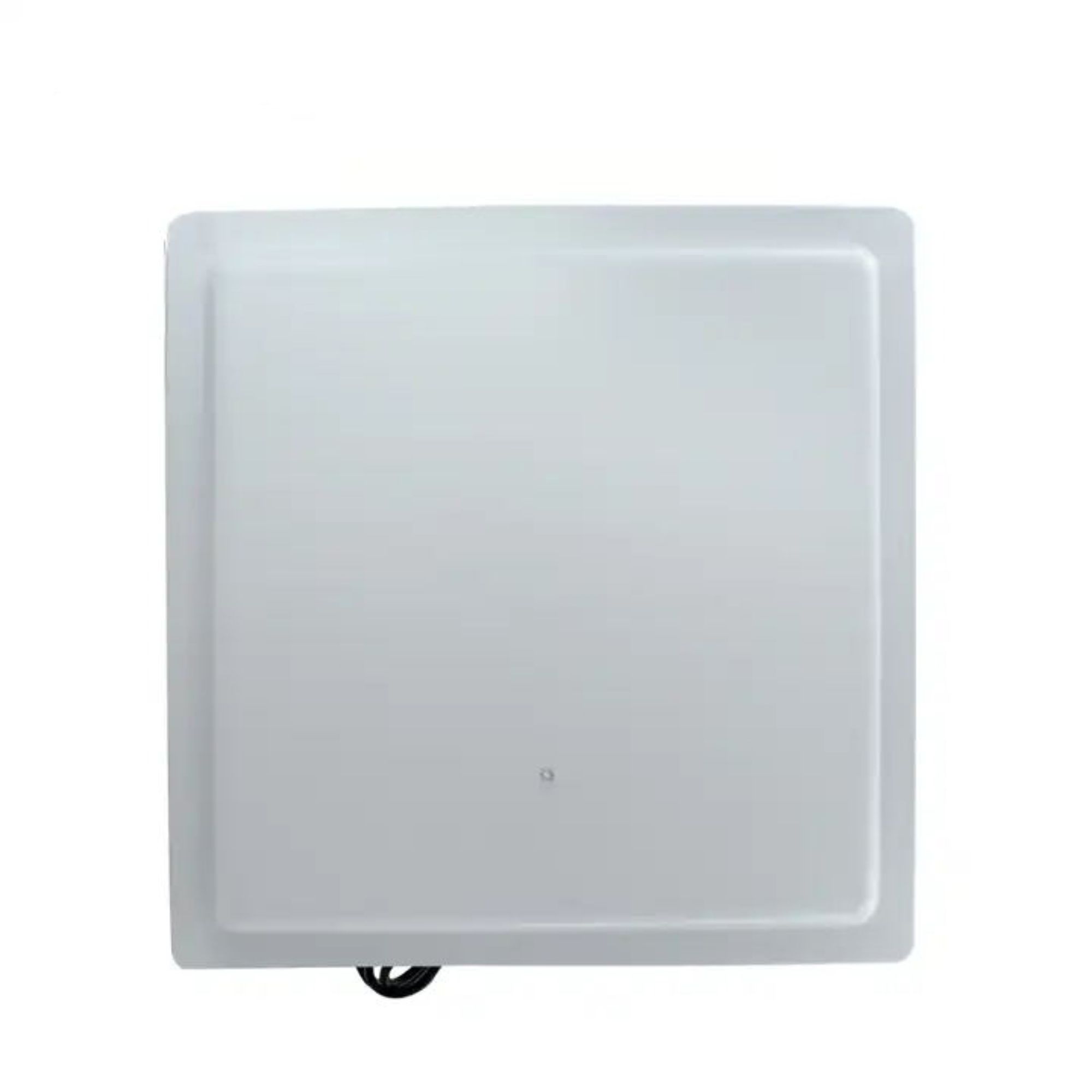

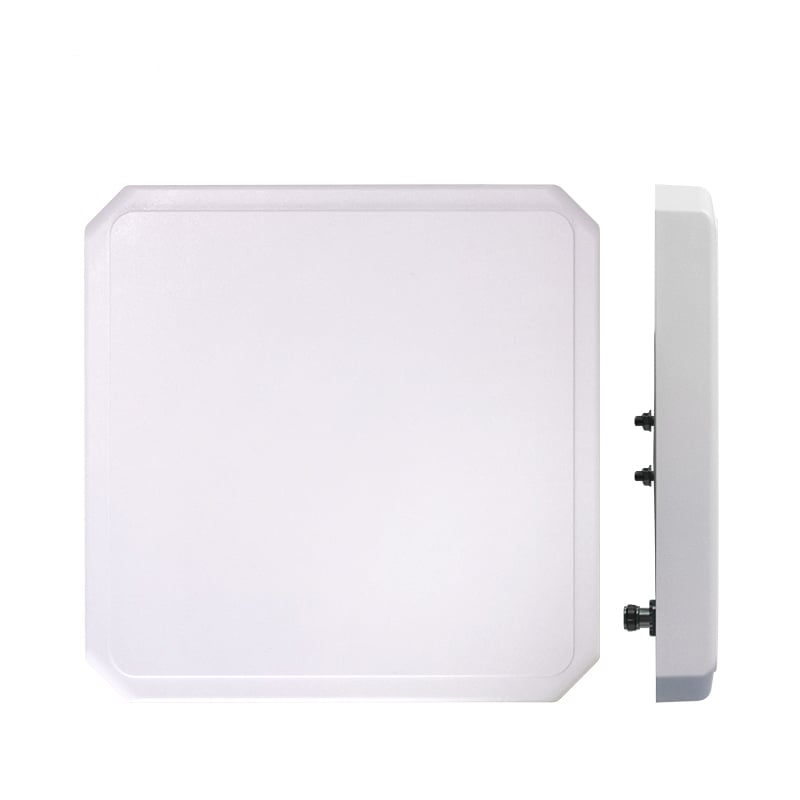
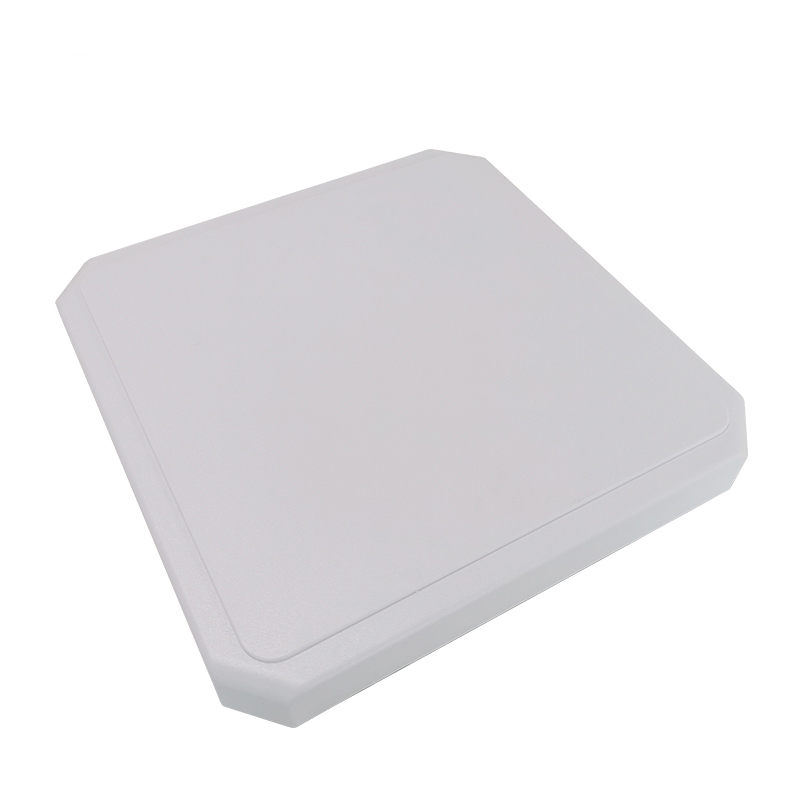
A 259 mm panel with a 70° beam: it covers a gate, not a doorway.
Nine decibels at 70° by 63° is the widest useful panel in this family. At 5 m it lights up a rectangle 7.0 m wide and 6.1 m high, which is why it suits a vehicle portal, a yard gate, a wide conveyor mouth or a defined zone — not a single door, where the extra width is wasted.
259 × 259 × 30 mm, aluminium reflector under a white ABS radome, IP67, VSWR below 1.3, 50 Ω, 100 W maximum input, circular polarisation, −20 to +80 °C, rated to 120 km/h of wind.
Coverage
Beamwidth is the number that decides whether a panel suits your opening. Published as 70° ± 5° horizontal by 63° ± 3° vertical, so the real beam is somewhere between 65 and 75 degrees wide. These are half-power widths: a tag at the edge of the rectangle is being powered with roughly half the energy it gets on axis.
Half-power widths, same origin. The wide fan is the point of this antenna: it does not need precise aim.
| DISTANCE | WIDTH, 70° H | HEIGHT, 63° V | WHAT IT SUITS |
| 3 m | 4.20 m | 3.68 m | A vehicle lane, a wide conveyor mouth |
| 5 m | 7.00 m | 6.13 m | A yard gate or a two-lane portal |
| 8 m | 11.20 m | 9.80 m | A pallet bay, a loading apron |
| 10 m | 14.00 m | 12.26 m | A full gate structure, a defined zone |
| 15 m | 21.01 m | 18.38 m | A yard area — but check the tag, not the datasheet |
Choosing
These two are the pair customers compare, so here is the decision in one table. Both are the same family, the same white radome and the same N-type rear — the difference is how much area you need to cover.
| 6 dBi PANEL | 9 dBi PANEL, THIS PAGE | |
| Outline | 123 × 123 × 34.2 mm | 259 × 259 × 30 mm |
| Beam, published | 42° H × 38° V | 70° ± 5° H × 63° ± 3° V |
| Width at 5 m | 3.84 m | 7.00 m |
| Sealing | IP65 | IP67 |
| Temperature | −40 to +80 °C | −20 to +80 °C |
| Choose it for | One door, one conveyor point, one chokepoint — a place where a narrow beam is an advantage because it ignores the tags on the neighbouring rack. | A gate, a portal, a lane or a zone, where you want every tag in an opening and do not want to aim carefully. |
Tag orientation
This panel is circularly polarised. In practice that means the tag can be stuck on at any angle and still read, which is the reason portal and gate work uses circular rather than linear antennas.
| CIRCULAR, THIS ANTENNA | LINEAR | |
| Tag orientation | Any direction reads. Nothing to align when the truck arrives. | The tag must sit roughly parallel to the antenna, or the read drops away. |
| Cost | About 3 dB against a linear tag, which is roughly 30% less usable distance at the same power. | Full power to an aligned tag, so linear wins when the tag orientation never varies. |
| Two antennas facing each other | Handedness must match: right-hand with right-hand. A mismatched pair rejects most of what crosses it. | Two linear units must be aligned the same way, and they will not reject each other. |
| Typical use | Portals, gates, lanes, anything where the tag arrives at a random angle. | A conveyor or print-and-apply station where the label always faces one way. |
The back of the panel
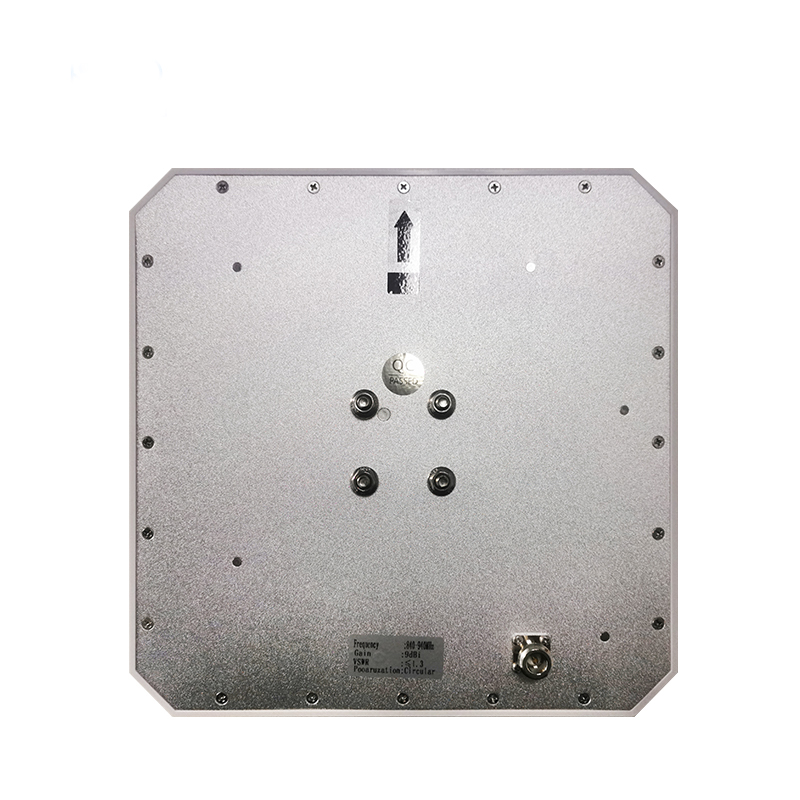
The rear face carries everything that matters for installation, and the old page described none of it: the up arrow, four threaded studs for the bracket, and a single N-type socket.
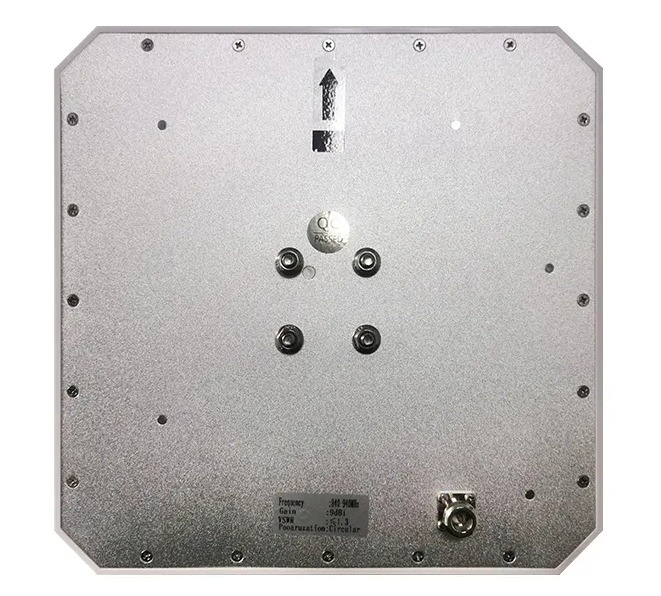
The actual rear face: aluminium reflector, perimeter screws, the up arrow, four threaded studs and the N-type socket at the lower corner.
Rear face, schematic. Perimeter screws hold the radome to the reflector; the four centre studs carry the bracket.
Where it belongs
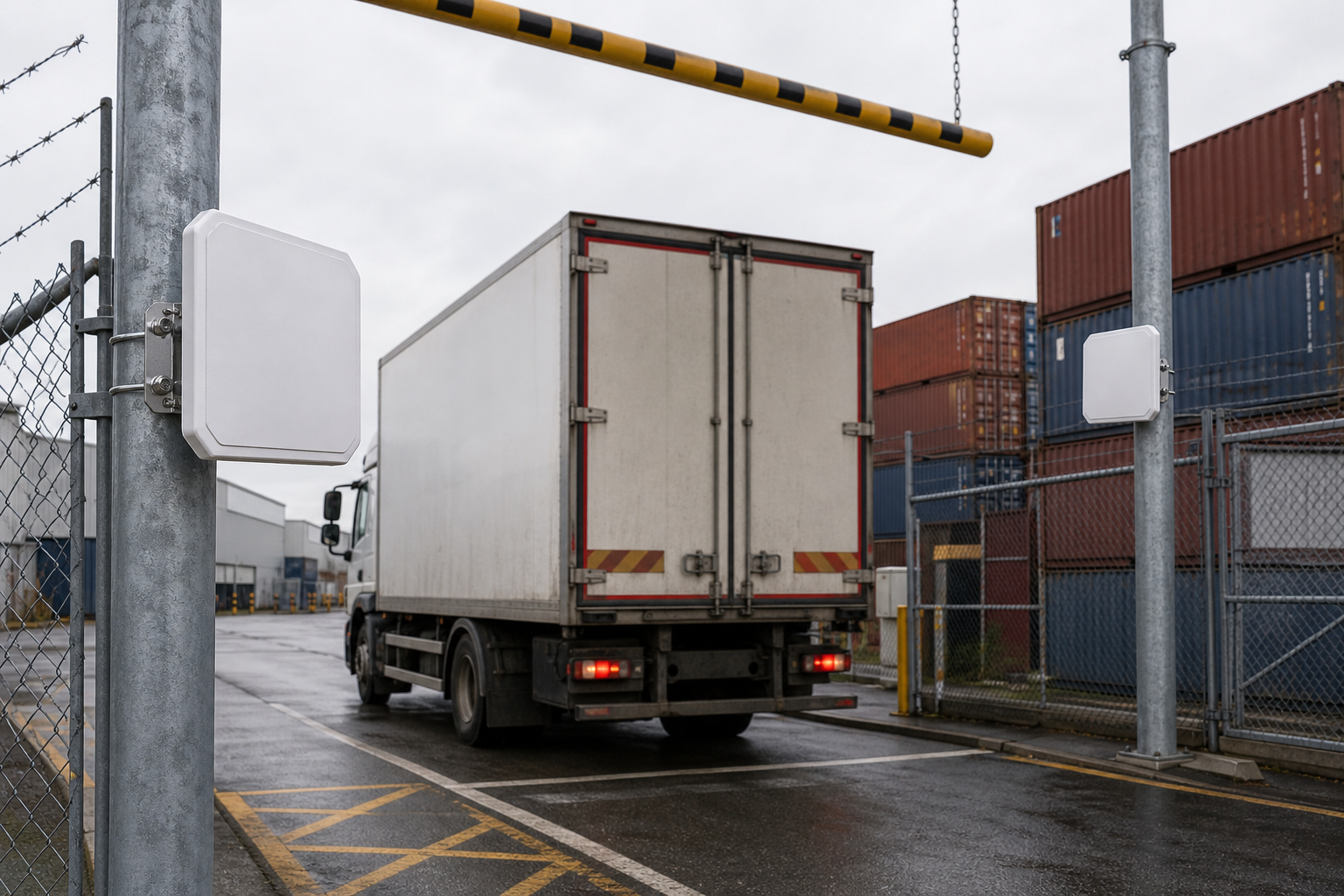
The 70° beam makes this the easier panel to build a portal with: mount one unit on each side of the opening at the same height, angled slightly inward, and the two fans overlap across the whole lane. Wider openings need the pair; a single unit covers roughly 7 m of width at 5 m.
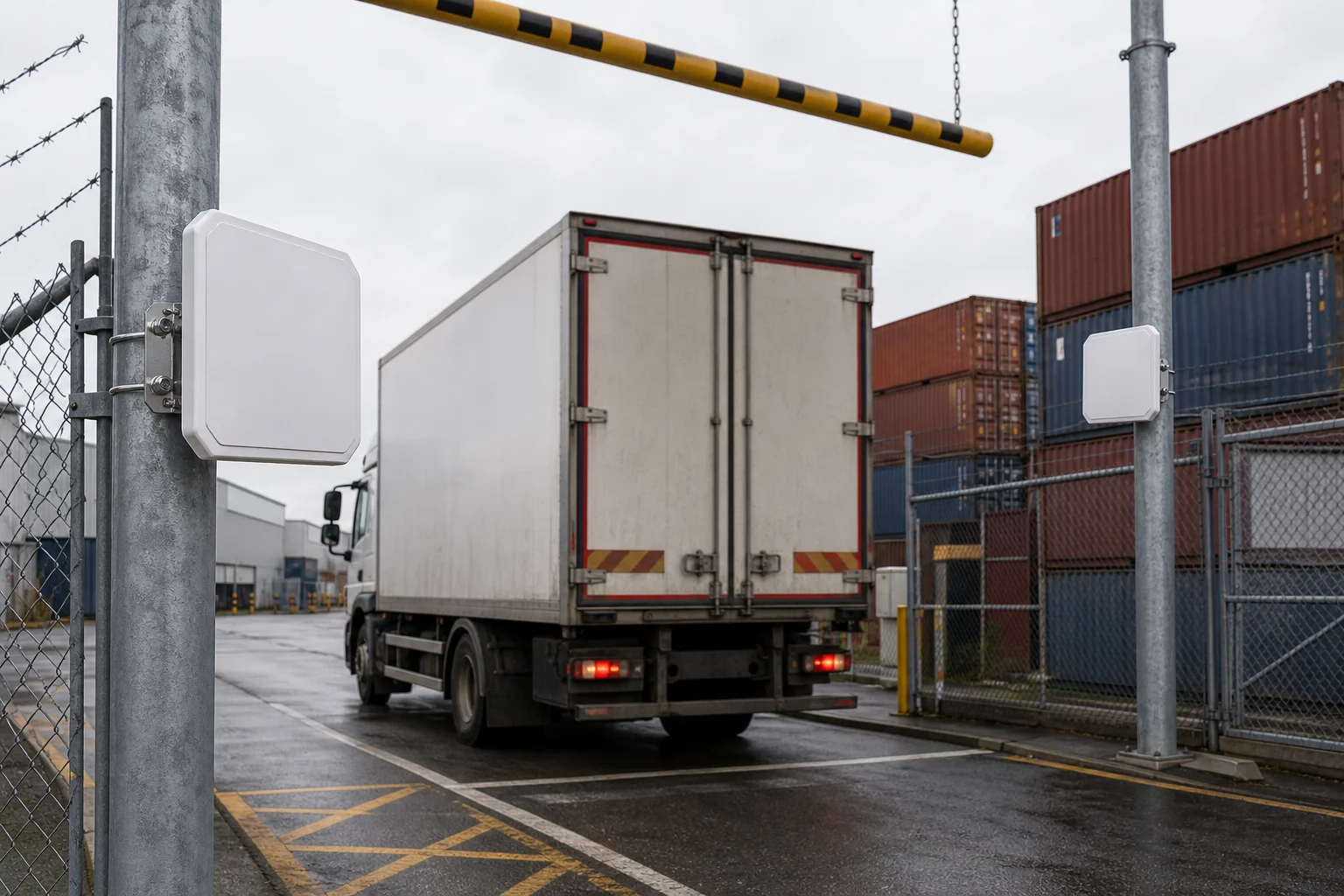
A pair across a yard gate. Order them together and ask for matching polarisation handedness.
This is a passive directional antenna. It contains no receiver, no transmitter, no decoder and no software. It shapes the field a reader produces; it cannot read anything on its own.
That matters because the phrases most often written about antennas — “fast reading and writing speed”, “multi-label reading”, “long reading distance”, “high data security” — all describe the tag and the reader, not the panel. What this panel contributes is a wide 70° field, 9 dBi of gain in that direction, and 25 dB of rejection behind it, so a reader can inventory a whole gate in one pass and largely ignore the rack behind the antenna.
Jobs this size suits: a vehicle gate or lane, a two-lane portal, a wide conveyor mouth, a pallet bay, a tool or asset zone, a toll or weigh lane. Jobs it does not suit: a single personnel door, where the beam spills past the opening and reads tags in the next room; and a hand-held or counter application, where a smaller panel or an embedded ceramic antenna is the right part.
Specification
| PARAMETER | VALUE |
| ELECTRICAL | |
| Frequency | 865–868 MHz for Europe, 902–928 MHz for North America; |
| Gain | 9 dBi |
| Horizontal beamwidth | 70° ± 5° |
| Vertical beamwidth | 63° ± 3° |
| Front-to-back ratio | ≥25 dB. This is why a gate antenna can sit beside a rack and ignore it |
| VSWR | ≤1.3 |
| Impedance | 50 Ω |
| Maximum input power | 100 W |
| Polarisation | Circular. |
| MECHANICAL | |
| Dimensions | 259 × 259 × 30 mm |
| Reflector material | Aluminium |
| Radome | White ABS |
| Connector | N-type female on a four-hole flange, as shown in the rear photograph. Confirm on the quote, because it decides your jumper |
| Mounting | Four threaded studs at the rear for the bracket. Ask us for the stud thread and the hole spacing |
| Rated wind velocity | 120 km/h. This is a rated figure; ask for the survival wind and any ice load if you are specifying for an exposed site |
| ENVIRONMENT AND PROTECTION | |
| Operating temperature | −20 °C to +80 °C |
| Sealing | IP67 — dust-tight and protected against immersion in 1 m of water for 30 minutes. The coax joint must be sealed for this to hold |
| Lightning protection | DC grounding: the radiating element is connected to the reflector, so static drains to the mast. It does not replace a surge arrestor on the coax |
Questions we are asked
The beam, not the gain, is what the datasheet can tell you honestly: 7.0 m wide and 6.1 m high at 5 m, 14.0 m by 12.3 m at 10 m. How far a tag answers depends on the tag, the reader output, the cable loss and the material the tag is attached to.
Yes, and this is the size most portals use. Order them together and ask for matching handedness: a right-hand circular antenna facing a left-hand one rejects most of the signal between them, and that failure looks exactly like a badly tuned reader.
Circular. That means a tag reads at any orientation, which is why gate and portal work uses it. The cost is about 3 dB against a perfectly aligned linear tag, which works out to roughly 30% less usable distance at the same reader power.
An N-type female on a four-hole flange, as the rear photograph shows. Confirm it on the quote because it decides the jumper. N-type is the right choice at this size: it is weatherproof when correctly sealed, and it handles the power.
IP67 is a claim about a sealed enclosure and the socket is the only opening, so the answer depends entirely on the joint. Use a mating plug with a gasket or a self-amalgamating wrap and put a drip loop in the cable.
Wider and easier to aim against narrower and further. This panel covers a gate at 70° without careful alignment; the 12 dBi panel concentrates the same power into a much tighter beam for a long throw down an aisle or across a yard. If you are not sure, tell us the opening width and the mounting height and we will pick.
The country and band, how many units and whether they will be used as a pair, the mounting height, the pole or structure you are fixing to, the cable run to the reader, and the tag you intend to read.
Copyright © ©Copyright 2024 Greatest IoT Technology Co., Ltd all rights reserved - Privacy policy