

Home > Products > RFID TAG > RFID EAS Tag
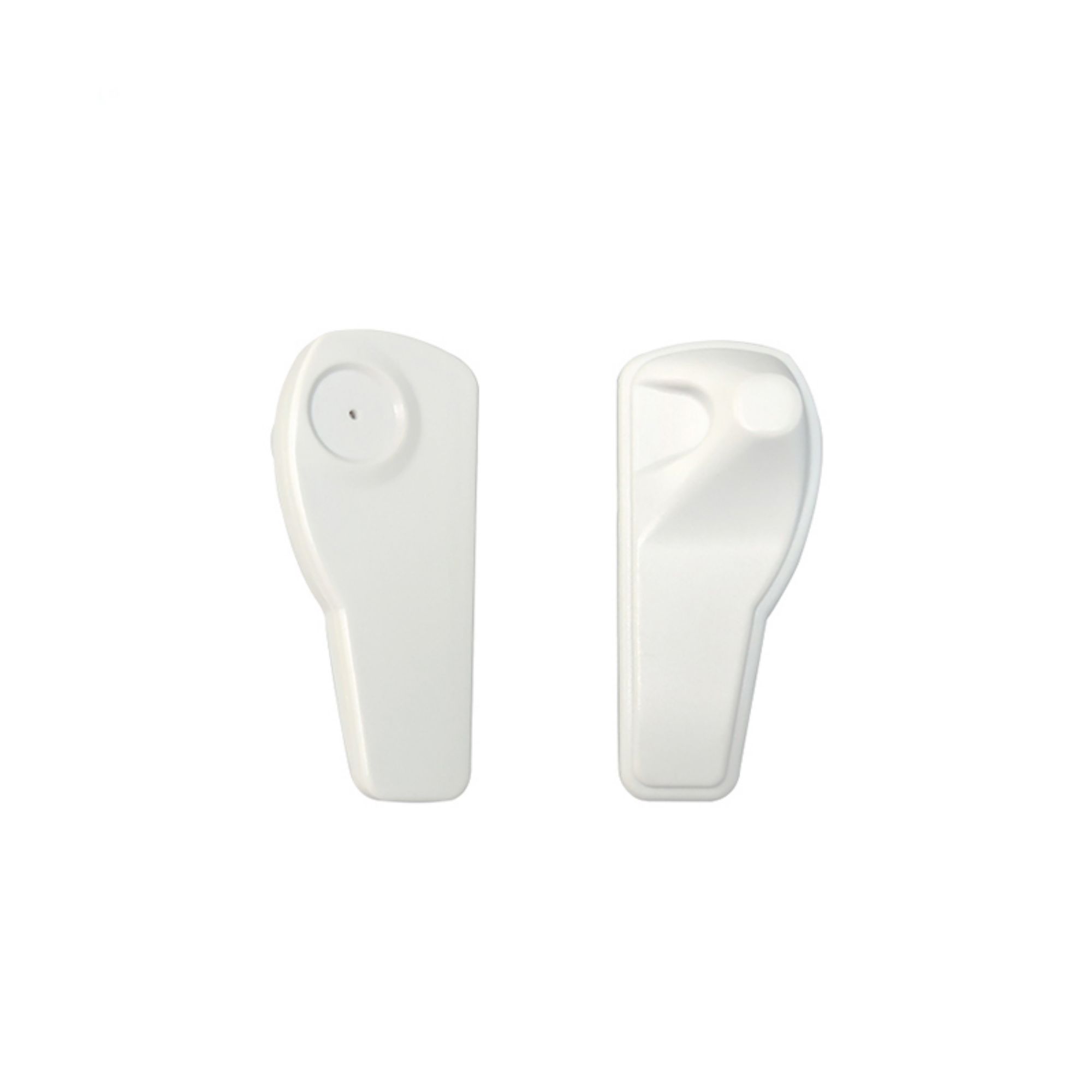
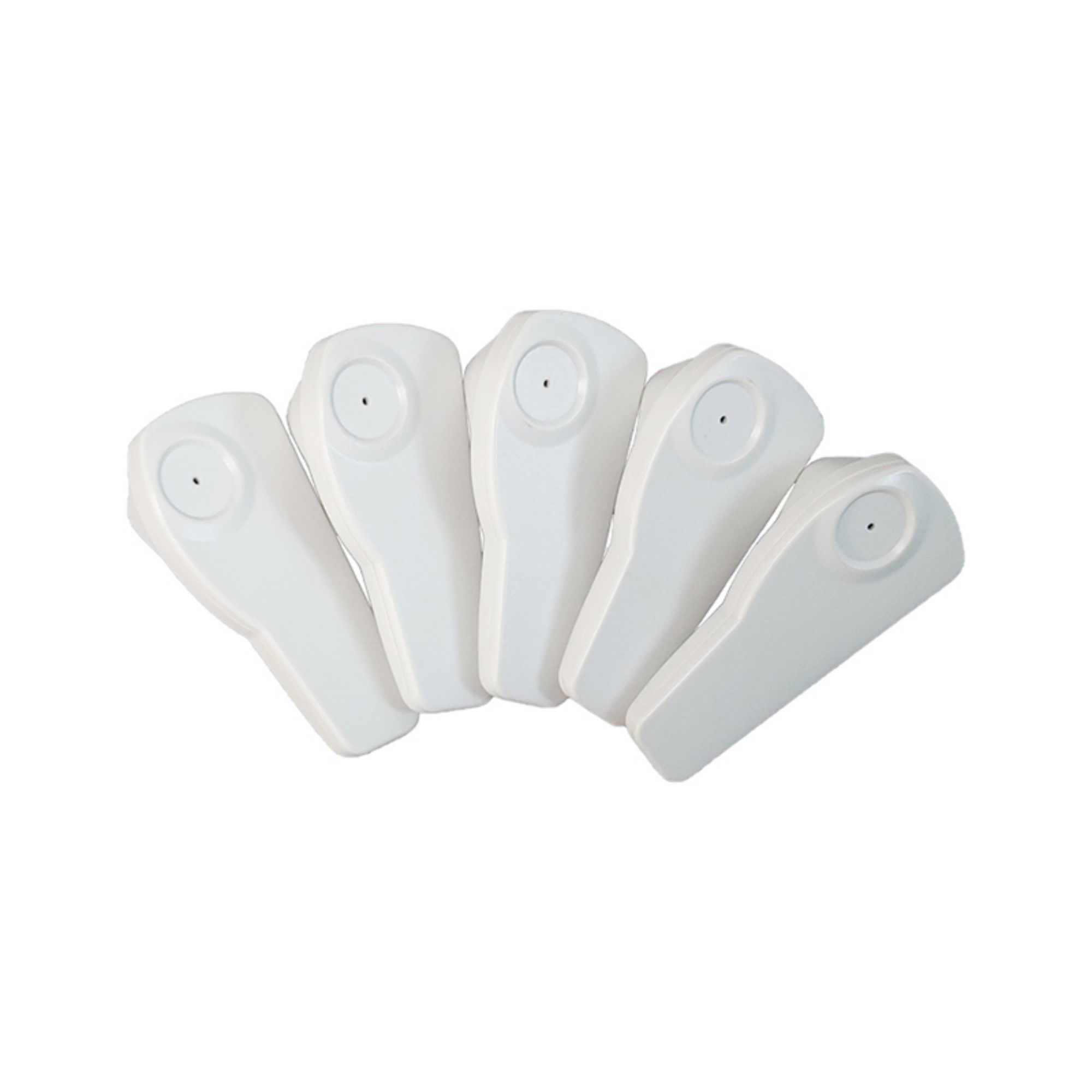


Dual hard tag
One ABS housing with two jobs: a UHF chip so the stock file is right, and an EAS element so the door goes off if the garment leaves without being released at the till.
The two jobs are independent and they are bought for different reasons. The UHF chip counts the item; the EAS element protects it. Neither one can substitute for the other, and the choice that decides whether this tag works in your shop is narrower than it looks: your existing door is either acousto-magnetic or radio-frequency, and the tag has to match it.
| 72.75 mm× 30.75 × 20.75 mm, 11.7 g | UCODE 8UHF EPC C1G2, for stock accuracy | AM or RFthe EAS side, matched to your door |
The decision your door makes for you
| EAS element | Frequency | Where you meet it | What it is good at, and what it is not |
| Acousto-magnetic | 58 kHz | The tall grey pedestals in fashion retail and department stores; usually the pair either side of the exit. | A wider and longer detection zone at the same pedestal height, and less upset by a body standing between the tag and the panel. Costs more, and the pedestals are physically larger. |
| Radio-frequency | 8.2 MHz | The slimmer pedestals common in smaller shops, pharmacies and supermarket fashion aisles. | Cheaper hardware and slimmer panels. The detection zone is narrower and more easily shielded, which is why placement on the garment matters more. |
A UHF RFID chip is not an EAS technology and is not part of this decision. It is the inventory half of the tag, read by handhelds and overhead readers at metres of range, and it plays no part in the alarm.
Neither element defeats a foil-lined bag. Both AM and RF are shielded by a metalised bag, which is the most common way organised retail theft works. If the plan relies on the tag alone to stop a determined thief, it will not — the EAS element stops the opportunist, and the UHF chip is what tells you afterwards which item went missing and when it was last counted. Selling it as the second thing when the customer expected the first is how a security tag gets returned.
How the alarm actually works
| Stage | What happens | Why it matters to the customer |
| In the stockroom | The tag is pinned to the garment and the UHF chip is read by a handheld or an overhead reader during receiving and stock counts. | The stock figure becomes right without anyone scanning barcodes one at a time. This is the half that saves labour. |
| On the shop floor | The UHF chip also allows a periodic count to find garments that are in the store but not on the rail. | Theft shows up as a gap between counted and expected, which is the only way a retailer learns it happened at all. |
| At the till | The assistant releases the tag with a detacher, which opens the pin housing. The garment leaves clean. | Until that happens the EAS element stays armed. There is no separate arming step, which is why the process survives busy Saturdays. |
| At the door | If an armed tag passes the pedestals, the EAS element responds and the alarm sounds. | The pedestals read the EAS element, at 58 kHz or 8.2 MHz. They do not read the UHF chip, and a UHF-only tag will not set them off. |
| Back in the stockroom | Released tags are collected and re-pinned to new stock. | That is the “recycled” claim on the live page. |
The inventory half
According to NXP’s own datasheet for the part, UCODE 8 has 128-bit EPC memory and no user memory at all; the 96-bit figure is the length of the TID, or the pre-serialised EPC, not a writable user area. The variant with user memory is UCODE 8m, and it has 32 bits.
| Part | EPC memory | User memory | What it means |
| NXP UCODE 8 | 128 bit | 0 bit | A unique identity and nothing else. Fine for counting, and it cannot store your own data. |
| NXP UCODE 8m | 96 bit | 32 bit | Room for a small amount of customer-written data. This is the part to order if the retailer writes anything to the tag. |
Memory figures are from the NXP UCODE 8/8m datasheet. Both parts carry a 96-bit TID, factory locked, which is where the 96 in the live table most likely came from.
Fitting and release
| Point | What it means in practice | Ask us for |
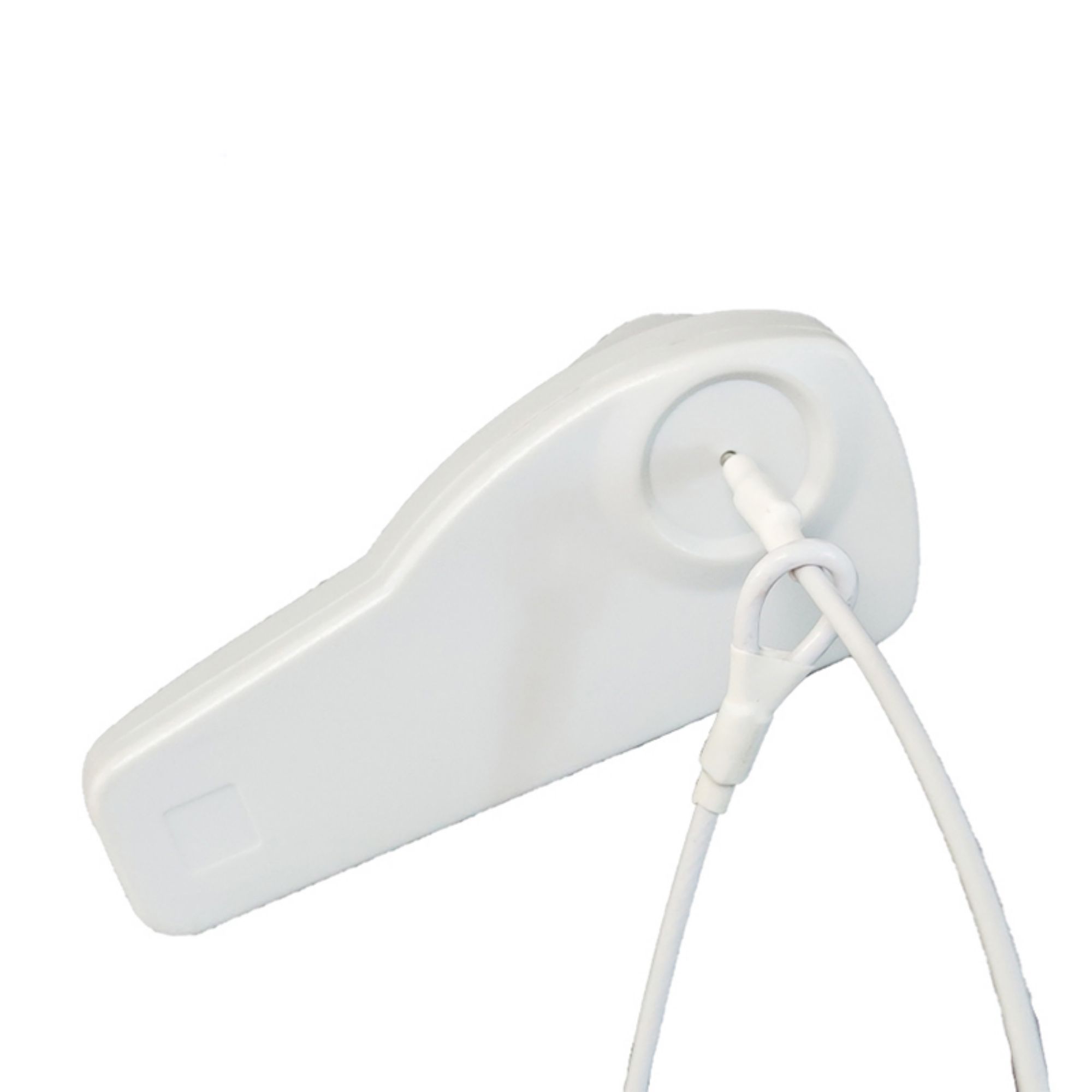
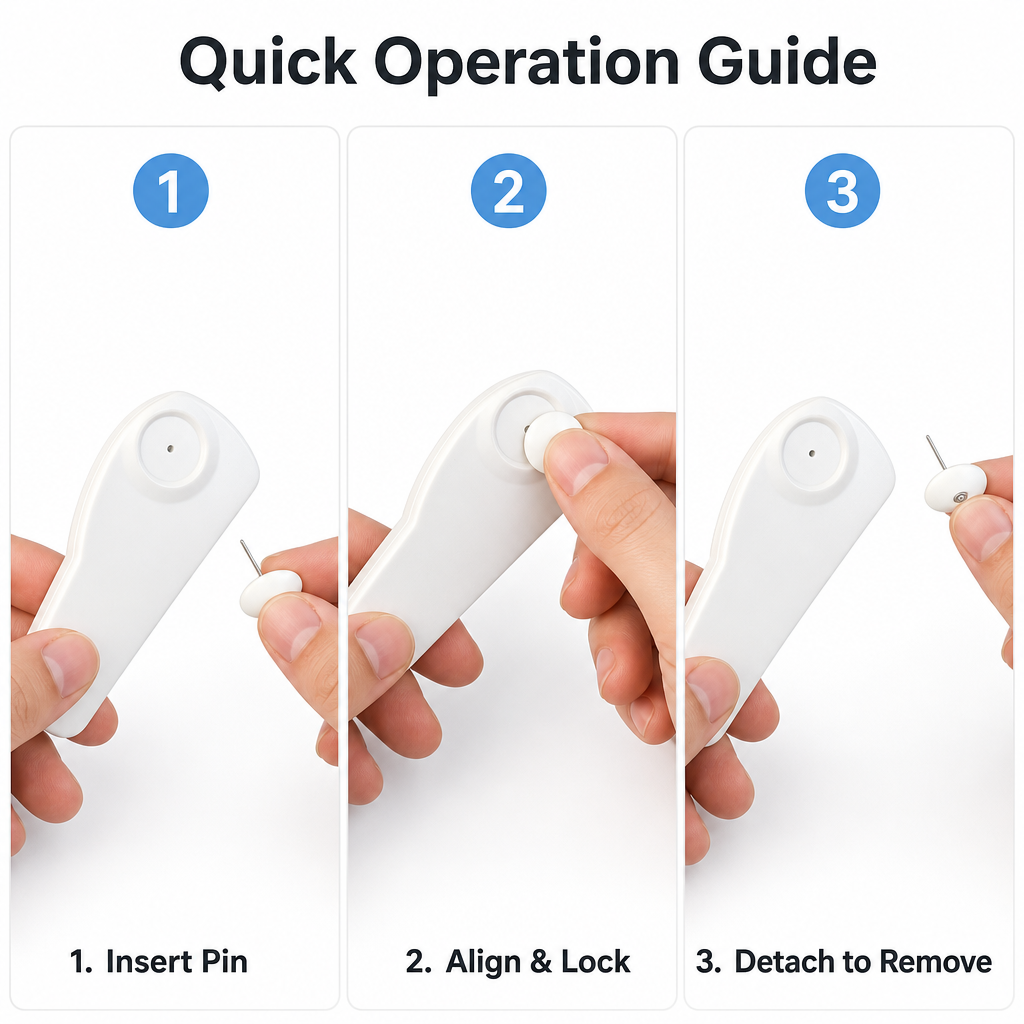
| The pin | The tag is pinned through the garment, usually at a seam or a buttonhole, and hangs below the point of attachment. | The pin diameter, and whether it is a standard or a fine pin. A fine pin matters on knitwear and on anything with a tight weave. |
| The damage | Every pin leaves a hole. On denim and outerwear it is invisible; on fine knitwear, silk or leather it is not. | Whether a loop version is available for delicate goods, since a cord through a buttonhole avoids a new hole entirely. |
| The release | A detacher magnet at the till opens the housing. Without the magnet the pin cannot be withdrawn. | The detacher specification, and whether one is supplied with the first order. A shop that buys tags without a detacher has bought a problem. |
| The reuse | Released tags go back into the pool and are re-pinned to new stock. | The number of release cycles the housing is rated for. |
| The colour | White is standard; the live page offers custom colours for large orders. | The minimum quantity per colour, and whether the colour is moulded in or painted — paint wears at the pin housing first. |
Specification
| PHYSICAL | |
| Product name | RFID EAS Tag, dual technology hard tag |
| Material | ABS |
| Dimensions | 72.75 × 30.75 × 20.75 mm (L × W × T) |
| Weight | 11.7 g |
| Ingress protection | IP54 |
| Installation | Pin buckle |
| UHF RFID | |
| Standard | EPC Class 1 Gen 2, ISO/IEC 18000-6C |
| Chip | NXP UCODE 8 |
| EPC memory | 128 bit |
| User memory | 0 bit on UCODE 8; 32 bit on UCODE 8m. The live page states 96 bits, which is the TID length, not user memory |
| TID | 96 bit, factory locked |
| Read range | 1-10 m |
| EAS ELEMENT | |
| Technology | Acousto-magnetic or radio-frequency, chosen to match the pedestals already installed |
| Frequency | 58 kHz is the AM band and 8.2 MHz the RF band; |
| Detection range | >1 m for one EAS door system. |
| Arming | Armed until released with a detacher. |
| ENVIRONMENT | |
| Working temperature | -40 to +85 °C as published |
| Storage temperature | Also published as -40 to +85 °C, identical to the working range. Ask whether that is deliberate or a copy |
| Data retention | >10 years |
| Write endurance | 100,000 cycles |
| ORDERING | |
| Customisation | Logo, barcode or QR code, number printing, chip encoding |
Where it fits
| Setting | Why the dual tag | Check first |
| Fashion and apparel | The core case. Stock accuracy from the UHF side, door protection from the EAS side, and a tag that comes back on the next delivery. | Whether the pin is acceptable on the fabric. Fine knitwear and silk need the loop fixing, or a different tag entirely. |
| Footwear and accessories | Tags go on a lace or a strap rather than through a seam, so the pin hole lands somewhere harmless. | That the fixing point is rigid enough that the tag cannot be slid off without opening it. |
| Optical and pharmacy | High value per item, low volume per store, and a door that is usually already fitted. | Whether the existing pedestals are AM or RF, because these stores are where the two systems are most often mixed up across a chain. |
| Specialty and department stores | Mixed departments on one floor, one pedestal set, one stock file. | Whether one EAS technology covers every department. A single RF pedestal pair will not protect an AM-tagged consignment. |
| Outlet and pop-up retail | Temporary sites where the door is rented or borrowed along with the pedestals. | What technology the rented pedestals are. This is the case where a wrong order is discovered on opening day. |
In use

The door. The pedestal reads the EAS element and nothing else; the UHF chip in the same housing is invisible to it. This is the moment the whole product exists for, and the one the tag has to survive being carried past a dozen times a day.
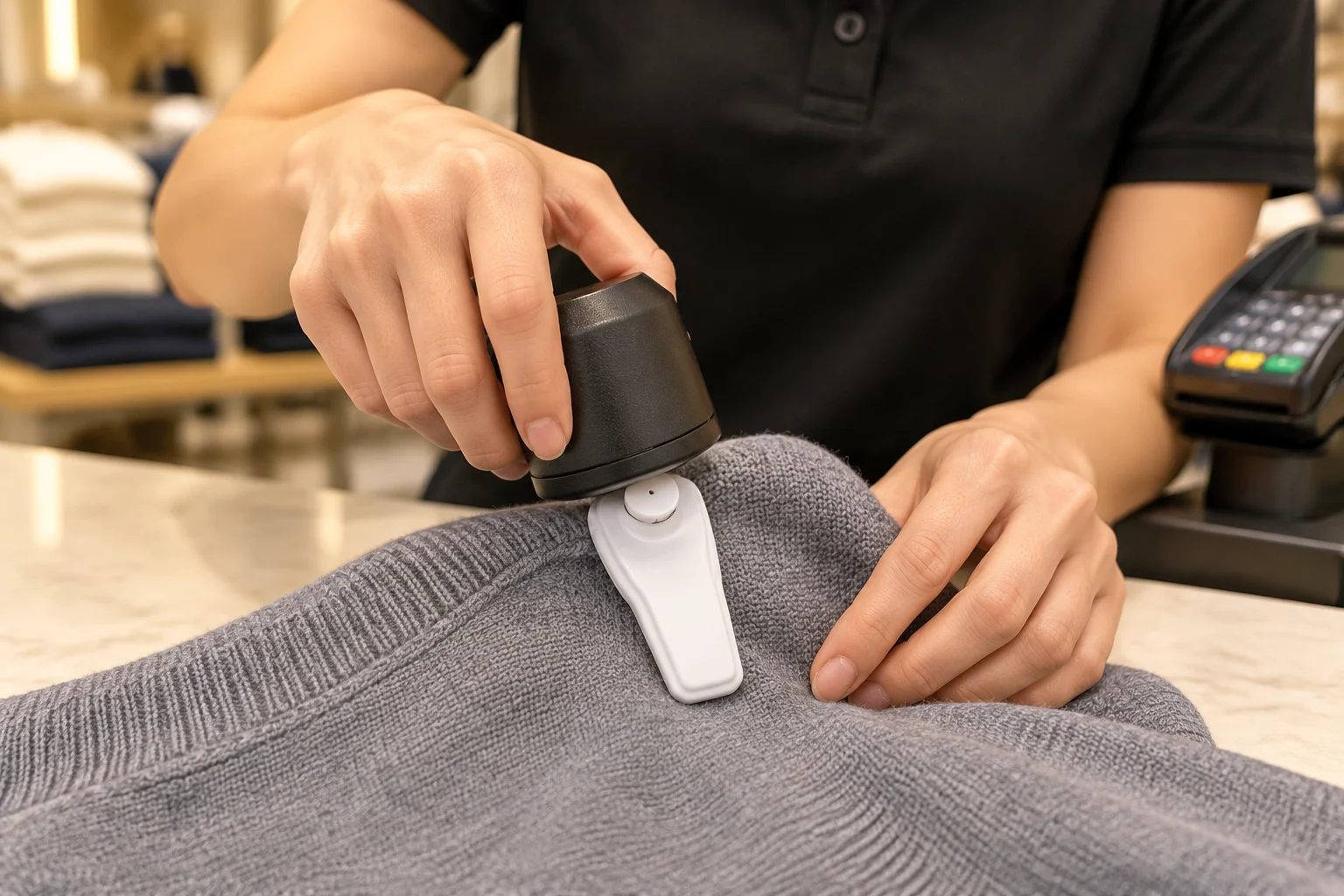
The till. The detacher releases the pin and the tag goes back into the pool. A store that buys tags without a detacher has bought a product it cannot use.
Questions we are asked
| Question | Answer |
| Will it work with the pedestals we already have? | Only if the EAS element matches them. Acousto-magnetic runs at 58 kHz and radio-frequency at 8.2 MHz, and a tag of one type will not trigger the other. Tell us the make and model of your pedestals, or the frequency on their label, and we will quote the matching version. |
| Does the UHF chip set off the alarm? | No. The pedestals read the EAS element; the UHF chip is for stock counting and is read by handhelds and overhead readers. That separation is the point of a dual tag, and it is why a UHF-only label can be walked out of a shop without a sound. |
| Can we write our own data to the tag? | Not on UCODE 8, which has no user memory. The part with user memory is UCODE 8m, with 32 bits. If your system writes a serial or a date to the chip, say so at the quotation stage rather than after the first delivery. |
| Will the pin damage the garment? | It leaves a small hole, as every pin tag does. On denim, outerwear and most wovens it closes and is invisible. On fine knitwear, silk or leather it is a visible defect, and those lines need the cord-loop version or a different fixing altogether. |
| What is the read range on the UHF side? | 1-10M. Treat that as a figure from a specific reader at a specific power, and ask for the conditions before quoting it in a tender. On a handheld at normal power you will see a shorter range, and that is normal. |
| Can you print our logo and a barcode? | Yes, along with number printing and chip encoding. On a tag this small the printable area is limited, so send the artwork and we will confirm what fits before production. |
Related. Soft EAS labels and the wider retail security range are on the RFID EAS tag page. For the inventory side alone, see RFID tags; for a store that uses a card rather than a hard tag, RFID cards.
Copyright © ©Copyright 2024 Greatest IoT Technology Co., Ltd all rights reserved - Privacy policy