

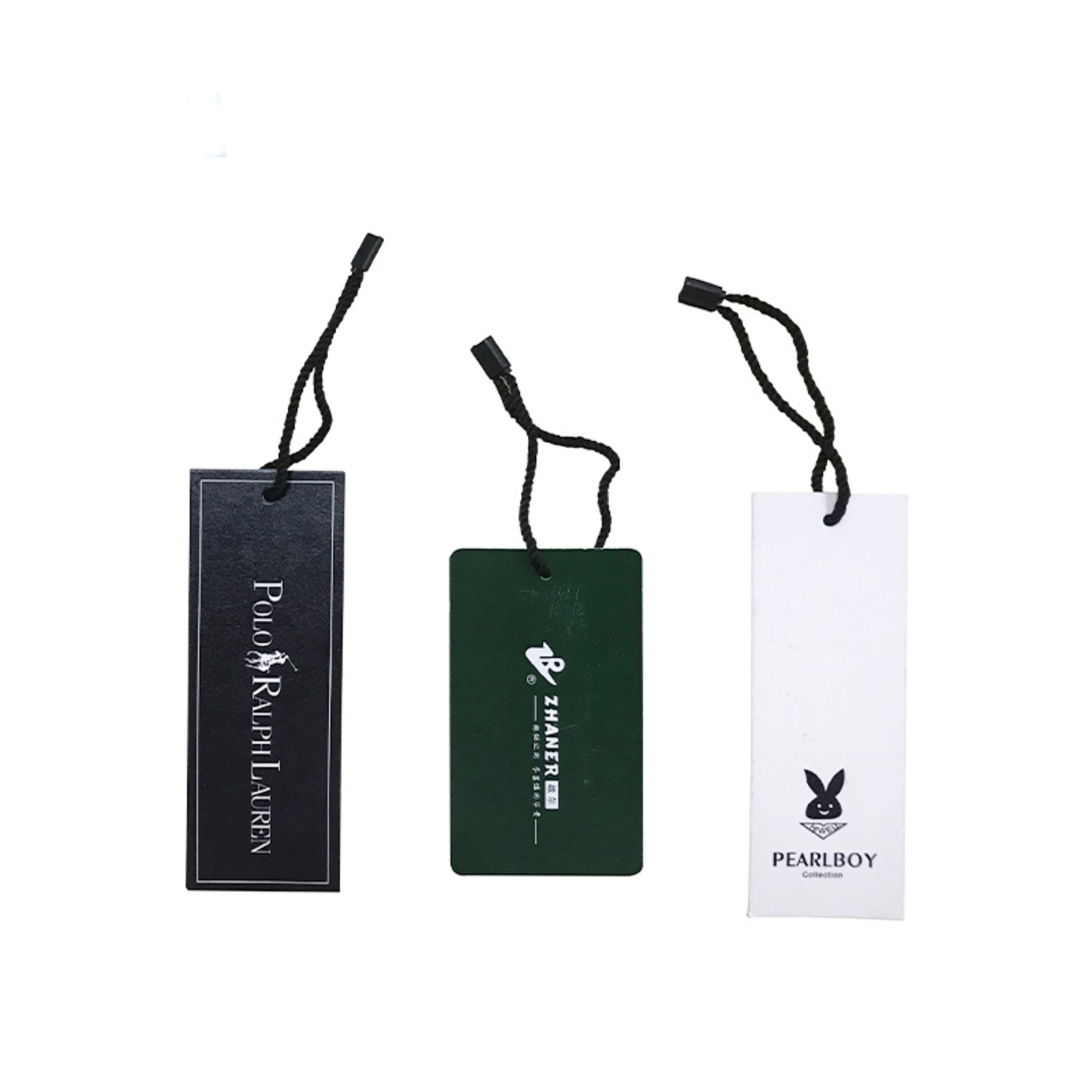
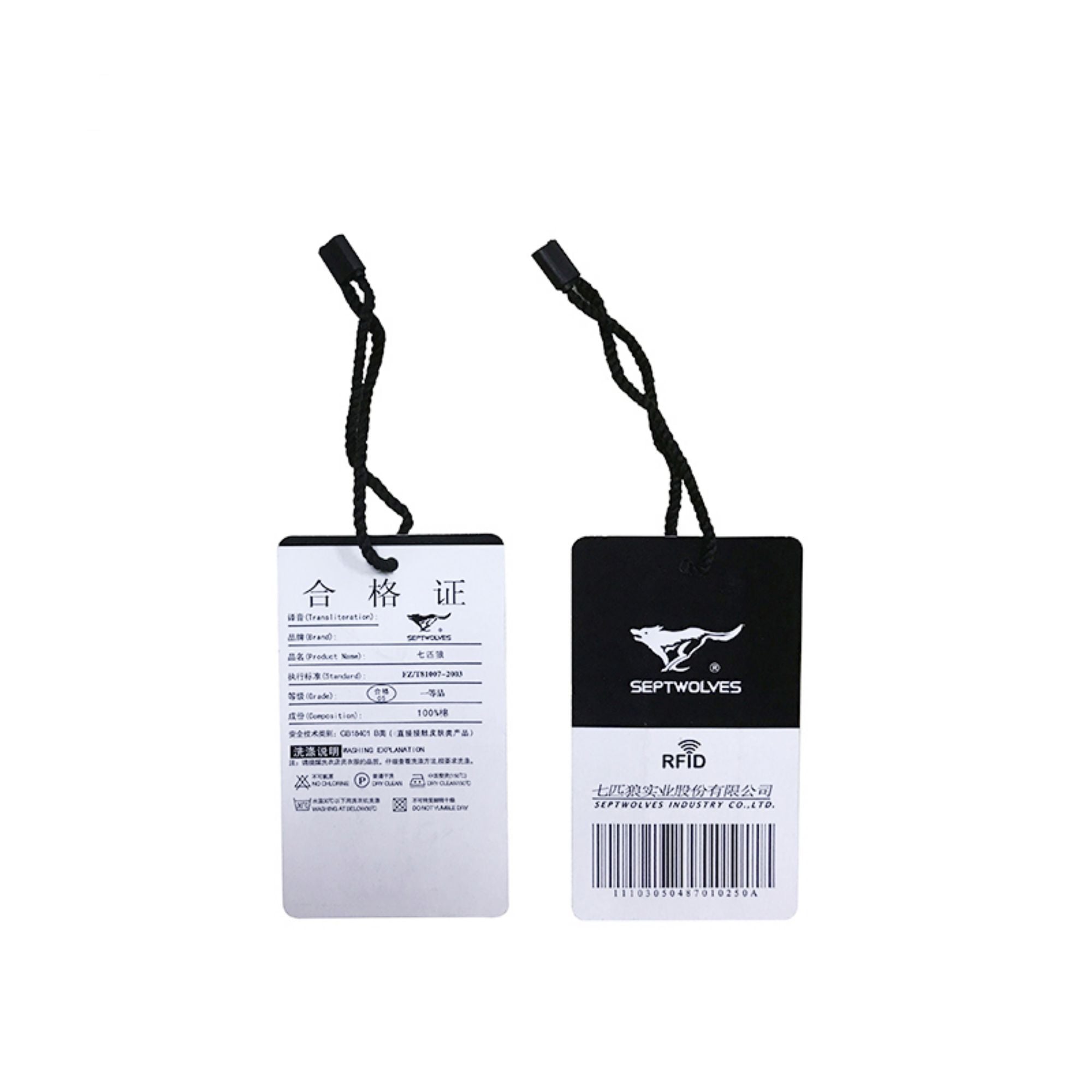
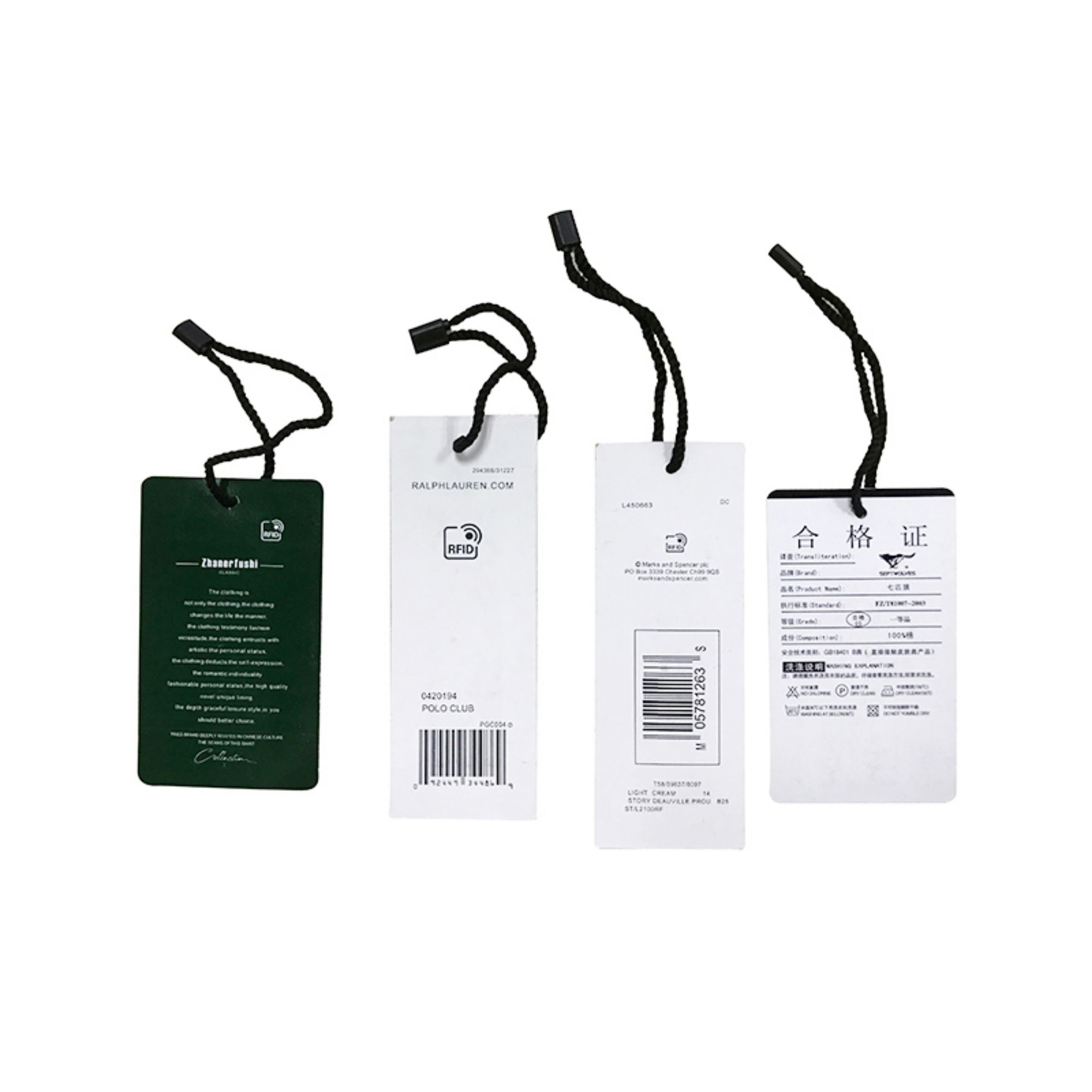
The tag that already hangs on the garment, with a UHF inlay inside it.
An apparel hang tag is the cheapest place to put an RFID inlay, because the tag exists anyway and nobody has to sew anything in. These are 53 × 33, 73 × 21 and 46 × 19 mm, in kraft, coated art paper, black paper, white board, recycled paper or PVC, printed in CMYK with hot stamping and embossing where the brand needs it.
UHF EPC Class 1 Gen 2 at 860–960 MHz on Impinj and NXP silicon, 96 or 128 bit EPC, 1 to 8 m read depending on the reader. Made on Mühlbauer inlay lines and printed on a Heidelberg press in a 25,000 m² plant.
Sizes
A hang tag has less room than it looks. The hole takes the top corner, the brand takes the face, and the inlay has to sit somewhere that is not folded, not punched and not covered by a heavy ink film. These are the three sizes we hold tooling for; anything else is a custom run.
All three at one scale, so the proportions are comparable. The narrow 73 × 21 mm format is the hardest to fit an inlay into.
| SIZE | WHAT IT SUITS | THE TRADE-OFF |
| 53 × 33 mm | The most common apparel format. Room for a logo, a size, a barcode and the inlay | A comfortable inlay area, so the best read range of the three |
| 73 × 21 mm | Long, narrow tags on tailoring and knitwear where the tag hangs below the hanger | Less usable area either side of the hole, so the inlay sits closer to the print |
| 46 × 19 mm | Small accessories, hats, socks and childrenswear | The tightest option. Ask for a read test on this size before you standardise on it |
Design
Why bother
| BARCODE HANG TAG | RFID HANG TAG | |
| Reading | Needs line of sight and alignment. One tag at a time, by hand | No line of sight. Reads through a garment bag and a thin carton, and many at once |
| Speed | A full store count is a person walking the floor with a scanner | A rail or a fixture can be swept in seconds, which is the whole argument |
| What the tag holds | An article number, which is then looked up in your system | An identifier in the EPC — 96 bits, about twelve characters — looked up in exactly the same way. Where the chip has user memory, extra fields can live on the tag |
| Durability | A scuff or a crease across the bars and it is dead | Tolerant of dust, damp and a creased tag, because nothing has to be read optically. A torn antenna still kills it |
| Reuse | Not reusable once printed | The chip can be rewritten, but a hang tag comes off at the point of sale, so in practice neither is reused. Do not buy this for the recycling story |
| Cost | Cents | More than a barcode, less than any other way of tagging a garment. The tag already exists, so you are paying for the inlay |
In the store
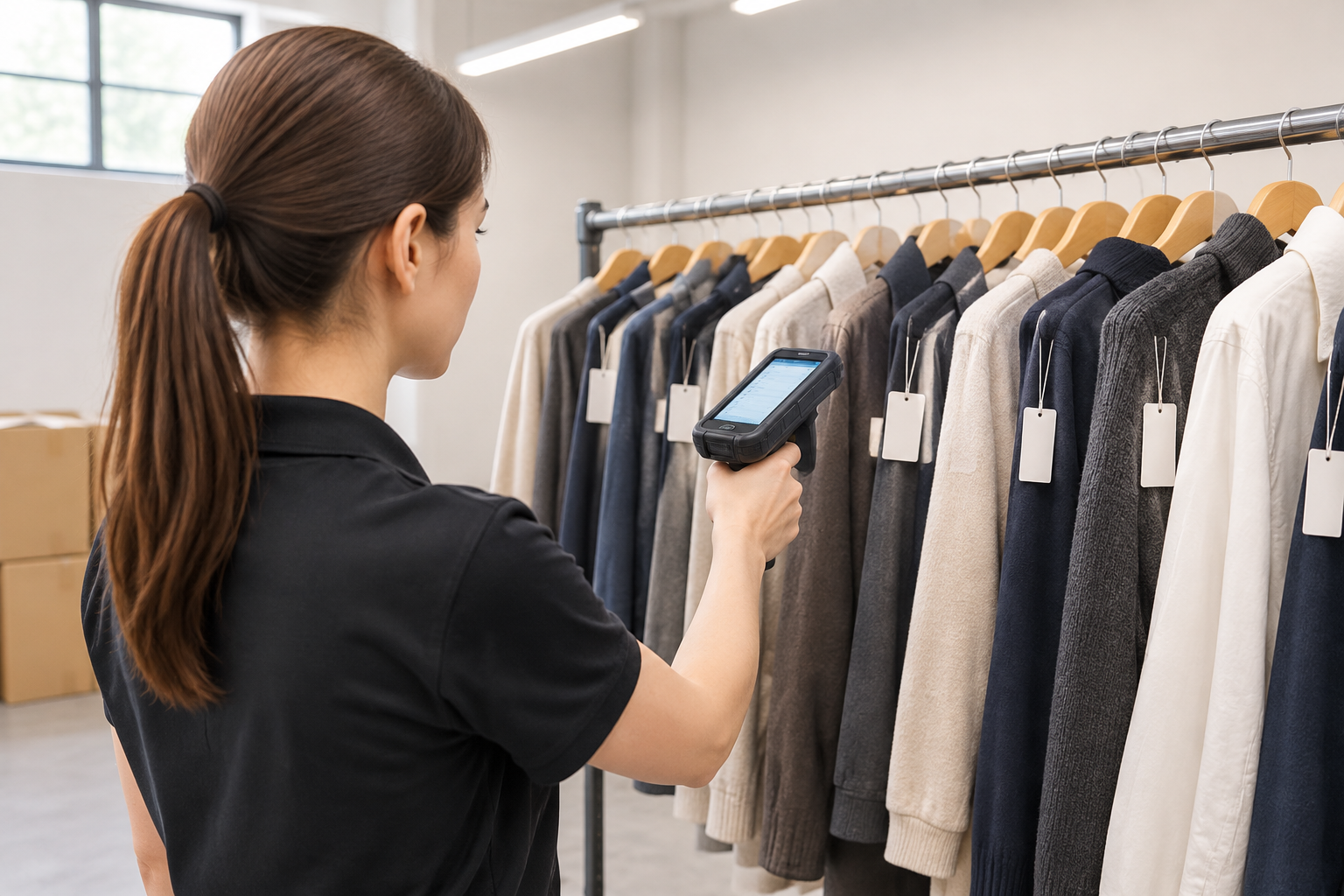
The reason apparel adopted this: a stocktake stops being a day of walking and becomes a sweep. The same pass supports replenishment, finding an item for an online order, and proving a count to an auditor.
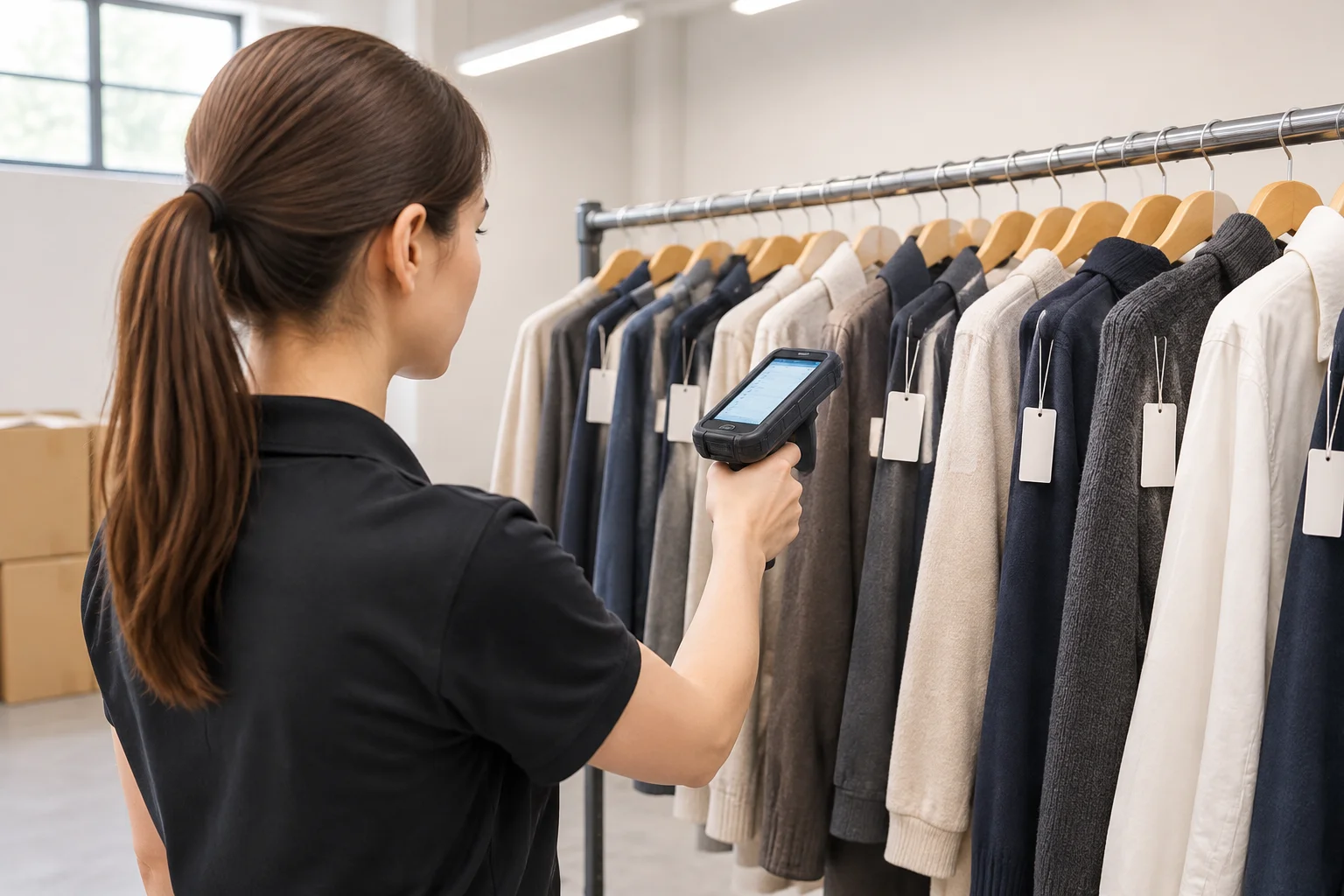
Reading a rail. Tags hang at every angle, which is why the antenna matters more here than the chip: a linear inlay facing the wrong way is a missed garment.
Who makes them
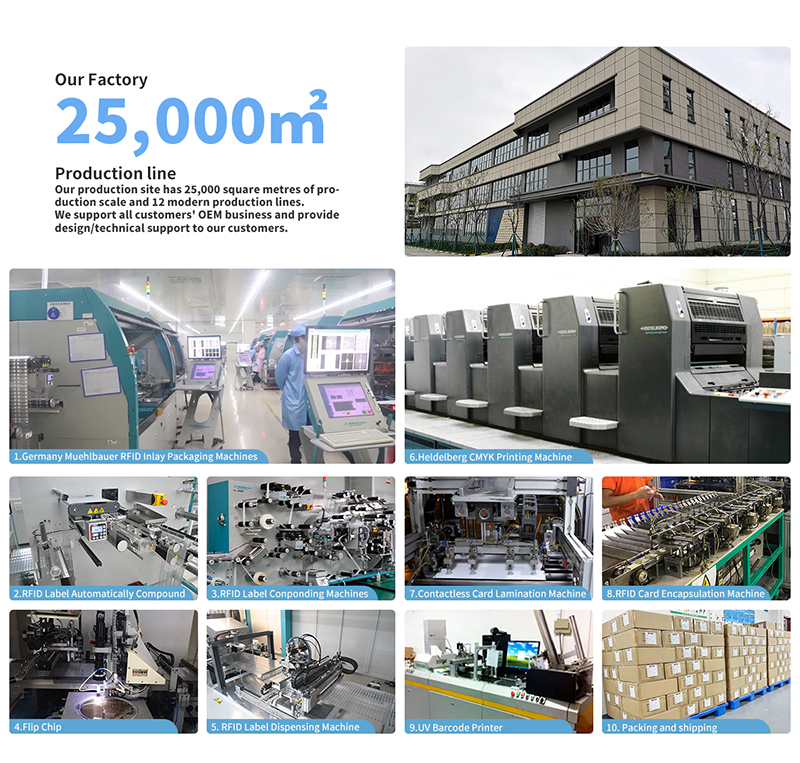
The line list: Mühlbauer inlay packaging, compounding, flip chip, dispensing, Heidelberg CMYK printing, lamination, encapsulation, UV barcode printing and packing.
| CLAIM | WHY IT IS WORTH KNOWING |
| Mühlbauer inlay lines | Mühlbauer is the reference equipment for RFID inlay assembly. |
| Heidelberg CMYK press | Printing in-house means the tag, the inlay and the print are one production run. It removes the usual failure where a converter prints beautiful tags over an inlay that was never tested with that ink film |
| One billion inlays a year | Volume that supports a private-label programme and a chip allocation. It also explains why the answer to a chip shortage is an alternative part rather than a delay |
| Chip partnerships and alternates | if your specified part is unavailable we will propose an equivalent and tell you what changes |
Specification
| PARAMETER | VALUE |
| SUBSTRATE AND PRINT | |
| Materials | Kraft paper, coated art paper, black paper, white board, recycled paper, PVC |
| Colour | Full colour printing |
| Finishing | CMYK, UV varnish, gold and silver hot stamping, embossing, gloss varnish, bronze printing |
| Stock sizes | 53 × 33 mm, 73 × 21 mm, 46 × 19 mm, or custom |
| String and barb | Standard tag string with a plastic barb, as photographed. Ask for the colour and length options |
| RADIO | |
| Air protocol | ISO/IEC 18000-6C, EPC Class 1 Gen 2 |
| Frequency | 860–960 MHz, UHF |
| Mode | Passive, no battery |
| Chips | Impinj Monza R6, R6-P; NXP UCODE 8 and UCODE 9. |
| EPC memory | 96 or 128 bit, depending on the chip |
| Read range | 1 to 8 m, decided by the reader and the environment. |
| ENVIRONMENT | |
| Working temperature | −25 to +55 °C |
| Storage temperature | −25 to +65 °C |
| Moisture | Tolerant of damp and of normal handling. Paper tags are not waterproof, and a soaked tag loses read range as the paper absorbs water |
| APPLICATIONS | |
| Suits | Garments, shoes, home textiles, hats, bags, bedding, blankets and toys — anything that already carries a hang tag |
Questions we are asked
Yes. The tags are printed in-house in CMYK with UV varnish, hot stamping, embossing and bronze printing, which is why the print and the inlay are one production run rather than two suppliers blaming each other. Send the artwork with the hole position marked and we will return a proof with the inlay keep-out drawn on it.
The inlay cannot run through the punch, and it needs clearance from the tag edge and from any heavy foil or varnish.
It depends on your encoding and on the sensitivity you need. Impinj Monza R6 and R6-P and NXP UCODE 8 and UCODE 9 are all listed, and the generations differ in read sensitivity and memory.
96 bits is about twelve characters and is enough for a serialised identifier in most apparel schemes. Choose 128 bits only if your encoding scheme genuinely needs the extra field, because it is not free: it comes with a specific chip. Either way the EPC is a pointer to your database, not a place to store a product description.
The tags are rated −25 to +55 °C, and paper tags tolerate normal handling and damp but are not waterproof. A soaked paper tag absorbs water and loses read range. If a tag has to survive repeated moisture, specify a PVC or synthetic substrate rather than paper.
The tag size, the substrate and the finishing, the chip or the read performance you need, the number of tags and the repeat order pattern, the artwork with the hole position, and whether we encode. Send the artwork first and the rest follows.
Copyright © ©Copyright 2024 Greatest IoT Technology Co., Ltd all rights reserved - Privacy policy