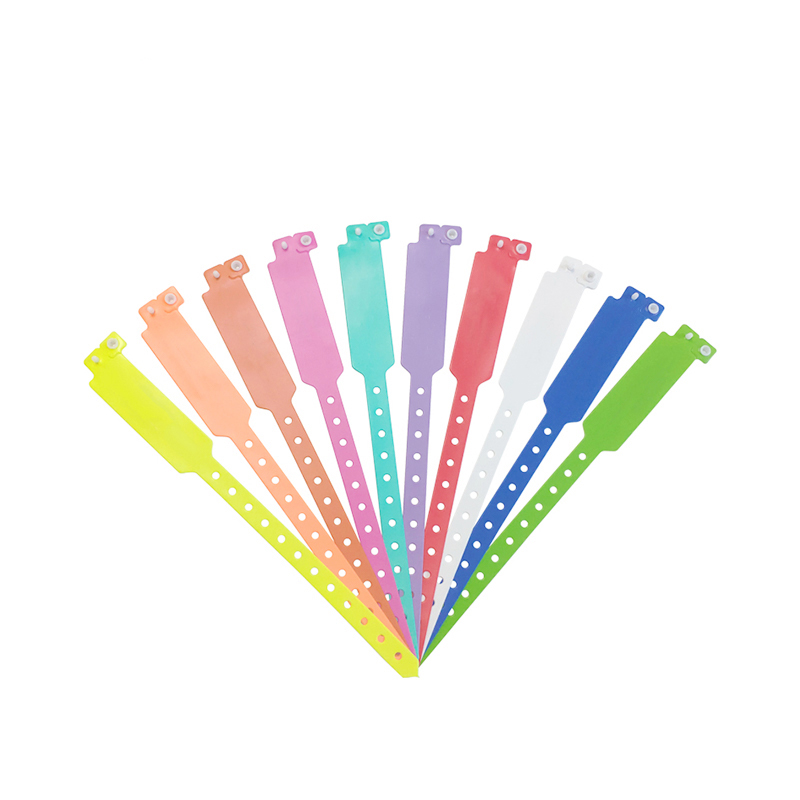

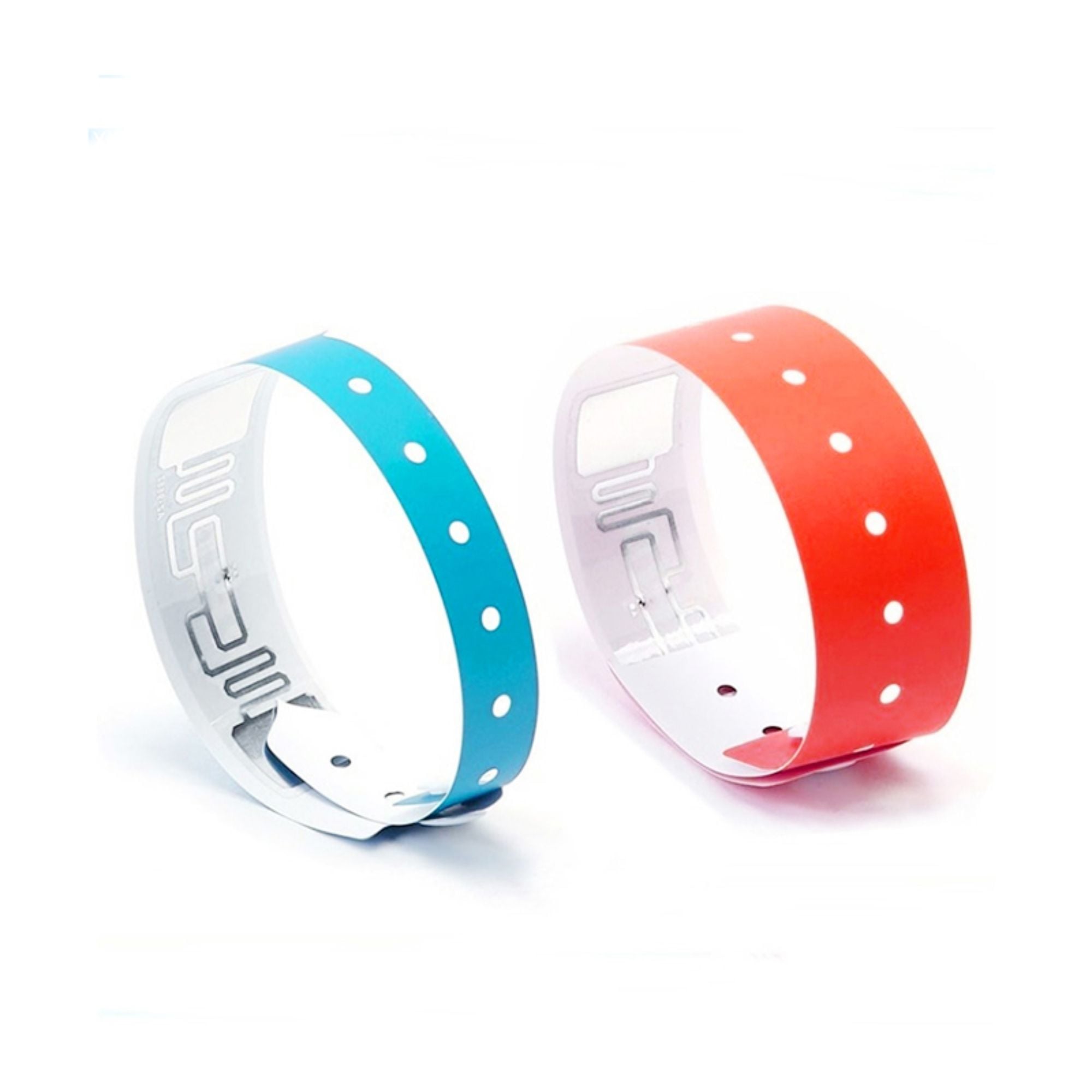
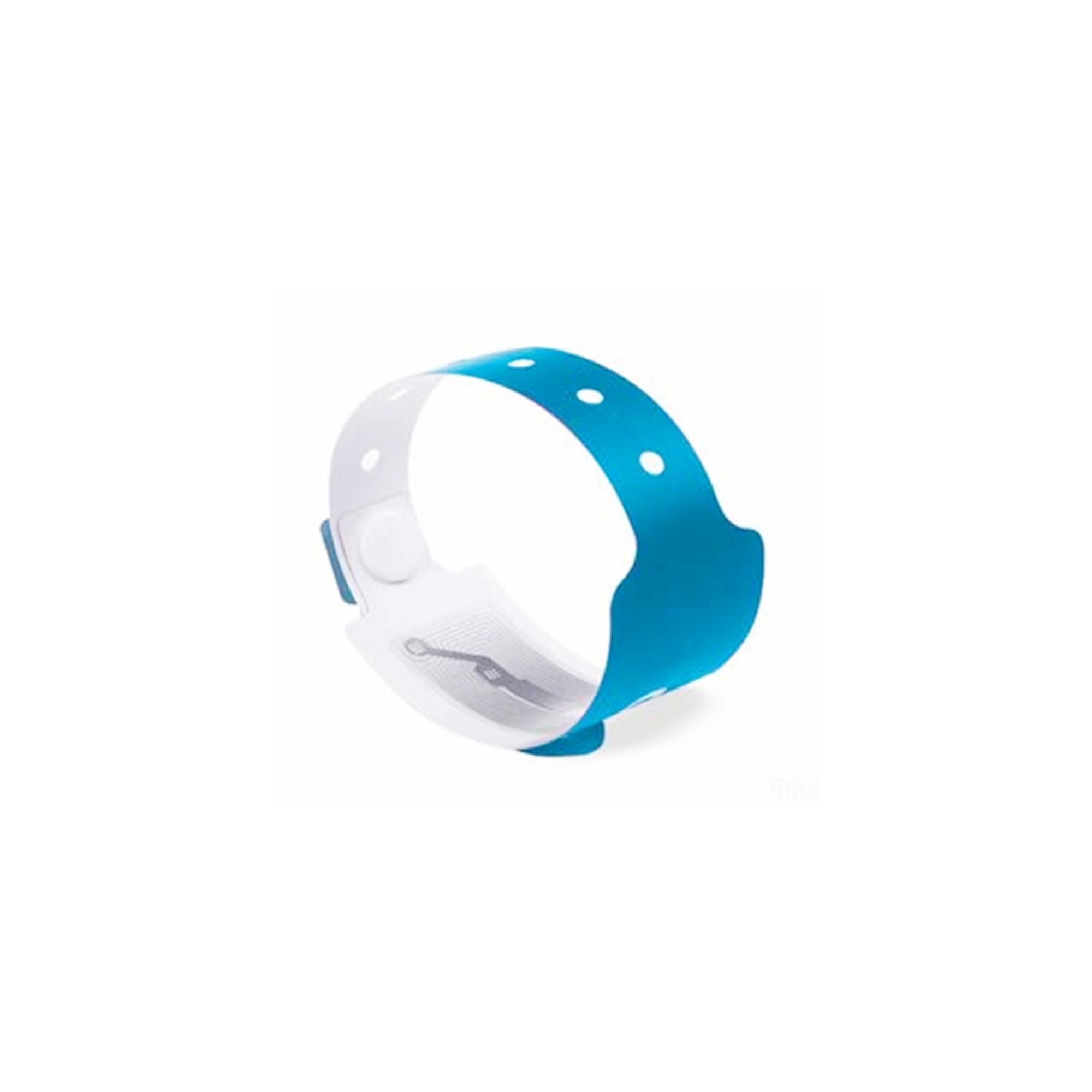
A soft PVC wristband with an HF chip laminated inside a clear window, closed by a one-way snap clasp that cannot be re-opened. It survives showers, pool water and a three-day festival; the clasp is what stops it being passed to someone else. 16 or 25 mm wide, 250 mm long, printed with your logo, QR code or a variable serial.
Read this before you compare prices
The live page calls this a “disposable wristband”. That word belongs to Tyvek and thermal-paper bands — the cheap, one-night kind. A PVC band is the opposite material, and it is bought for the opposite reasons.
The decision that matters most
The band, colour and print are cosmetic. The chip decides which readers work, how much data fits, and whether the credential can be cloned. The live datasheet lists ten part numbers in one cell; this is the same list, sorted by what each one is for.
| CHIP | PROTOCOL | USER MEMORY | WHAT IT IS FOR |
| NTAG213 | ISO 14443A | 144 B | Guest ID, a short URL, a ticket number. The default for phones |
| NTAG215 | ISO 14443A | 504 B | A contact record, a multi-day itinerary, several NDEF entries |
| NTAG216 | ISO 14443A | 888 B | Largest NFC payload — long text, several records, offline data |
| MIFARE Classic 1K (S50) | ISO 14443A | 1 KB | Legacy access control, lockers, vending — if your estate already runs on it |
| MIFARE Ultralight | ISO 14443A | 48 B | Lowest cost ID where only a serial number is needed |
| MIFARE DESFire EV1 2K | ISO 14443A | 2 KB | Secure multi-application: cashless purse plus access, with cryptography |
| MIFARE Plus S 2K / S 4K | ISO 14443A | 2 KB / 4 KB | The upgrade path away from Classic without replacing the reader fleet |
| ICODE SLIX (ISO 15693) | ISO 15693 | 112 B | Vicinity readers at a gate — reads slightly further than 14443A |
Memory figures move with the variant. The NTAG numbers are fixed; MIFARE and ICODE variants differ by sub-part (Plus S versus Plus X, SLIX versus SLIX2). Tell us the chip you need and we will send the datasheet of the exact part rather than let you design a data layout against the wrong number.
Specification
| SPECIFICATION AT A GLANCE | Full parameter table below |
| Product type | Soft waterproof PVC RFID wristband, one-way snap clasp |
| Frequency | HF 13.56 MHz |
| Chip options | NTAG213 / NTAG215 / NTAG216 · MIFARE Ultralight · MIFARE Classic 1K (S50) · MIFARE Plus S 2K / 4K · MIFARE DESFire EV1 2K · ICODE SLIX |
| Protocol | ISO/IEC 14443A for NTAG and MIFARE · ISO/IEC 15693 for ICODE The chip you pick decides the protocol — they are not interchangeable |
| Working mode | Read / write |
| User memory | By chip — 144 / 504 / 888 B on NTAG, 1 KB on Classic 1K, 2 KB on DESFire EV1 2K See the chip table above; the variant changes the number |
| Data retention | More than 10 years |
| Write endurance | More than 100,000 cycles |
| Operating temperature | −30 to +75 °C |
| Size | 16 × 250 mm · 25 × 250 mm Custom length on request; a shorter band suits children and slim wrists |
| Material | Multi-layer PVC, chip laminated between the layers |
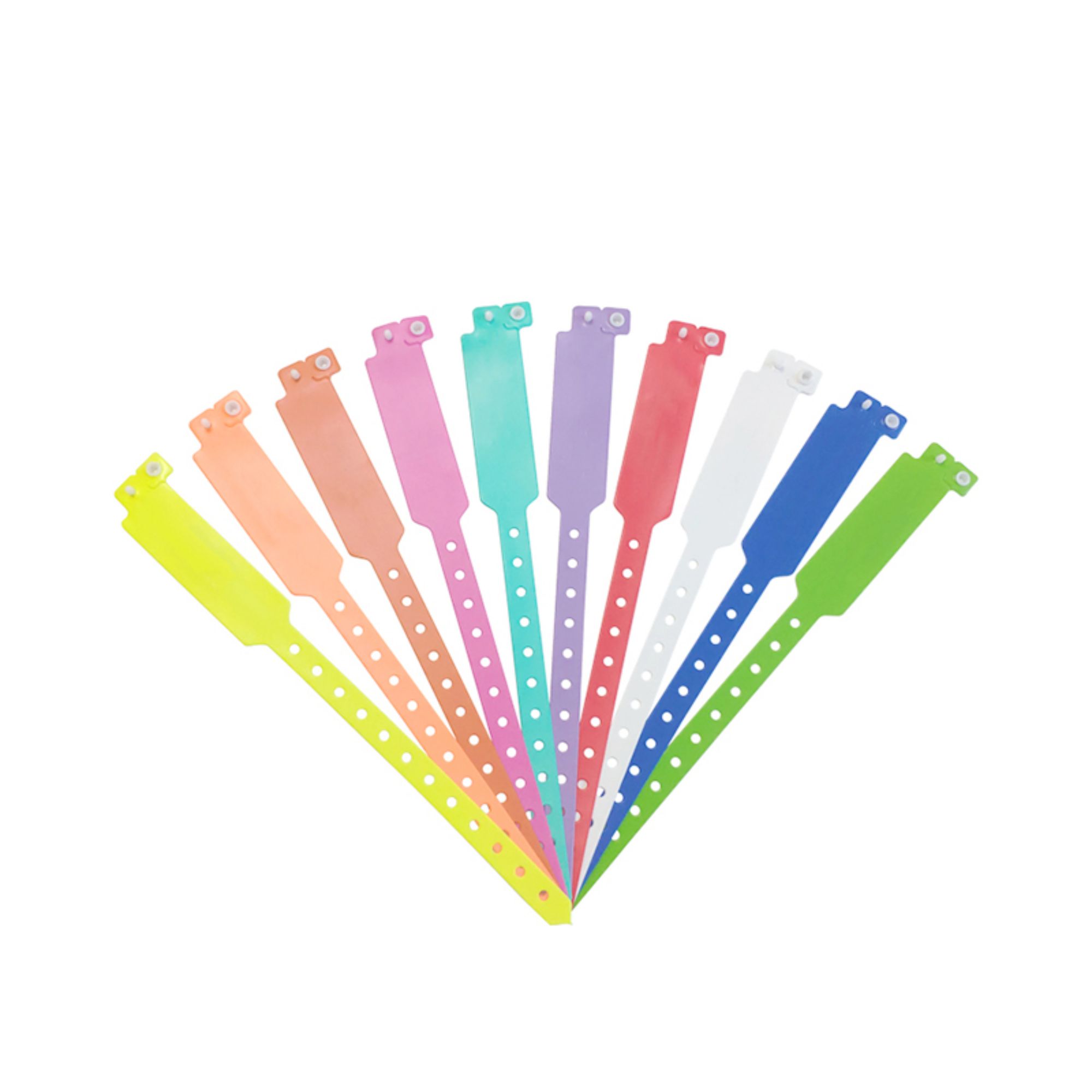
| Colour | 11 stock colours, custom colour on request |
| Printing | Logo, QR code, barcode, serial numbering Silk screen for flat colour, offset for multi-colour artwork |
| Clasp | One-way snap on two studs — cut to remove |
| Read range | 0-10cm |
Two widths
16 × 250 MM
The default. Enough band for a logo and a QR code, and enough slack for most adult wrists. On a child's wrist the 250 mm length has to be trimmed or the tail doubled back, which can cover the print.
25 × 250 MM
Roughly 60% more printable area — the width to choose when the band has to carry a barcode, a name, a date and a logo at once, or when the wearer is elderly and the text has to be legible at arm's length.
Both widths use the same clasp and the same chip window, so the reader does not care which you pick. Choose on how much you need to print, and on wrist size — not on read performance.
Hospitals
In use
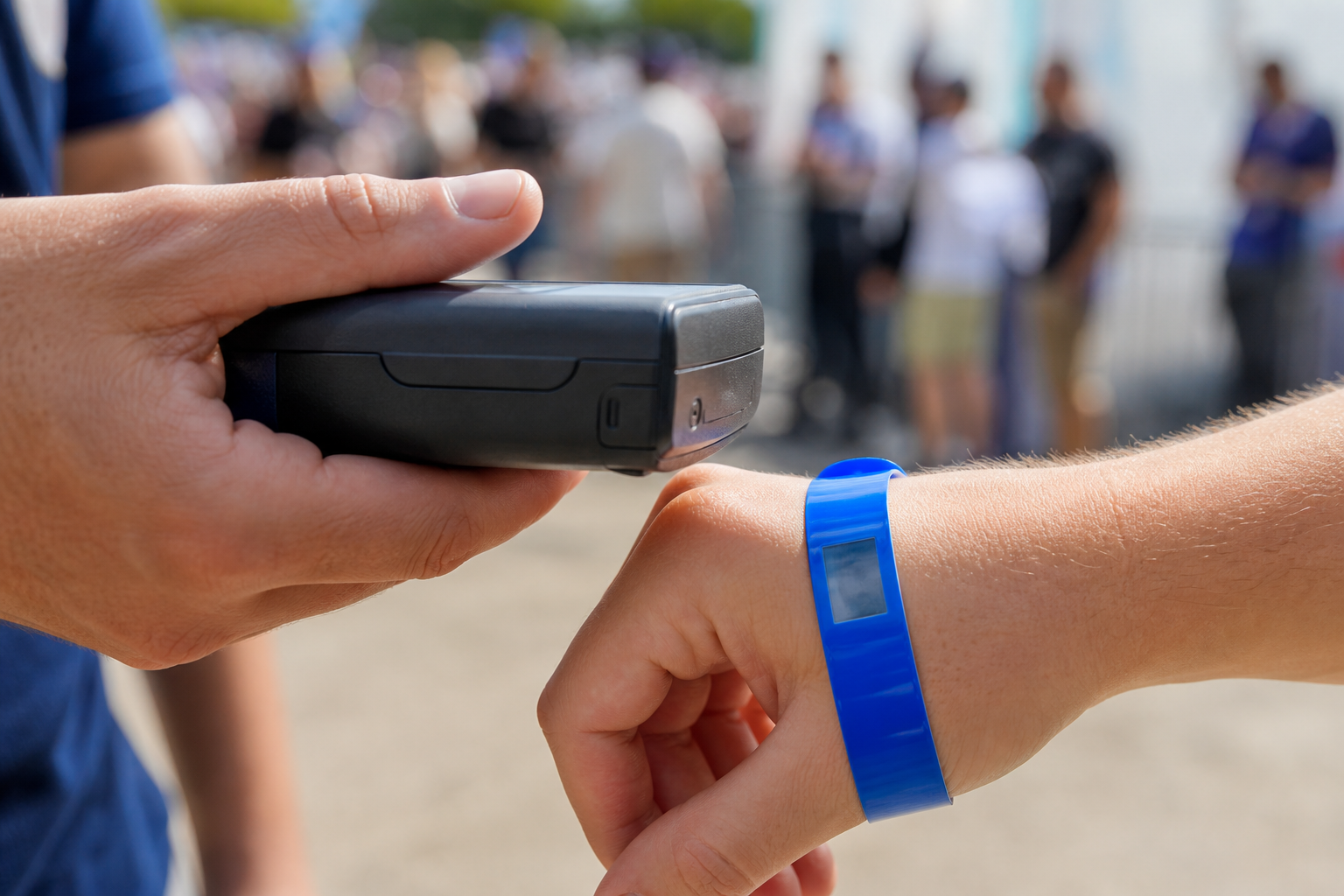
Festivals and venuesGate staff tap the band with a handheld; the band is waterproof enough for three days of showers and rain. Use the eleven colours as access tiers — one colour per zone is faster to police at a glance than any screen.
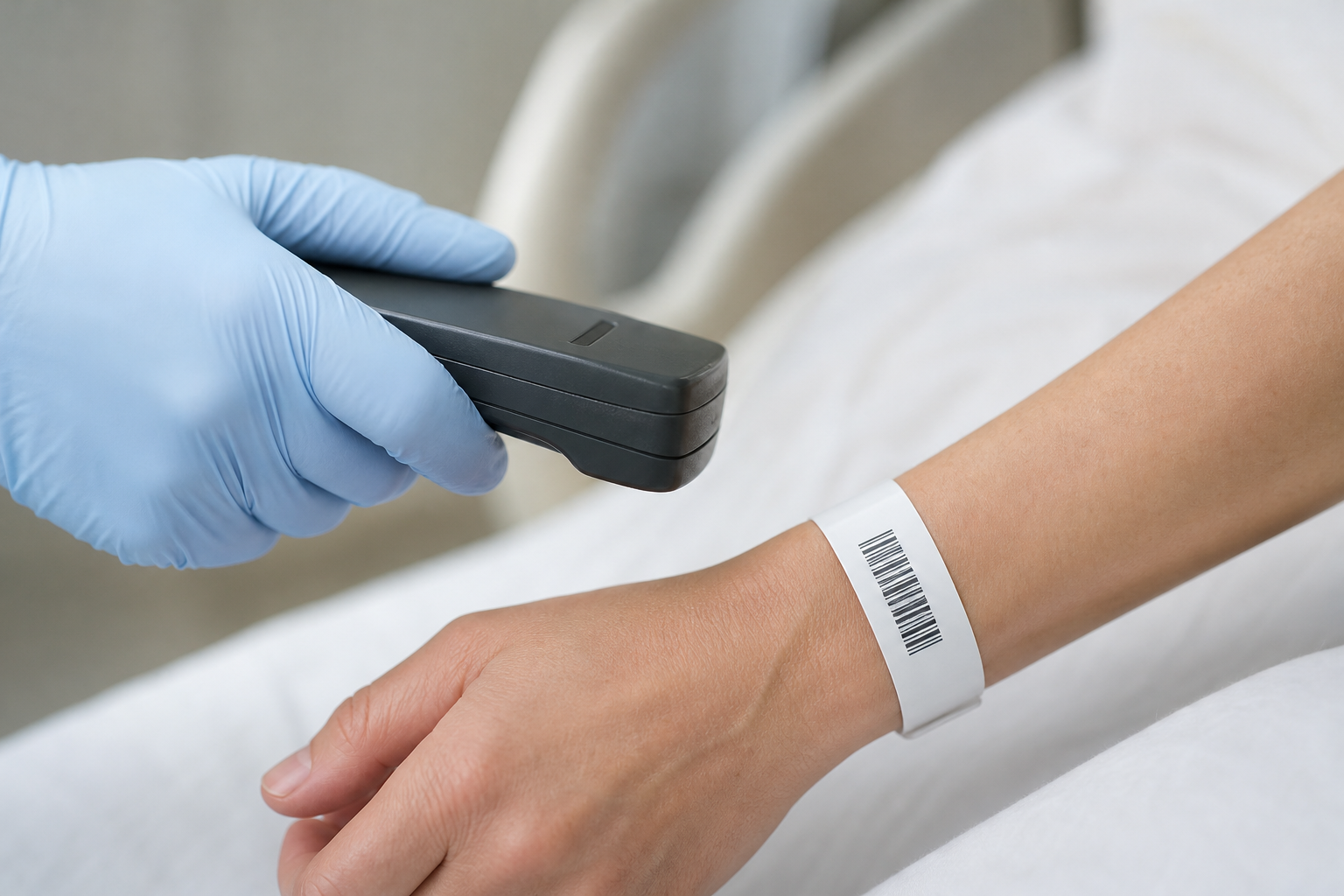
Hospitals and clinicsThe band carries the patient identifier and a printed barcode; the record stays in the HIS. The one-way clasp is the point — a band that can be moved between patients is worse than no band at all.
Colour and print
Colour is the cheapest access-control system there is: it reads at ten metres without a reader, a battery or a network.
Send vector artwork and your numbering rule. We will return a print proof on the actual band width before production — a QR code that reads on screen can fail once it is printed on curved PVC.
Questions we get asked
It is single-use, but “disposable” usually means a Tyvek or thermal-paper band that lasts one night. This is multi-layer PVC: waterproof, tear-resistant and comfortable for several days. The reason it cannot be used twice is the one-way clasp, not the material.
Not intact. The clasp snaps onto two studs and does not release — removing the band means cutting it. That is the whole security argument for a PVC band over a paper one, and it is why it suits gated events and hospital wards.
The PVC body is waterproof and the chip is laminated between the layers, so a shower, a pool or a rainy festival is fine. Note that the datasheet gives no formal IP rating — if you need a stated ingress figure for a tender, ask us and we will tell you what has actually been tested.
NTAG213 if you only need an ID or a short URL and phones must read it. NTAG215 or 216 if the band has to carry a contact record or several entries. MIFARE Classic 1K if your readers and software already run on it. DESFire EV1 if the band also has to hold a cashless purse or a secure multi-application. ICODE SLIX if your readers are ISO 15693. The chip decides the reader, not the other way round.
Centimetres. This is HF at 13.56 MHz — a tap, not a sweep. A phone reads it at around 1–3 cm, a fixed reader a little further. If you need to read a wristband from a metre away, HF is the wrong technology and UHF is the conversation to have.
Yes — silk screen for flat colour, offset for multi-colour artwork, with variable numbering. Send vector artwork and your numbering rule; we return a proof printed on the actual band width, because a QR code that scans on screen can fail on curved PVC.
We do not publish a skin-contact certification for this band, so do not assume one. For hospital or paediatric tenders, ask us for the material declaration and take a sample through your own skin-contact evaluation before you commit to a volume order.
Yes, with the right chip — DESFire EV1 is the usual choice where a purse or a secure credential is involved. Understand the split: the band carries and protects the credential, your POS and payment provider run the transaction. We supply the carrier, not the payment scheme.
Why us
Bands are laminated and punched in house, so the chip window and the print register are controlled on the same line.
We buy from the main IC brands as a strategic partner rather than through spot brokers, so allocation is predictable.
A print proof on the real band width, and a read test on your reader, before the run starts.
Where a number is not tested, we say so. A datasheet that survives a tender is worth more than one that reads well.
Which chip your readers expect, how many days the band has to survive, and what has to be printed on it. We will come back with the width, the chip and a proof.
Copyright © ©Copyright 2024 Greatest IoT Technology Co., Ltd all rights reserved - Privacy policy