

Home > Products > RFID TAG > RFID Jewelry Tag
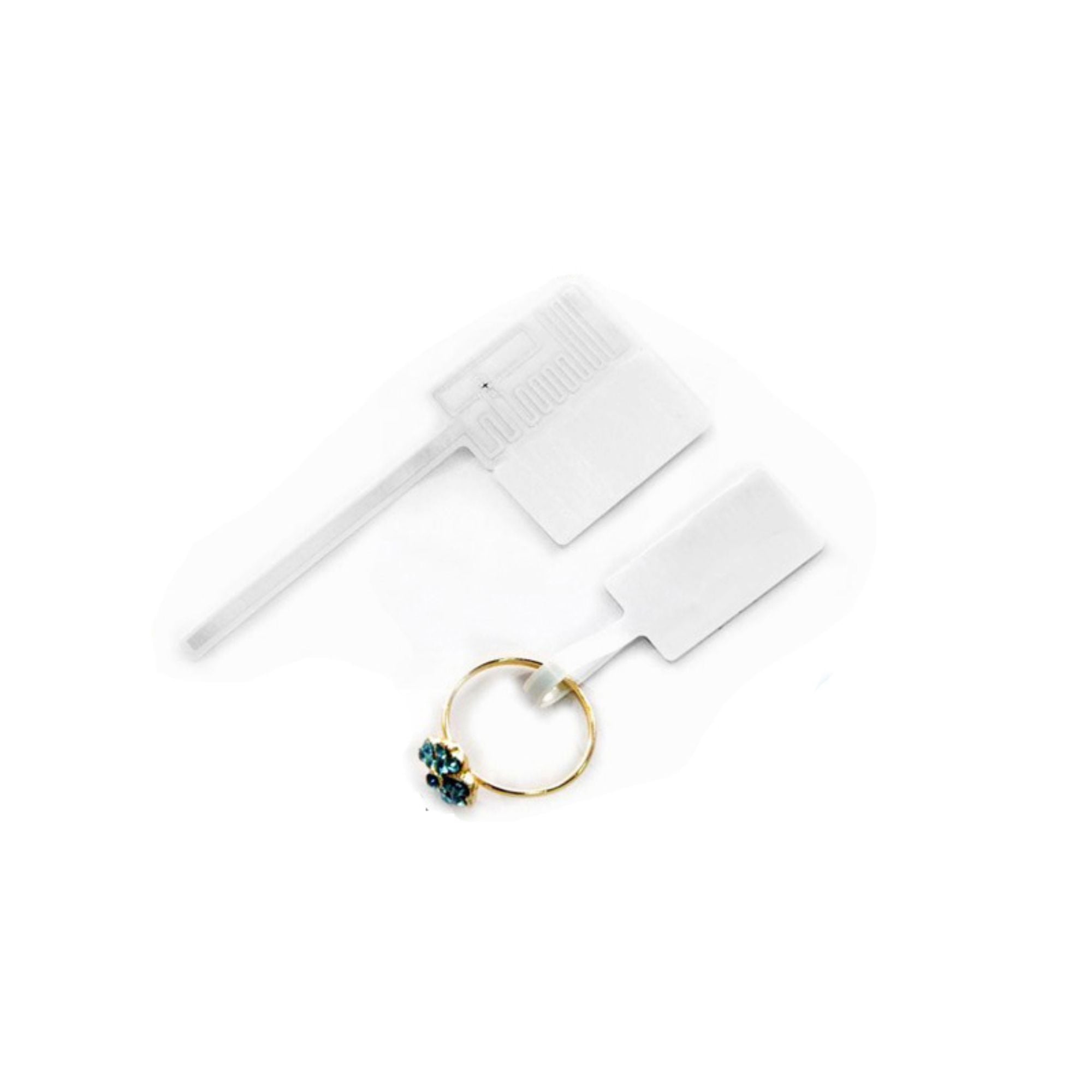
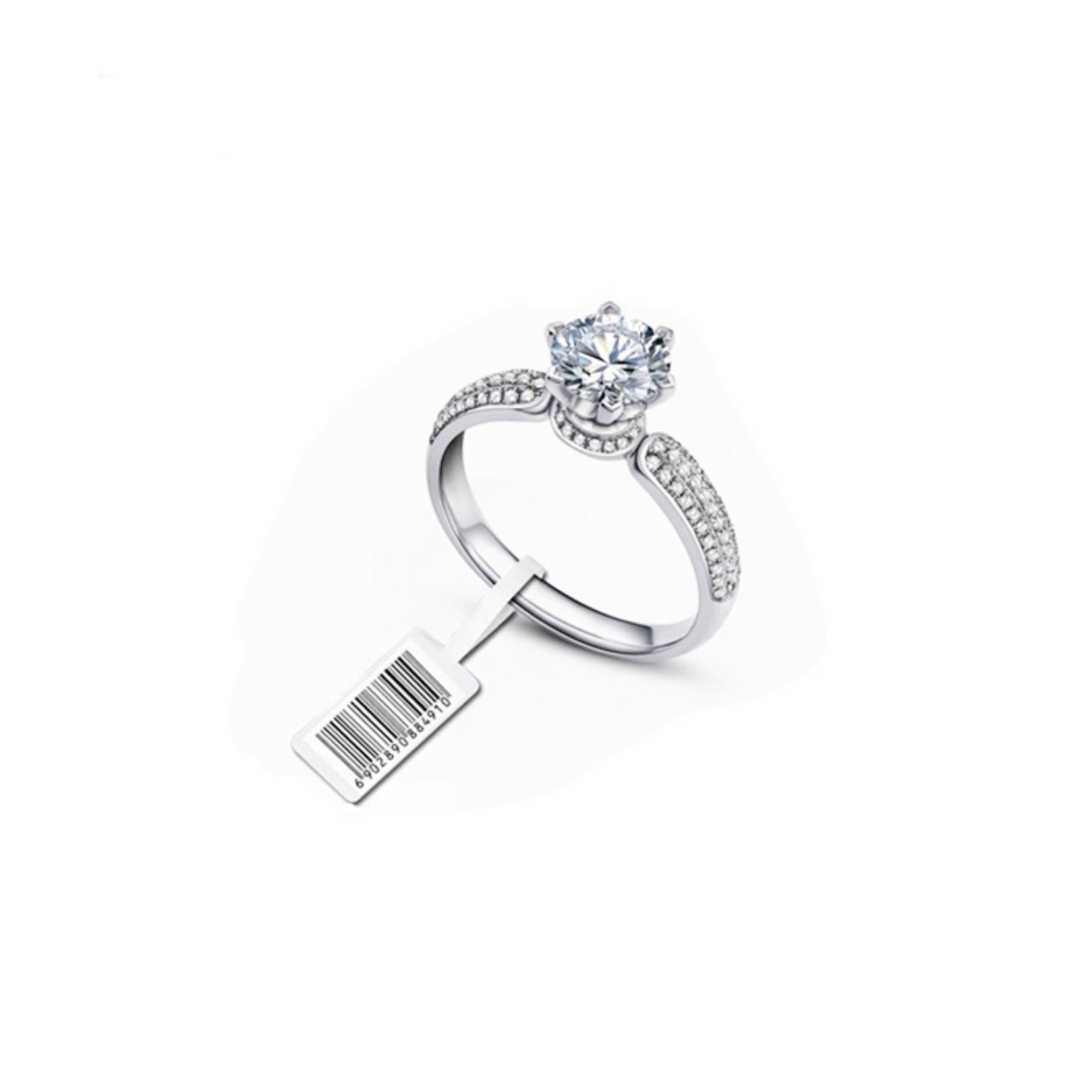
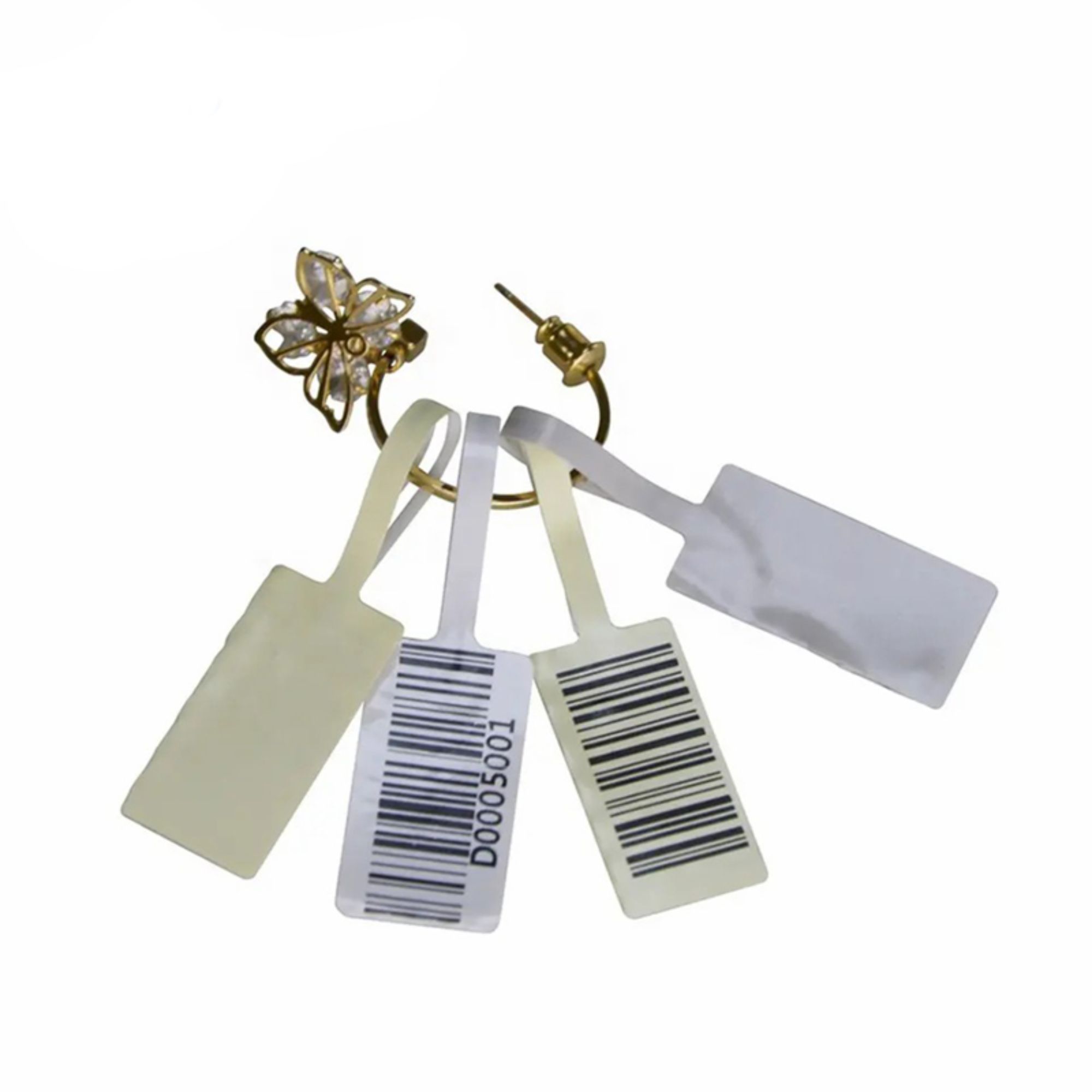

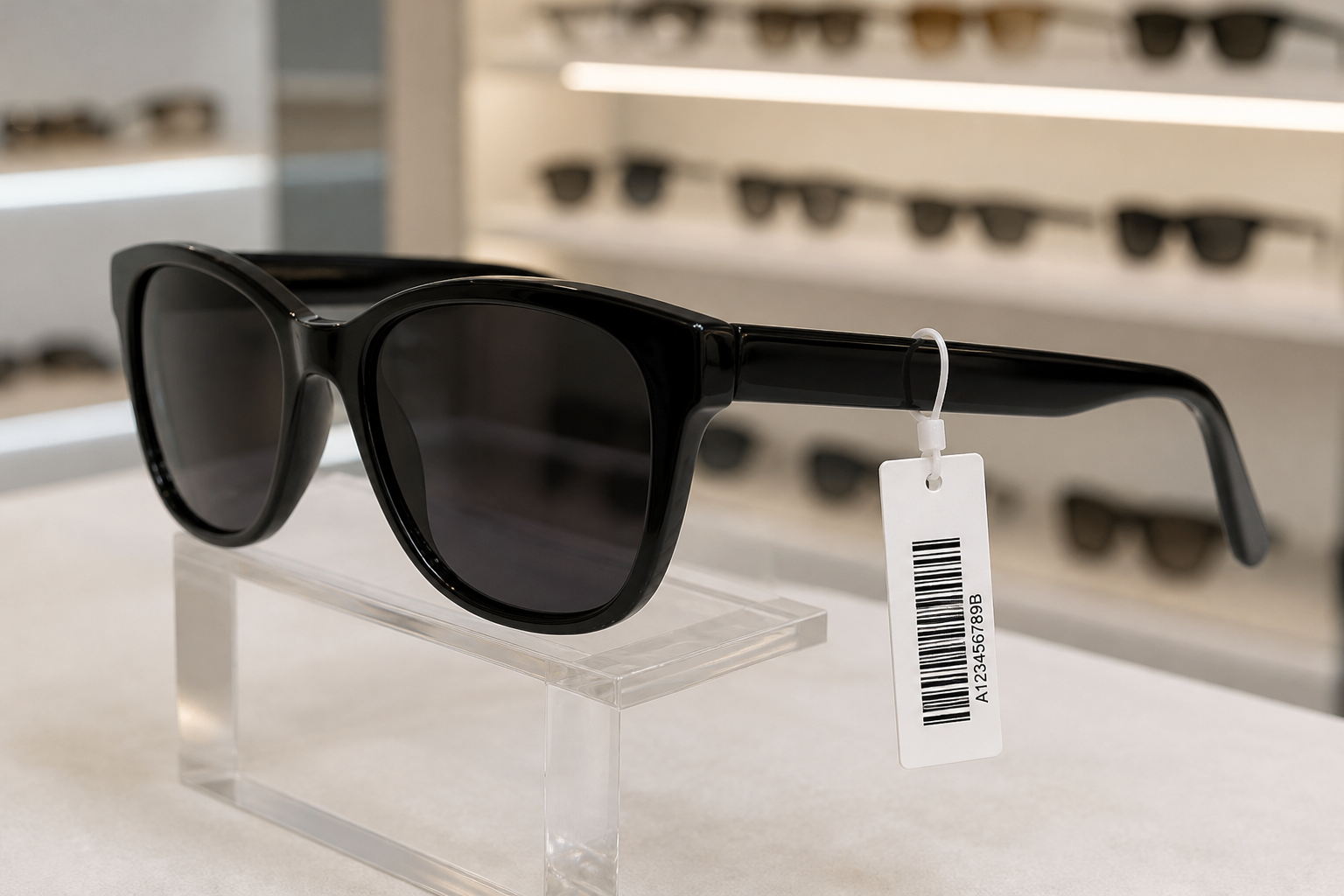
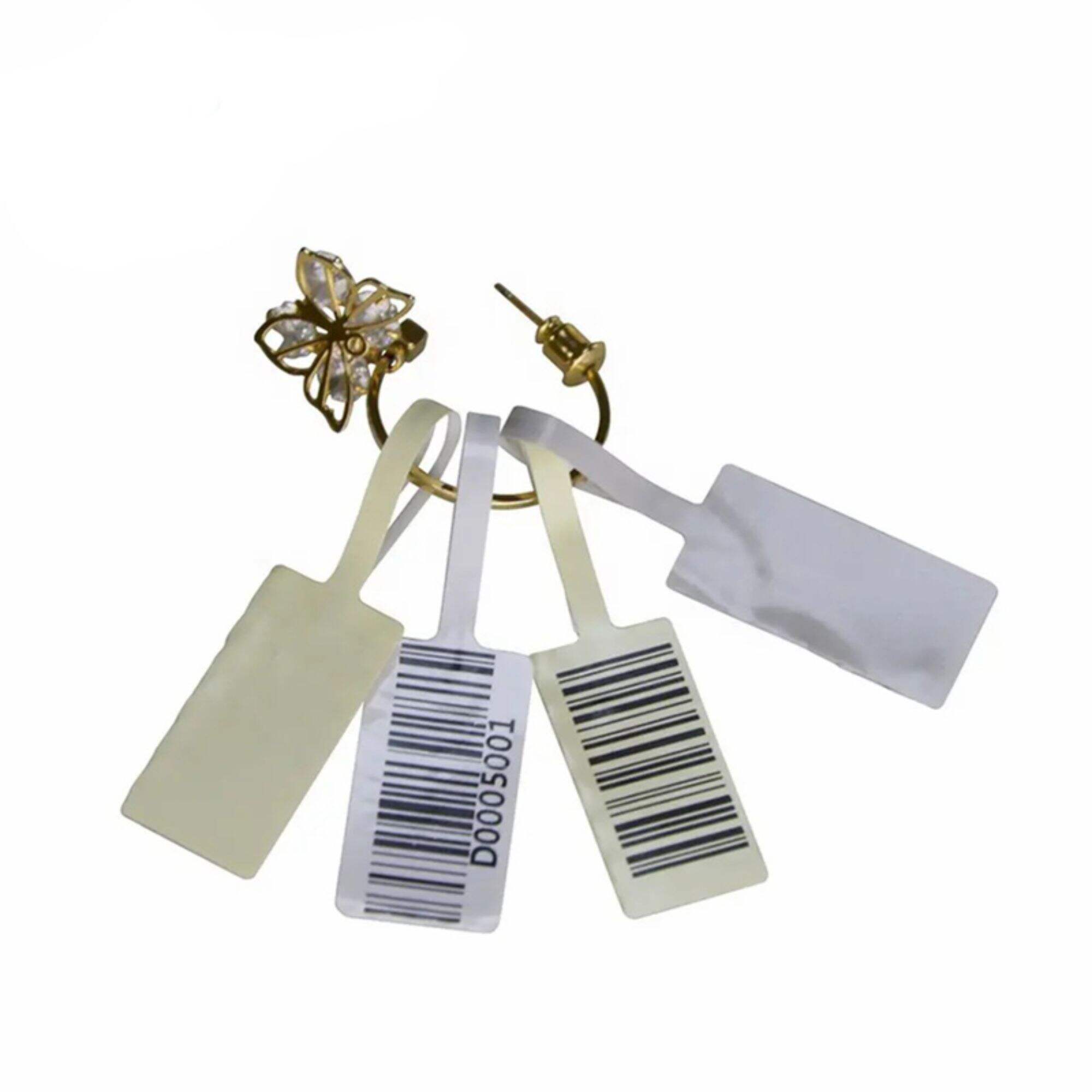
A loop-lock tag, not a sticker: a 68 × 26 mm paper or PET flag carried on a one-way plastic tail. The tail loops through a ring band, an earring post or a spectacle temple and locks — it cannot be slipped off without cutting. Inside the flag sits an 11 × 42 mm UHF inlay with a 96-bit EPC and a printed barcode, so the same piece can be counted in bulk on the shelf and read again at the door.
Before you specify
Most jewelry-tag enquiries bounce because the buyer expects an adhesive label and receives a seal tag, or the reverse. Here is the difference in one screen.
If your requirement is an adhesive label that sits flat on a jewelry box lid or a pouch, this is the wrong part — our adhesive UHF labels are the correct product. Tell us which one you need and we will quote the right item instead of the closest one.
Mounting
The tag is the same; what changes is the path the tail takes. Pick the one that matches how the piece is displayed, because that decides whether staff can re-seat the tag after a customer tries it on.
01
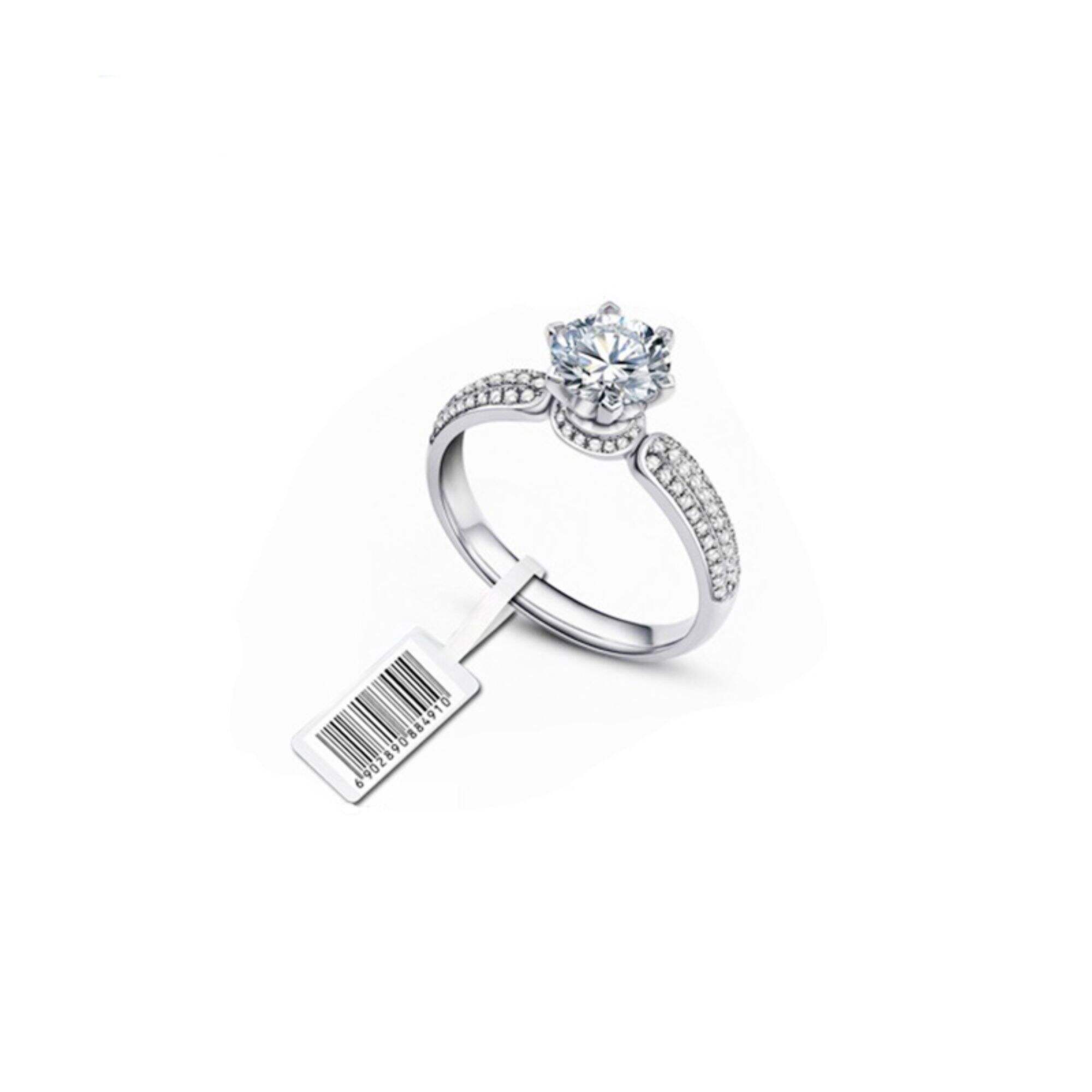
The tail passes once around the shank. Works for bands from about 1.5 mm thick upward. The flag then hangs clear of the ring — which is exactly where it needs to be for RF reasons.
02
Looped behind the butterfly so the pair stays together. Suits studs and small drops; the flag hangs below the earring rather than across the face of it.
03
One loop around the arm, flag hanging beside the frame. This is the eyewear mode — sunglasses and optical frames on an open wall or a rotating display.
04
Tail stapled or sewn to a velvet pouch or a travel box. Used when the piece itself must not carry anything, for example high-value loose stones.
The word “anti-theft”
A tag on its own protects nothing. What stops a piece walking out is the combination below, and each layer needs something from your side. We would rather say this plainly than let you buy a tag that cannot do what the name suggests.
A barb inside the slot lets the tail in and refuses to let it out. To remove the tag you cut the tail, and a cut tail is obvious. This layer works with no electronics at all — it is what makes the tag a seal rather than a label.
An RFID reader at the door reads every EPC passing through, including tags inside a bag or a coat pocket. This is the layer buyers most often assume is built into the tag — it is not. It is hardware you install at the threshold.
At the till, the item is marked sold against its EPC. The portal compares what it reads with what your system says is still in stock. A tag that reads as unsold at the exit is the event worth reacting to.
Why it looks like a luggage tag
A UHF antenna is detuned by anything conductive near it. An inlay laid flat on a gold or silver band loses most of its read range, and a watch case is worse. The tail is what keeps the antenna away from the metal.
We will test this tag on your own reader before you commit to a full order — send us the reader model and how the pieces sit in the case.
Specification
Everything below is the part as we build it. Rows marked [confirm] depend on the order — ask and we will put the number in writing on the quotation rather than guess here.
| SPECIFICATION AT A GLANCE | Full parameter table below |
| Product type | Loop-lock seal tag — flag plus one-way tail Not a self-adhesive label |
| Flag size | 68 × 26 mm |
| Inlay | 11 × 42 mm UHF dry inlay, dipole antenna |
| Frequency | 860–960 MHz Band fixed to the market — EU 865–868, US 902–928, CN 920–925 |
| Protocol | ISO/IEC 18000-6C · EPCglobal Class 1 Gen 2 Now numbered ISO/IEC 18000-63 |
| Chip | Impinj Monza R6 / NXP U8,U9 |
| Memory | EPC 96 bits · no user memory on R6 Monza R6-P adds 32 or 64 bits of user memory if you need to hold data on the tag |
| Chip sensitivity | Read −22 dBm · write −17 dBm Impinj datasheet figures for the chip, not for the finished tag |
| Read range | 3–5 m stated Depends on reader power, antenna, tag orientation and how far the flag hangs from the metal — see the note below |
| Face material | Paper / PET / PVC |
| Antenna | Etched aluminium on PET carrier |
| Operating temperature | −40 to +85 °C |
| Printing | Barcode, serial number, logo Thermal transfer or offset — send artwork and numbering scheme |
| Packaging | [confirm] — supplied on roll or in sheets, depending on the line |
| Minimum order | [confirm] — quoted per order |
Why some rows say [confirm]. Tail length, lock type and packaging change with the order, and a number invented on a web page becomes a dispute on a purchase order. Ask for the quotation — every one of these rows is fixed in writing there.
How to read the specification
It assumes a clear path, a full-power reader and a flag hanging free. Inside a closed display case, with the flag lying against a metal shelf, expect materially less. Treat 3–5 m as the ceiling of the design, not the number you will see in a cabinet. We will measure it on your reader before you commit.
Monza R6 carries a 96-bit EPC and no user memory. That is 24 hex characters — enough for an SGTIN-96 or your own serial, not enough to also hold price, weight or grade. Keep those in your database, keyed by the EPC. If you genuinely need data on the tag itself, ask for R6-P.
The flag is big enough for a barcode beside the inlay. Put the same serial in the barcode and the EPC and you gain a fallback: when a reader plays up, staff can still scan the tag at the till. Our current stock tags already do this — the serial is printed on the flag.
In use
Three settings, each with a different reason for tagging. The tag does not change; the workflow around it does.
Counting a tray without opening the caseA handheld read across the glass picks up every flagged piece in the tray. What used to be a two-person stock count becomes one person walking the counter — and the count is a read, not a reconciliation of handwritten sheets.
Sunglasses and optical framesOne loop around the temple, flag hanging beside the frame. Frames on an open wall are the easiest pieces to walk away with and the hardest to count — the temple tag fixes both, and it does not mark the frame.
 Pairs that must stay together
Both earrings looped to one flag, or one flag per earring with matching serials. The pair cannot be split on the display without leaving evidence, which is the whole point of a seal tag.
 High-value single pieces
A solitaire on its own stand: the tag rides on the band, the flag hangs behind. Staff can re-seat it after a customer tries the ring on, and the serial survives the handling.
Personalisation
Three inputs, in this order. Get them wrong and the tags arrive with the right shape and the wrong data — the most expensive kind of reprint.
Questions we get asked
No. EAS labels ring a dedicated pedestal with no software in the loop. This is a UHF tag: it raises no alarm on its own. Detection requires an RFID portal at the door plus a POS that marks items sold. If you need a standalone pedestal alarm, say so and we will point you to the right part instead of selling you this one.
The tail locks one way. Removing it means cutting it, so the tag is single-use and the cut is visible. That is deliberate: a tag that can be slipped off and re-fitted protects nothing.
Yes, with a caveat that decides most projects. UHF antennas are detuned by nearby metal, so the flag has to hang clear of the piece rather than lie against it. On a ring the tail does this for you. If your display presses the flag flat onto a metal shelf, ask for a longer tail or a different inlay before ordering.
A UHF RFID portal or overhead reader at the threshold, sized to the doorway, plus middleware that compares reads against your stock status. That hardware is outside this tag — tell us the doorway width and we will say what class of reader suits it.
Impinj Monza R6: 96 bits of EPC, no user memory, read sensitivity −22 dBm. 96 bits is 24 hex characters — enough for an SGTIN-96 or a serial number, not for price or grade. If you need data written on the tag, Monza R6-P adds 32 or 64 bits of user memory.
Yes. The face is 68 × 26 mm and the inlay occupies the middle, which leaves room for a barcode and a small logo. Send vector artwork and we will show you a layout proof before printing.
There is no adhesive anywhere on the tag, so there is no residue. The tail is thin paper or PET and loops loosely around the band or post. On very soft stones and on pearls we recommend looping around the fitting rather than the setting.
Both depend on the chip, the print and whether tags are encoded here. Send the quantity and the numbering scheme and we will confirm both in writing — we do not publish a number that changes with the chip market.
Why us
One of China’s larger RFID inlay and label manufacturers, with capacity of about one billion inlays a year.
Inlay assembly runs on Mühlbauer equipment, which is what keeps die placement and yield consistent at volume.
We buy from the main IC brands as a strategic partner rather than through spot brokers, so allocation is predictable.
When a specific chip is on allocation we can quote a drop-in equivalent and tell you what changes in your encoding.
Copyright © ©Copyright 2024 Greatest IoT Technology Co., Ltd all rights reserved - Privacy policy