

A security label that can be checked four ways, and that destroys itself if someone tries to move it.
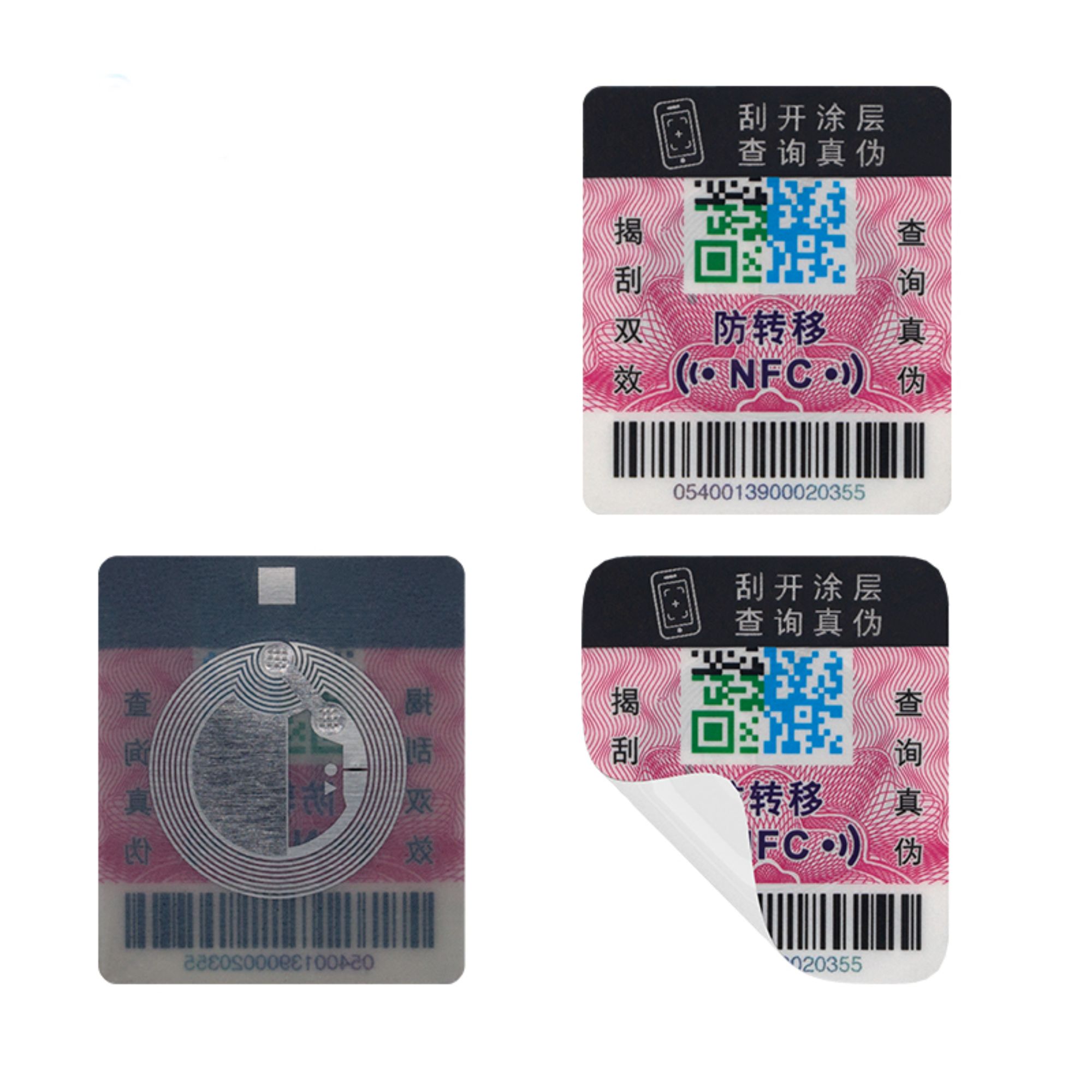
This is not a plain NFC tag. It is a security label: a scratch-off verification panel, a QR code, a barcode with a human-readable serial, and a 13.56 MHz NFC inlay, all on the same 40 mm face, printed over a guilloche pattern on fragile paper with a tamper-transfer adhesive.
The anti-counterfeit mechanism is physical. Once applied, lifting the label tears the antenna and voids the printed pattern, so the identity cannot be moved from a genuine carton to a counterfeit one. Chips are NTAG213, NTAG215, NTAG216, FM1108 or MIFARE S50, read at 0 to 10 cm by a phone or a reader.
One label, four checks
A counterfeit label fails at the weakest channel. Having four of them on the same face is the reason this product works: a copier can reproduce a QR code perfectly but cannot reproduce the scratch panel underneath it, and cannot reproduce the inlay at all.
Four channels, one face. Each one is a separate thing for a counterfeiter to beat.
The physical mechanism
The security is not in the chip. It is in the construction: a fragile paper face, a tamper-transfer adhesive, and an antenna that is designed to break rather than lift. Applied and left alone, it works. Pulled off, it comes away in pieces and stops being a tag.
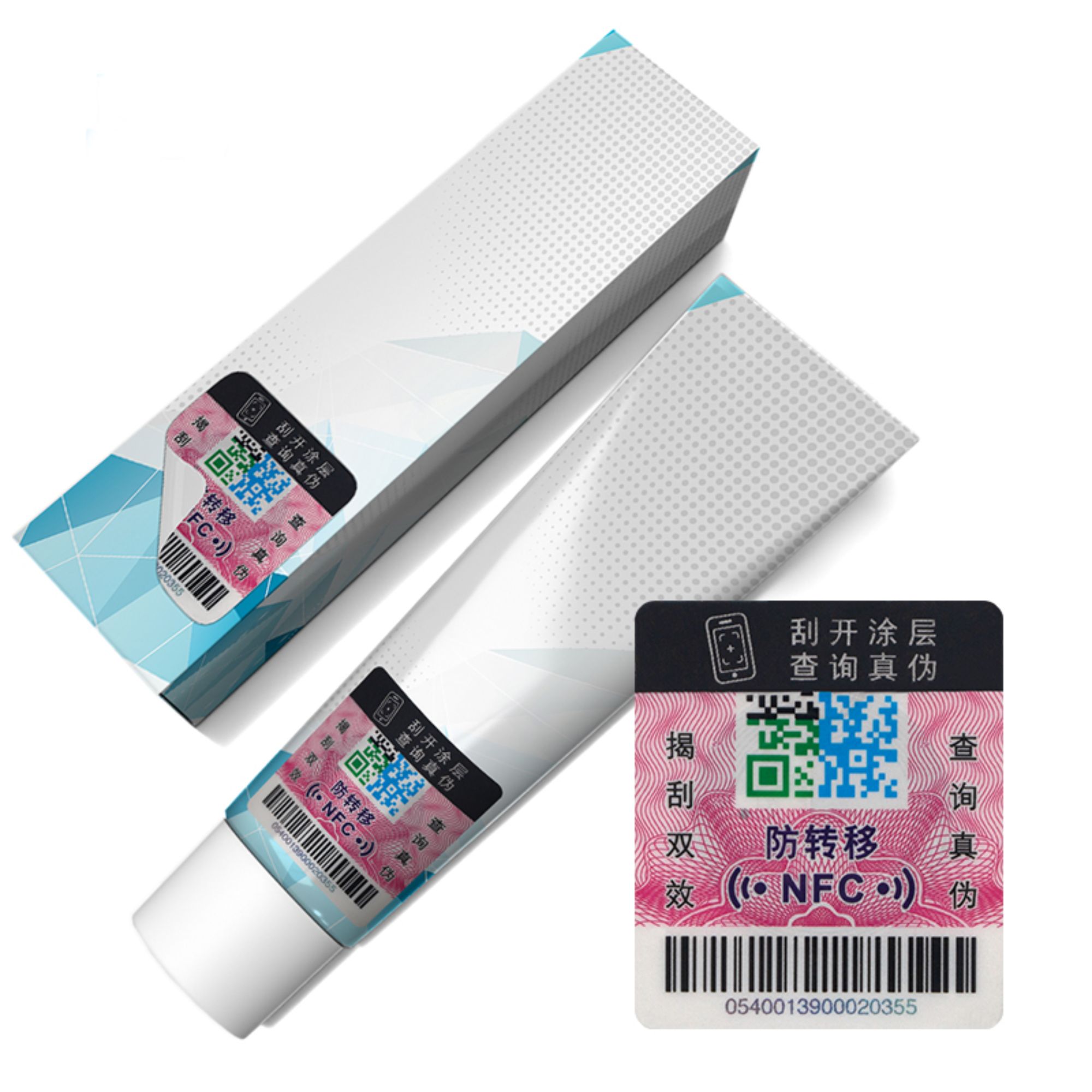
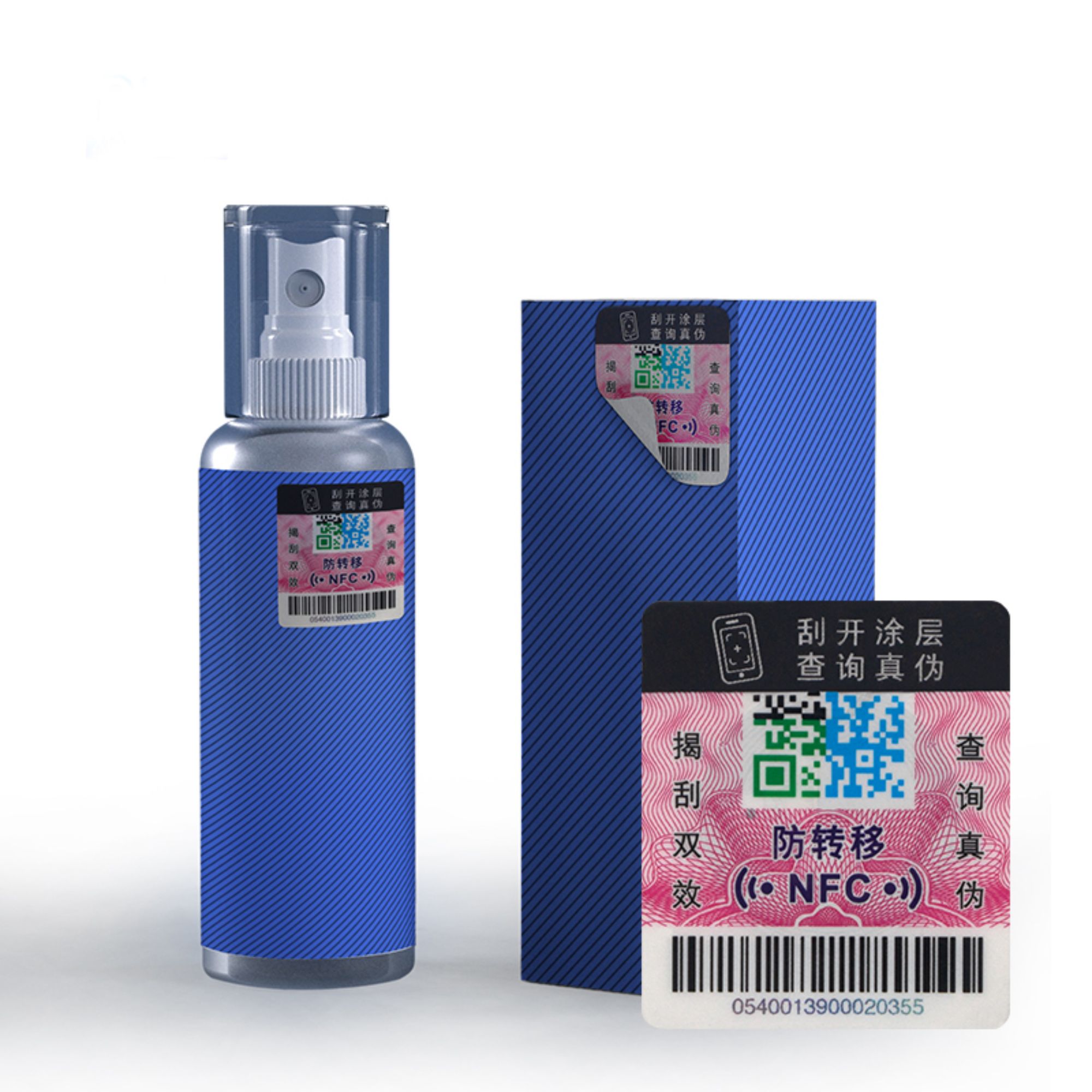
Applied to a cosmetic carton and a tube. A curved or highly finished surface needs testing before you commit — the adhesive has to grip well enough to be permanent and release badly enough to void.
What the chip can and cannot prove
Every chip on this label is readable and copyable by anyone with a phone. The security comes from the physical label and from your verification database, not from the silicon. That is a perfectly good system — it is what most pharmaceutical and cosmetics enforcement actually runs on — but it is not the same thing as a tag that proves its own authenticity.
| CHIP | WHAT IT IS | CAN IT PROVE AUTHENTICITY |
| NTAG213 / 215 / 216 | NXP memory tags, 144, 504 and 888 bytes of user memory, fixed 7-byte serial number | No. The serial is unique but it is printed to anyone who asks, so it can be read and copied onto a clone |
| FM1108 | A Fudan part compatible with MIFARE Classic 1K | No. MIFARE Classic’s Crypto1 cipher was publicly broken in 2008 and clones are cheap and common |
| MF S50 | MIFARE Standard 1K, the original of the same family | No. Same cipher, same problem, and the same weakness applies to every Classic-compatible part |
Where it belongs
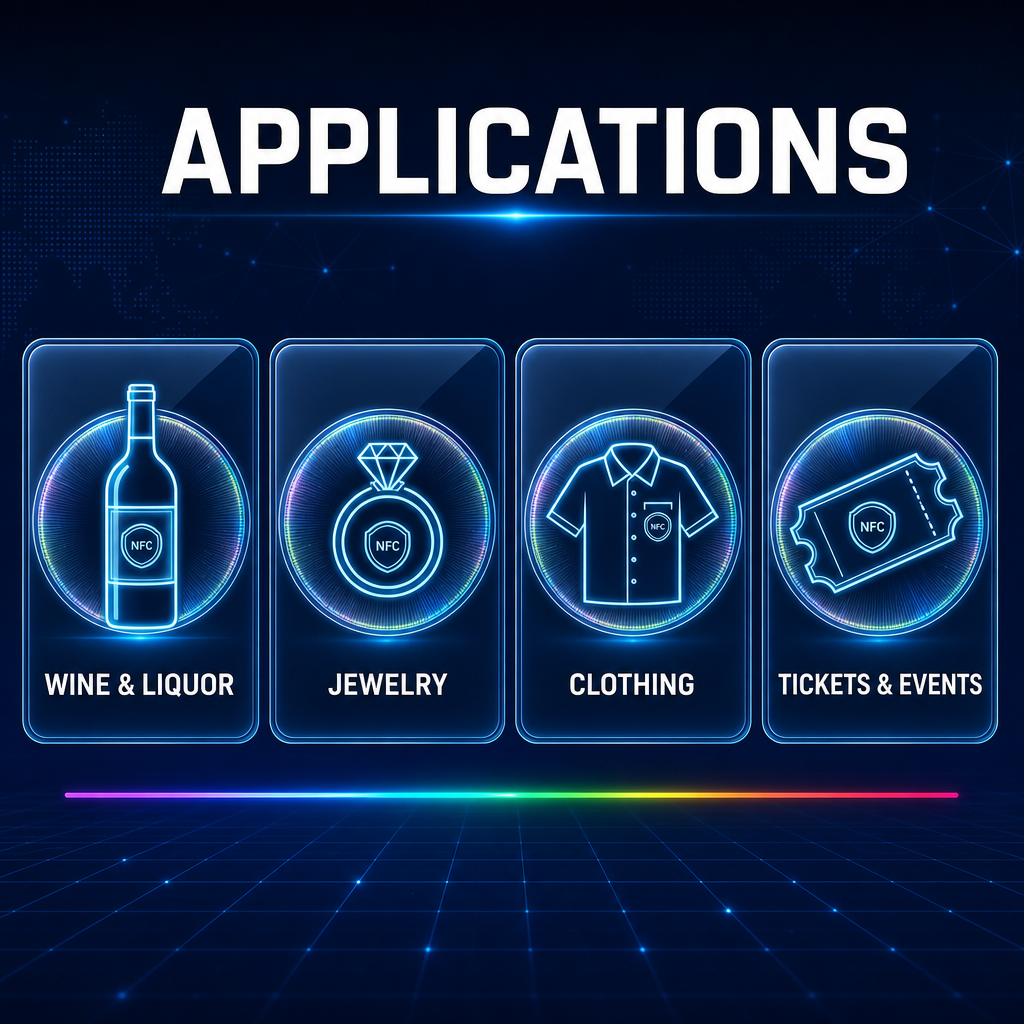
| APPLICATION | WHAT THE LABEL HAS TO DO | WHAT TO SPECIFY |
| Pharmaceuticals and healthcare | Survive a cold chain, prove a kit was not opened, and leave evidence if it was | Fragile paper on a carton board face, NTAG213 for a short URL, and a verification site that logs every check |
| Luxury and branded goods | Look like part of the packaging on a premium product, and be impossible to move to a fake | Guilloche print and foil if the brand needs it, plus a serial range that your system can validate |
| Cosmetics and chemicals | Grip a lacquered or curved surface permanently, and void on removal | A surface test before the order: coated board, varnish and curvature all change how the adhesive behaves |
| Supply chain and secure seals | Detect opening in transit and be checkable at a gate without a camera | Barcode and serial for the gate reader, NFC for the phone, and a substrate that survives handling |
| Event tickets and access | One check per item, fast, at a turnstile | NFC read speed matters more than memory, so a smaller chip is enough |
Specification
| PARAMETER | VALUE |
| RADIO | |
| Frequency | 13.56 MHz, HF. This is an NFC label. |
| Air protocol | ISO/IEC 14443A and ISO/IEC 15693 |
| Chips | NTAG213, NTAG215, NTAG216, FM1108, MIFARE S50, or to order |
| Memory | 144, 504, 888 or 1,024 bytes depending on the chip |
| Read range | 0 to 10 cm, depending on the reader and the antenna. Metal and liquid reduce it further |
| Write endurance | 100,000 cycles or more |
| Mode | Passive, no battery |
| CONSTRUCTION AND SECURITY | |
| Face material | Fragile paper, PET, PVC, transparent PVC or coated paper. Fragile paper is what makes it tamper evident |
| Adhesive | Tamper-transfer. The face tears and the printed pattern voids when the label is lifted, and the antenna breaks with it |
| Security print | Guilloche background pattern, scratch-off verification panel, anti-transfer marking. |
| Variable data | Human-readable serial, barcode, QR code and an encoded NFC payload |
| Printing | Single or multi-colour, with barcode and QR printing and data encoding as options |
| Colour | White or custom |
| Size | custom |
Questions we are asked
It is NFC, 13.56 MHz. It reads at 0 to 10 cm with a phone or an HF reader. If you need to read a carton from three metres, or read a whole pallet in one pass, that is UHF and this is the wrong product — tell us and we will quote the UHF version.
NTAG213, 215 and 216 carry a fixed serial number that anyone can read and copy, and FM1108 and MF S50 are MIFARE Classic parts whose cipher has been broken since 2008. What this label provides is physical tamper evidence plus a one-time code checked against your database. If you need a per-read cryptographic signature that a clone cannot produce, ask for NTAG 424 DNA with AES-128 instead.
The scratch panel. The QR code and the printed serial can be photographed and reproduced, but the code under the scratch layer is single use: the first check returns valid, every later check on the same code returns already used. A counterfeiter who copies the visible parts still fails the hidden one, and your team learns that a duplicate is in circulation.
It is designed to fail. The fragile paper tears, the printed pattern transfers or voids, and the antenna breaks so the label stops being readable. That is what stops an identity being moved from a genuine carton to a counterfeit one, and it is why a buyer should never accept a label that looks patched or lifted.
NTAG213 if you only need a short URL and a serial, NTAG215 or 216 if the payload is longer or you want more user memory. FM1108 and MIFARE S50 exist because some installed systems still expect MIFARE and because they are inexpensive, not because they are more secure — they are less. If your reader estate is MIFARE-based, say so and we will quote accordingly.
Usually, but the adhesive has a hard job: it has to hold permanently and release badly. Lacquered carton board, curved tubes, textured or low-energy plastics and frozen surfaces all behave differently, so send us the actual packaging or a sample of it and we will test before you commit to a die.
The packaging surface and a sample of it, the size and shape you need, the chip, the data you want printed and encoded, whether you need the verification platform, the quantity and the repeat pattern. Send the packaging first — everything else follows from whether the label will hold.
Copyright © ©Copyright 2024 Greatest IoT Technology Co., Ltd all rights reserved - Privacy policy