

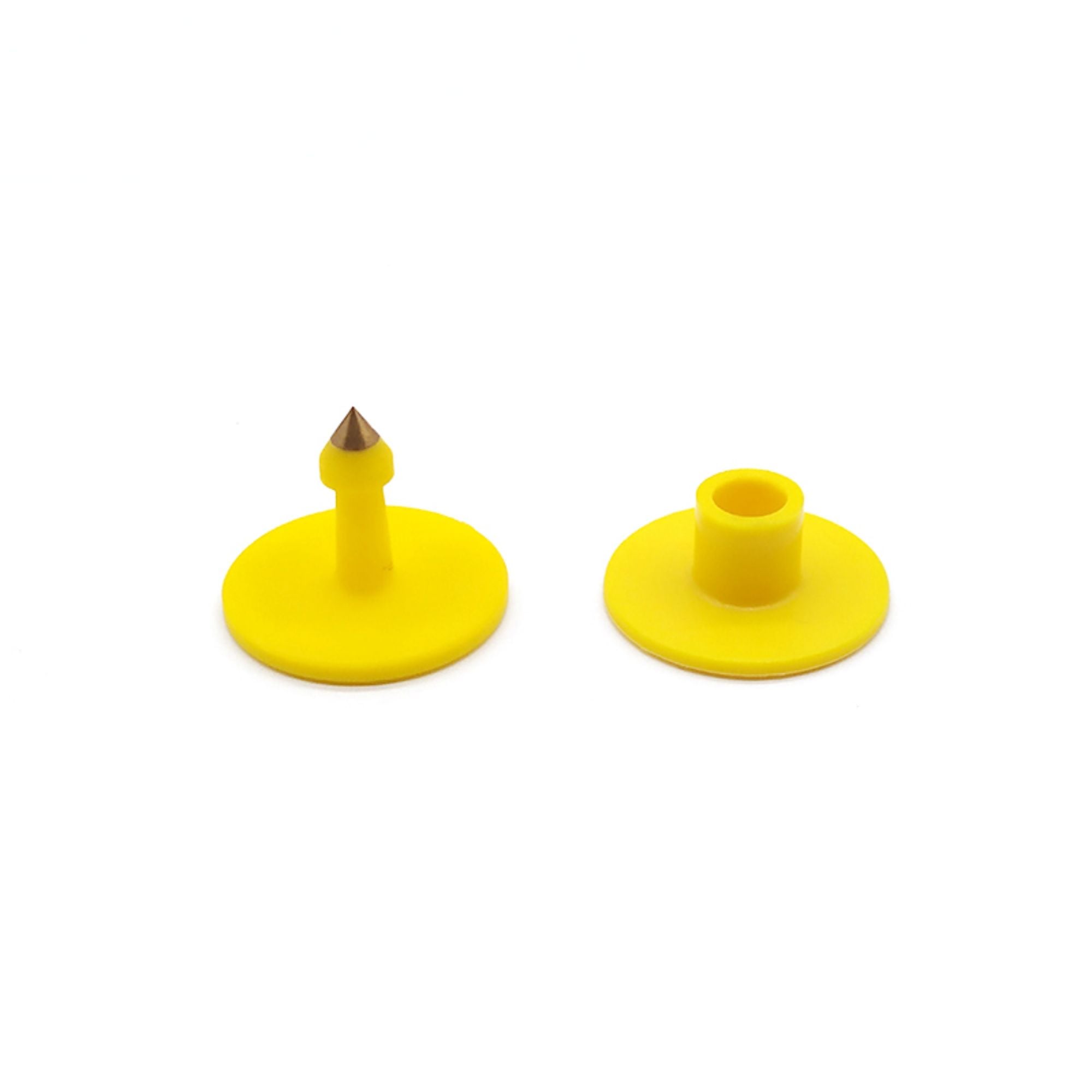
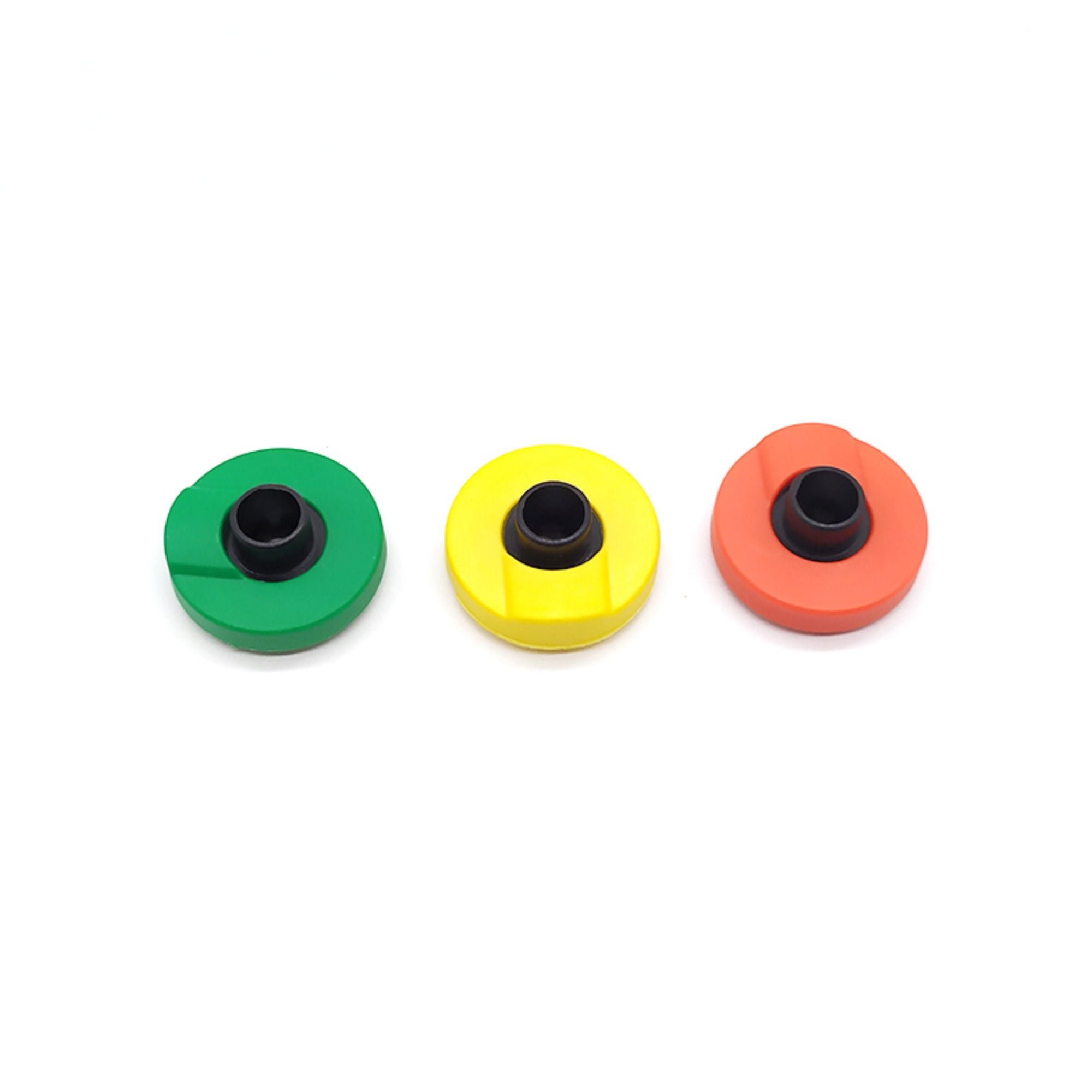
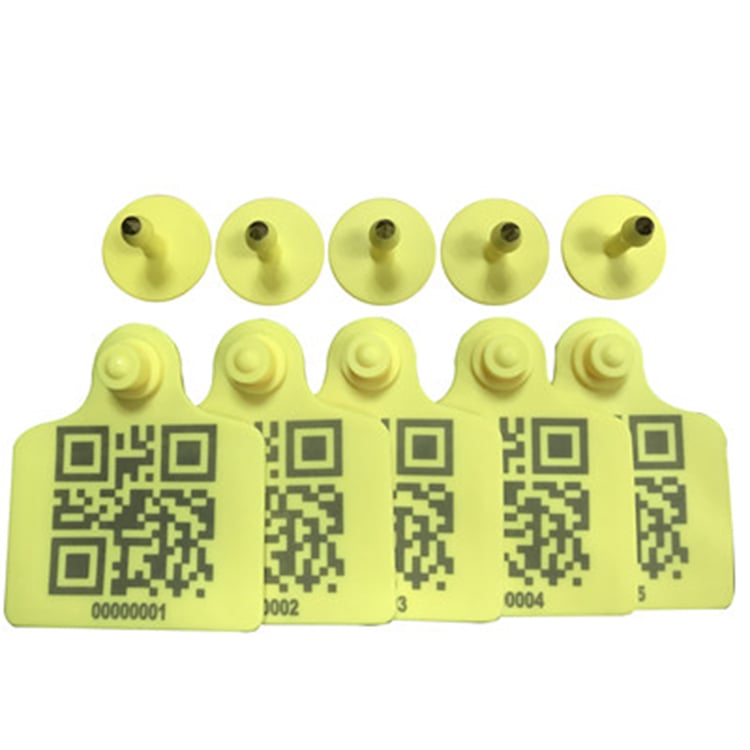
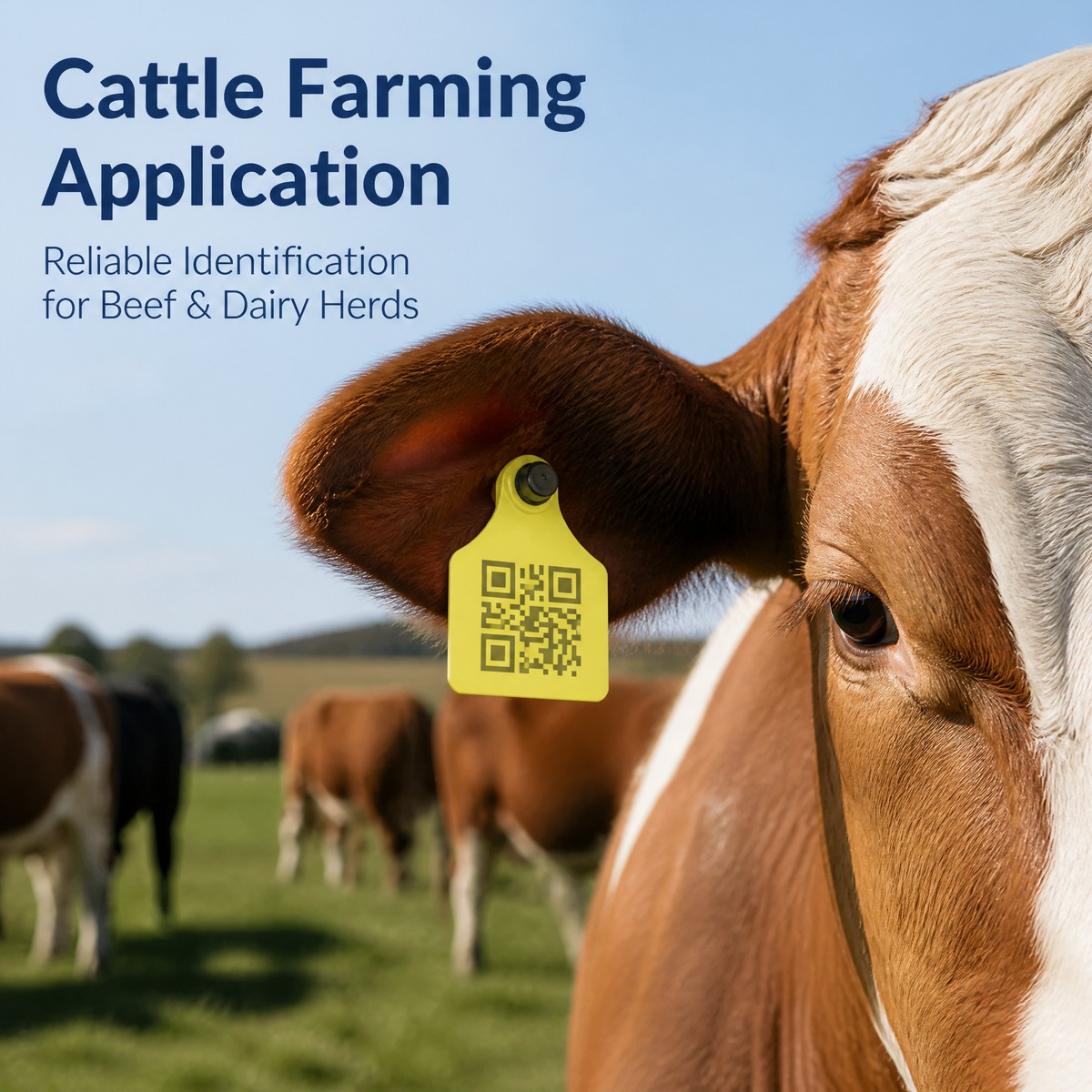
A 30 mm round TPU tag with a metal-tipped male stud, read by a stick reader at close range in the LF version, or by a UHF reader from several metres in the long-range version. Two different products in one listing — and which one you need decides everything.
ISO 11784/11785. Official ID. Close-range tap.
ISO 18000-6C. Counting and yard work. Metres.
The first decision
The two versions are not faster and slower variants of one product. They answer different questions, and one of them is regulatory.
Typical for handheld readers. Actual distance depends on the reader, the tag and the animal’s orientation — confirm against the reader you already own.
National herd register, subsidy claim, movement licence, abattoir record, or an export certificate. The 15-digit code is a regulatory artefact, and the reader output has to match it exactly. You accept tapping each animal, which is also what makes the record credible — the reader had to be at the animal.
Animals read in a race, through a gateway or while walking past an antenna, without being stopped. It is a productivity layer on top of visual or LF identification, not a replacement for it — and in most regulated markets it is not accepted as official identification.
The second decision
The chip decides what your reader can do with the tag. Two chips can look identical in a moulded disc and behave completely differently at the reader.
| CHIP | BAND | WHAT IT IS | CHOOSE IT WHEN |
| EM4305 | LF 134.2 kHz | ISO 11784/11785, FDX-B. 512-bit EEPROM, read and write. | This is the standard choice. Official identification, and you can write the number yourself. |
| TK4100 | LF 125 kHz | Read-only, EM4100-compatible. Not ISO 11784/11785. | Only for a legacy 125 kHz system already installed. A 134.2 kHz compliance reader will not read it as a standard transponder. |
| Impinj Monza R6 | UHF | EPC Gen2 / ISO 18000-6C. | Long-range counting where read speed matters most. |
| NXP UCODE 8 | UHF | EPC Gen2V2 / ISO 18000-63. EPC 128-bit, no user memory. | Long range with the extra Gen2V2 features; the EPC cannot be shortened. |
| NXP UCODE 9 | UHF | EPC Gen2V2 / ISO 18000-63. EPC 96-bit. | The same job with a shorter EPC, which suits some herd-coding schemes. |
A 64-bit structure: a country code, the national identification number and an animal-application flag. That is why the issuing authority matters. Tell us which country and which scheme, and we will program the sample to the same format your reader and your register expect — correcting a programmed batch afterwards means re-tagging animals.
Application
A tag that comes out of an ear in week three is almost never a moulding fault. It is placed too close to the head, through a blood vessel, or too near the tip where the skin is thin. The rule below takes ten seconds to learn and it is the single biggest influence on retention.
Green is the zone. The two red crosses mark the placements that account for most early losses.
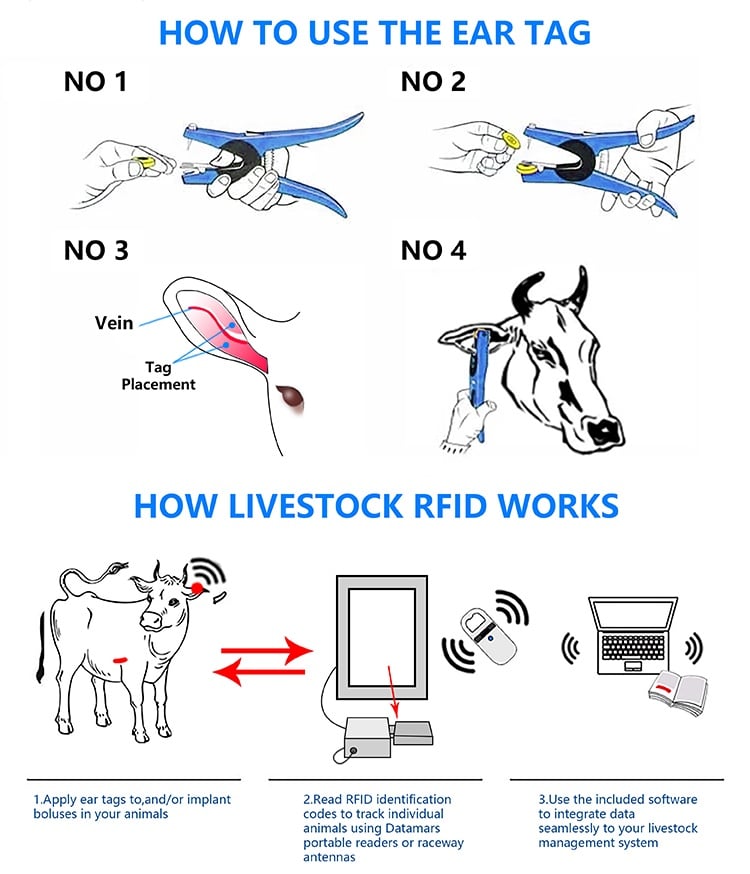
Loading the plier, positioning on the ear, the vessel to avoid, and applying. Below it, the three steps from tag to herd record.
What it looks like on an animal
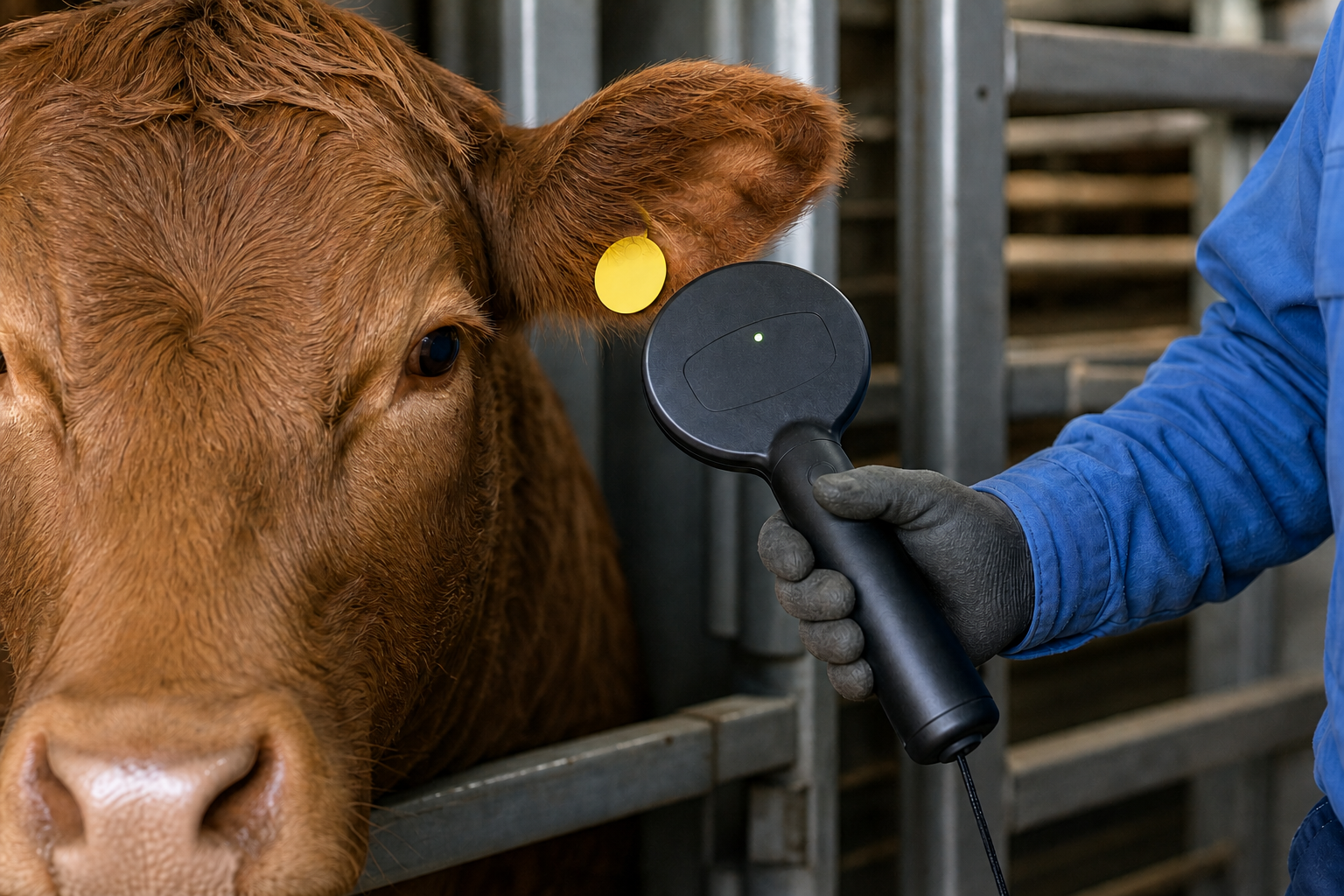
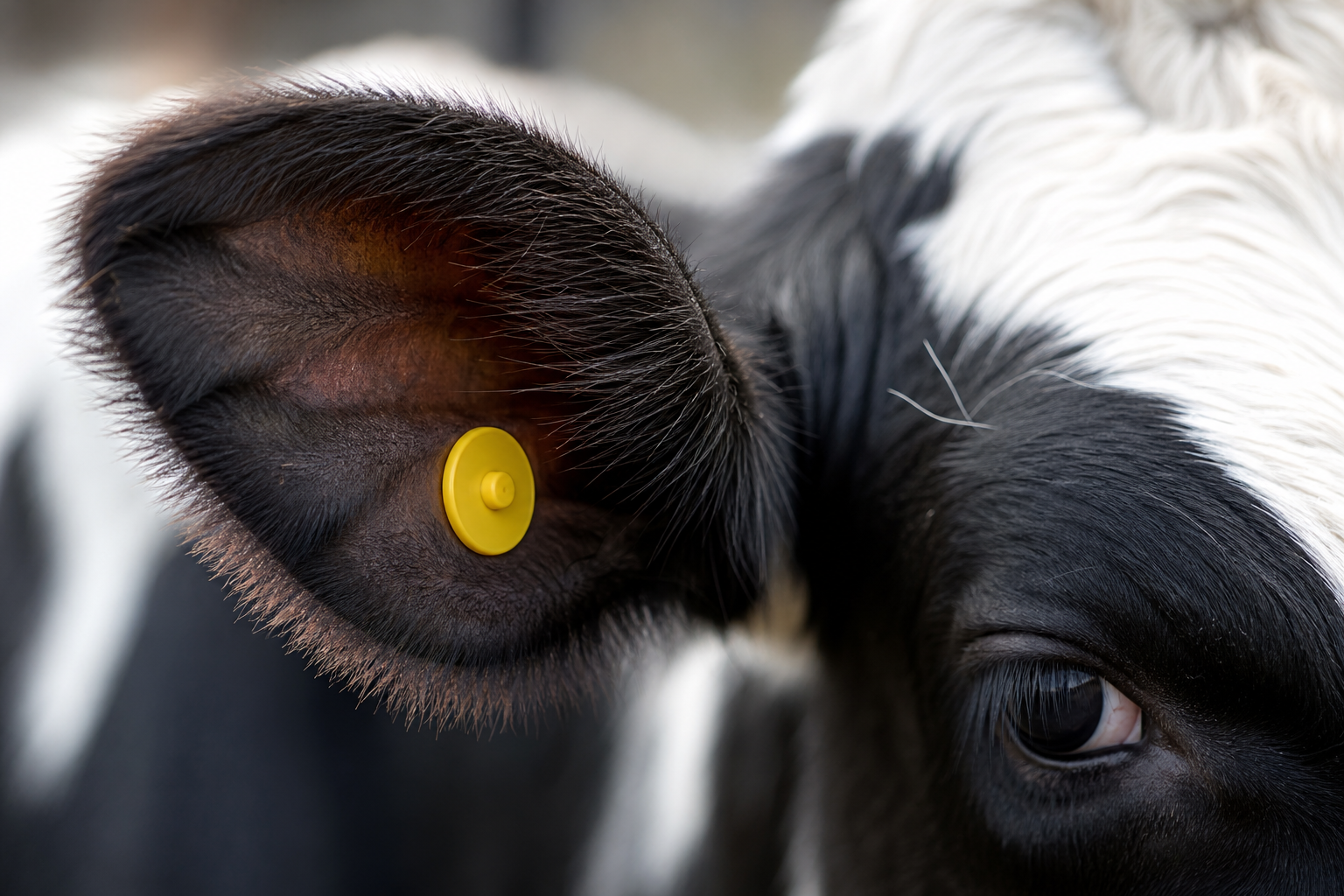 Applied, at working size. The disc sits flat against the ear with the pin through the cartilage — this is the image that answers “how big is it really”.
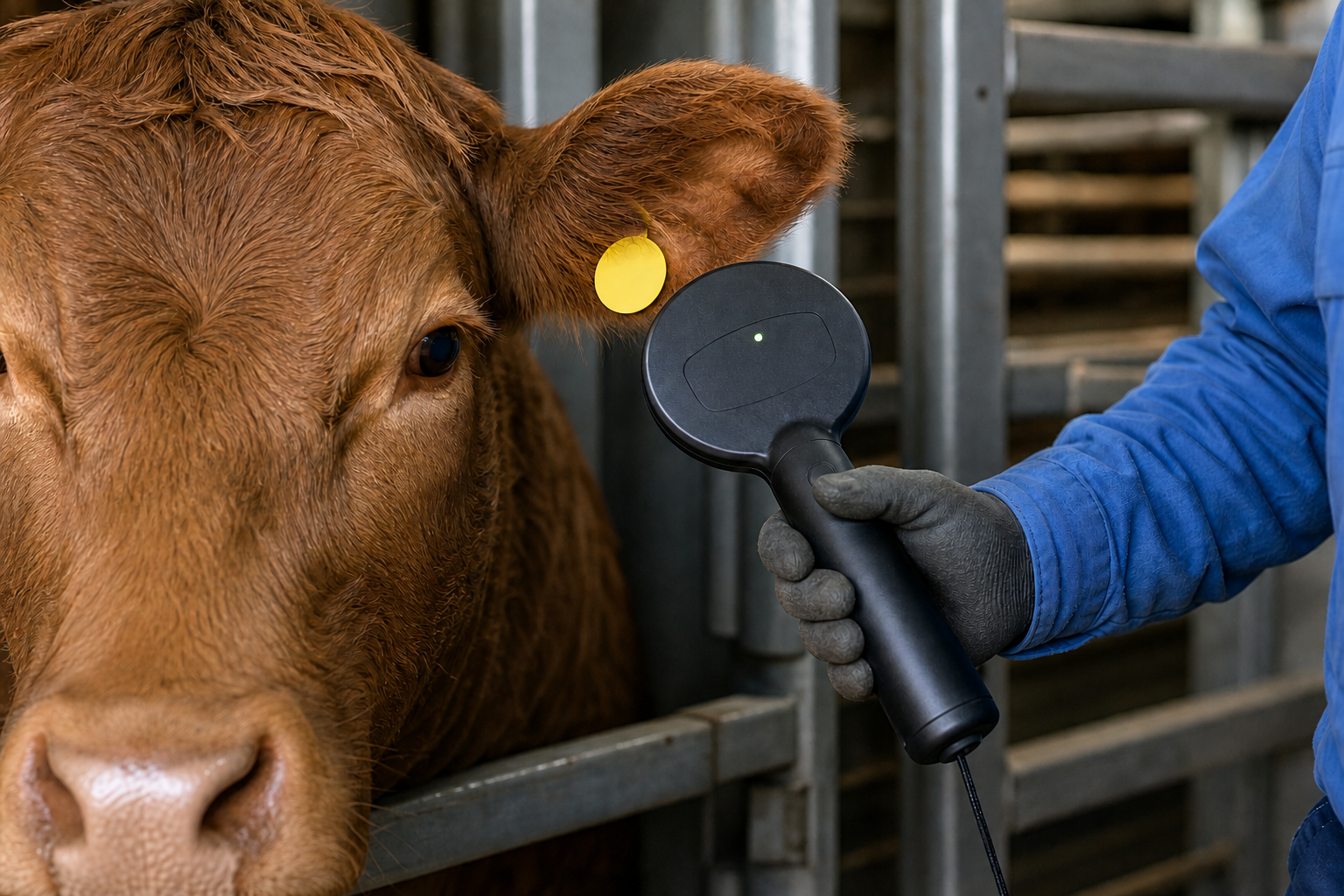 The read moment. An LF tag is read at a hand's width, not from across the yard.
Specification
Split by band, because the two versions differ in the rows that matter.
| PARAMETER | LF 134.2 kHz | UHF 860–960 MHz |
| RADIO | ||
| Protocol | ISO 11784 / ISO 11785, FDX-B | EPCglobal Class 1 Gen 2, ISO 18000-6C |
| Frequency | 134.2 kHz | 860–960 MHz, regional variants |
| Chip | EM4305 as standard | Impinj Monza R6, NXP UCODE 8 or UCODE 9 |
| Code structure | 64-bit ISO 11784: country code, national identification number, animal-application flag | EPC 96 or 128-bit |
| Memory | 512-bit EEPROM, read and write | EPC 96–128-bit |
| Read range | Typically 10–30 cm with a handheld stick reader | Typically 1–5 m handheld; further with a fixed antenna |
| Anti-collision | Multiple tags in field | Multiple tags in field; the sustainable count depends on your reader |
| PHYSICAL — BOTH VERSIONS | ||
| Construction | Two-piece: female disc with the transponder, male stud with metal pin | |
| Disc size | 30 mm diameter × 13.3 mm ± 0.3 mm, customisable | |
| Stud | Pin length matched to the species — cattle, sheep and pig use different studs | |
| Material | TPU, soft and flexible | |
| Colour | Yellow, green and orange as standard; other colours on request | |
| Marking | Laser-printed visual number; custom colour | |
| Data retention | 5 years | |
| Programming cycles | 100,000 | |
| Operating temperature | −30 °C to +85 °C | |
| Operating humidity | 20% to 90% RH | |
| Application | Ear tag plier — middle third of the ear, between the cartilage ridges | |
Ranges are typical for handheld readers and depend on the reader, the tag and the animal’s orientation.
Questions we are asked
If the animals need official identification — a national register, a subsidy claim, a movement licence or an abattoir record — it is LF 134.2 kHz to ISO 11784/11785. If you are counting or sorting animals in a race and want them read without stopping, it is UHF. UHF is a management layer, not an official ID, in most regulated markets. Tell us the country and the scheme and we will confirm which one the authority accepts.
No. TK4100 is a 125 kHz read-only chip from the older EM4100 family, and a 134.2 kHz ISO 11784/11785 reader will not read it as a standard transponder. We supply it only for legacy systems already running at 125 kHz. If you need ISO compliance, specify EM4305.
Either we program it to the number you supply, or it ships blank for you to write with your own reader. The code is 64 bits — a country code, the national identification number and an animal-application flag. Tell us the issuing authority and the format, and we will match it before production, because correcting a programmed batch afterwards means re-tagging animals.
The physical tag should outlive the animal — TPU stays flexible and does not embrittle like rigid plastic. Data retention is a property of the chip rather than the tag, so ask us for the guaranteed and typical figures for the chip you order. A breeding cow lives eight to twelve years, and the number has to survive her whole life plus the record period afterwards, so this is worth confirming before you specify.
LF reads at a hand’s width — typically 10 to 30 cm with a handheld stick reader, depending on the reader. UHF reads at 1 to 5 m with a handheld, and further with a fixed antenna. The LF distance is not a weakness: it is what makes a record credible, because the reader had to be at the animal.
Retention is decided on the day of application more than in the mould. Apply in the middle third of the ear, between the two cartilage ridges, clear of both marginal vessels, with the pin length matched to the species. Tags lost in the first weeks are almost always too close to the head or through a vessel. An illustrated procedure is included with every carton.
Yes — the disc is sealed and moulded in one piece around the transponder, and the reading needs no line of sight. LF is the more forgiving of the two in a dirty ear because it reads through material at close range. Ask us for the UV and chemical-resistance declaration for your market if the animals are outdoors year round.
Five things: species and animal age, LF or UHF, which chip, whether the number is pre-programmed and in which format, and the quantity per colour. Those five fix the price, the lead time and the packing — and they are the same five questions we would ask on a call.
Copyright © ©Copyright 2024 Greatest IoT Technology Co., Ltd all rights reserved - Privacy policy