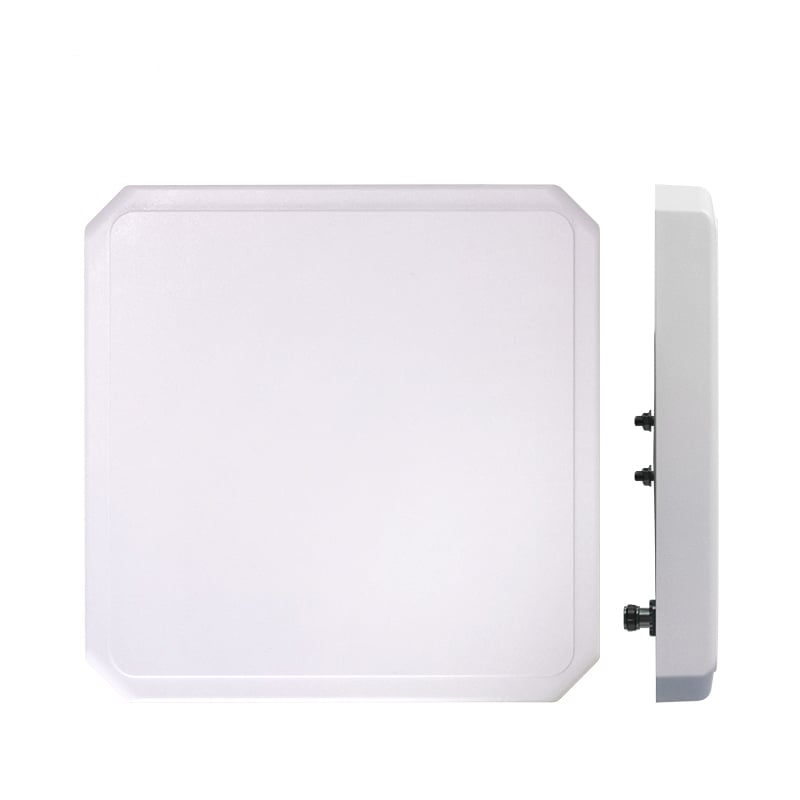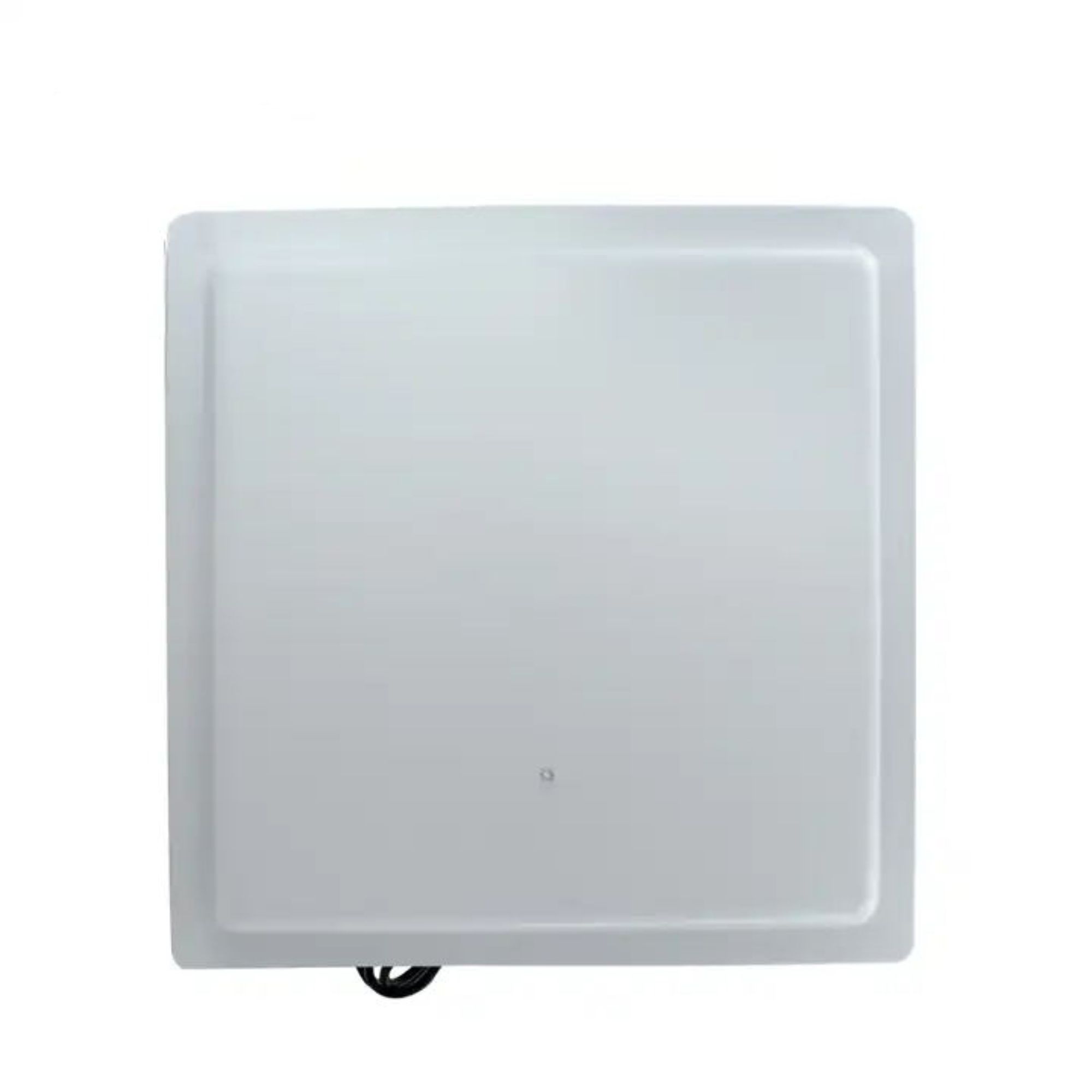

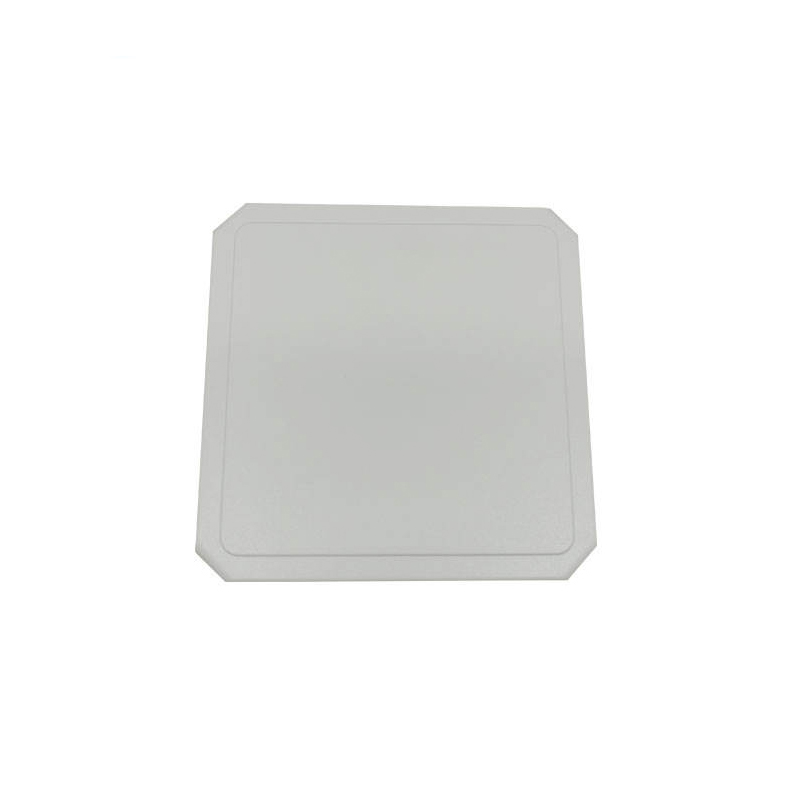
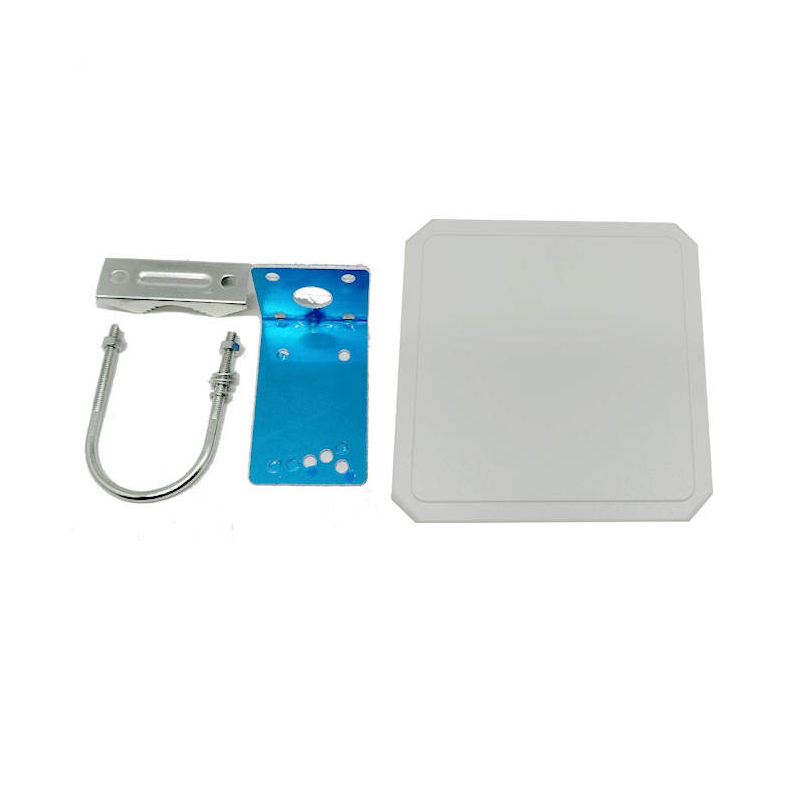
Six decibels is a deliberate middle. A small antenna sees a wide fan of tags and cannot tell you which one is where; a big one reaches further but needs aiming. This panel is the size that suits a dock door, a conveyor read point or a return counter: a beam about 2.3 m wide at 3 m, IP65, VSWR under 1.3, and the pole bracket in the box.
Published as 865–868 MHz or 902–928 MHz, 50 Ω, 100 W maximum input, −40 to +80 °C, aluminium reflector under a white ABS radome.
Coverage
Beamwidth is the number that decides whether this antenna suits your doorway. Published as 42° horizontal by 38° vertical, which converts to a rectangle at any distance: keep in mind that these are half-power widths, so a tag at the edge of the rectangle is being read with roughly half the power it would get on axis.
Vertical half-power width. The horizontal plane opens wider, 42°, because the aperture is wider than it is tall in the array.
| DISTANCE | WIDTH, 42° H | HEIGHT, 38° V | WHAT IT SUITS |
| 1 m | 0.77 m | 0.69 m | A single read point on a conveyor |
| 2 m | 1.54 m | 1.38 m | A return counter or a service desk |
| 3 m | 2.30 m | 2.07 m | Half a dock door |
| 5 m | 3.84 m | 3.45 m | A full dock door, a short rack aisle |
| 8 m | 6.15 m | 5.51 m | A small portal or a gate width |
| 10 m | 7.68 m | 6.89 m | Beyond this, look at the 12 dBi panel |
The choice that decides your tag orientation
| CIRCULAR, THIS ANTENNA | LINEAR | |
| Tag orientation | The tag can be facing any direction and still reads. Nothing to align at installation. | The tag has to be roughly parallel to the antenna's plane, or you lose the read. |
| Cost | About 3 dB against a linear tag — roughly a 30% shorter usable distance for the same power. | Full power to a correctly aligned tag, which is why fixed read points with a known tag orientation use linear. |
| Two of these antennas | Handedness must match: right-hand must meet right-hand, or the pair rejects most of the signal. | Two linear antennas must be aligned the same way, and they will not reject each other. |
| When to choose it | Any job where the tag might be stuck on at any angle. This is why portals, doors and handheld work use circular. | A conveyor or a print-and-apply station where the label always arrives the same way up. |
Specification
One reconciled set of figures. Where the datasheet, the bullet list and the label on the unit used to disagree, the page now states the figure we will ship to and tells you where to check it.
| PARAMETER | VALUE |
| ELECTRICAL | |
| Frequency | 865–868 MHz for Europe, 902–928 MHz for North America. Other bands on request. Confirm the tuning you are ordering, because the two are separate builds |
| Gain | 6 dBi |
| Horizontal beamwidth | 42° |
| Vertical beamwidth | 38° |
| Front-to-back ratio | ≥23 dB. Enough to mount near a wall, but leave about 80 mm — a quarter wavelength at 915 MHz — clear of metal behind the radome |
| VSWR | ≤1.3 |
| Impedance | 50 Ω |
| Maximum input power | 100 W |
| Polarisation | Circular |
| MECHANICAL | |
| Dimensions | 123 × 123 × 34.2 mm as published. Ask for the dimension drawing for your batch — see the note below |
| Reflector material | Aluminium |
| Radome | White ABS |
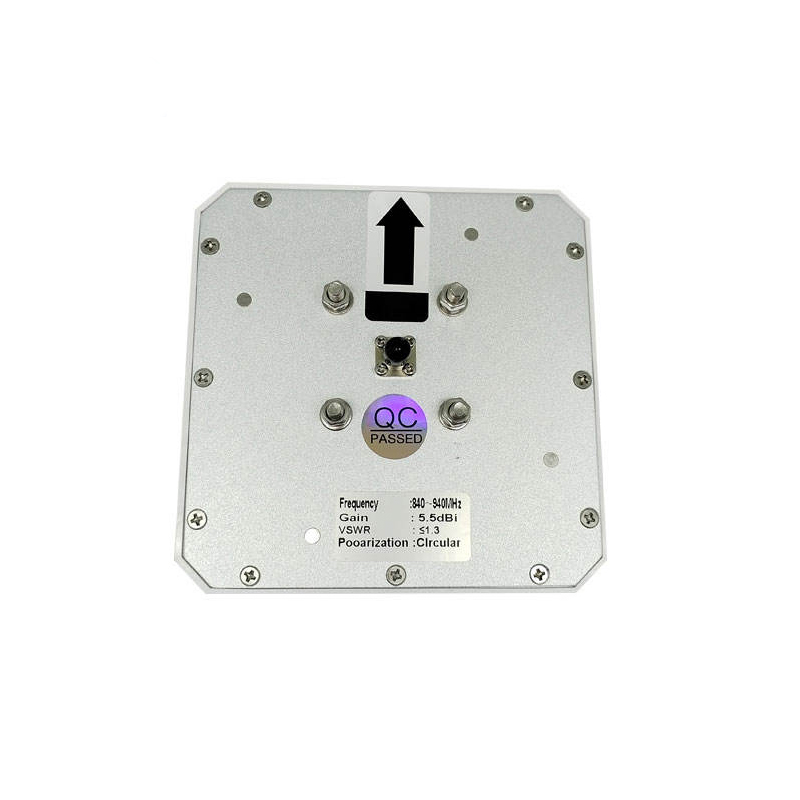
| Connector | N-type female on a 4-hole flange, as shown in the rear photograph. Confirm when ordering, because the mating cable depends on it |
| Mounting | U-bolt and steel bracket plate supplied. Fits a pole; the plate carries a slotted arm for adjustment |
| Rated wind velocity | 30 m/s, about 108 km/h |
| ENVIRONMENT AND PROTECTION | |
| Operating temperature | −40 °C to +80 °C |
| Sealing | IP65 — dust-tight and protected against water jets from any direction. |
| Lightning protection | Direct ground: the radiating element is connected to the reflector, so static bleeds to the mast through the bracket. This is not a substitute for a surge arrestor on the coax |
Installation
You get a stainless U-bolt, a steel bracket plate and a slotted arm, which is enough to clamp the antenna to a pole and angle it down toward the read zone.
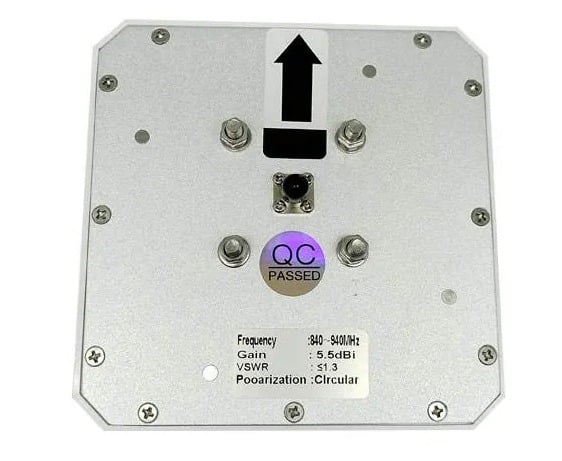
The rear face: the up arrow, four threaded studs for the bracket, and the connector socket. Note the arrow before you drill anything — a directional panel mounted upside down aims at the floor.
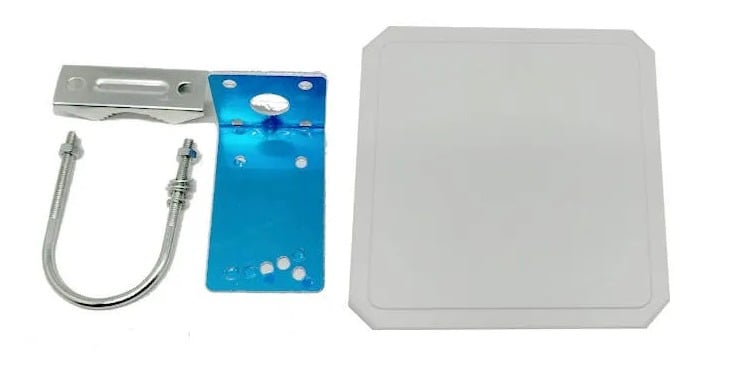
Antenna, U-bolt, bracket plate and slotted arm. The multiple hole patterns let you set the tilt before you tighten the U-bolt.
A directional panel with a 38° vertical beam is an aiming problem, not just a mounting problem.
Where it belongs
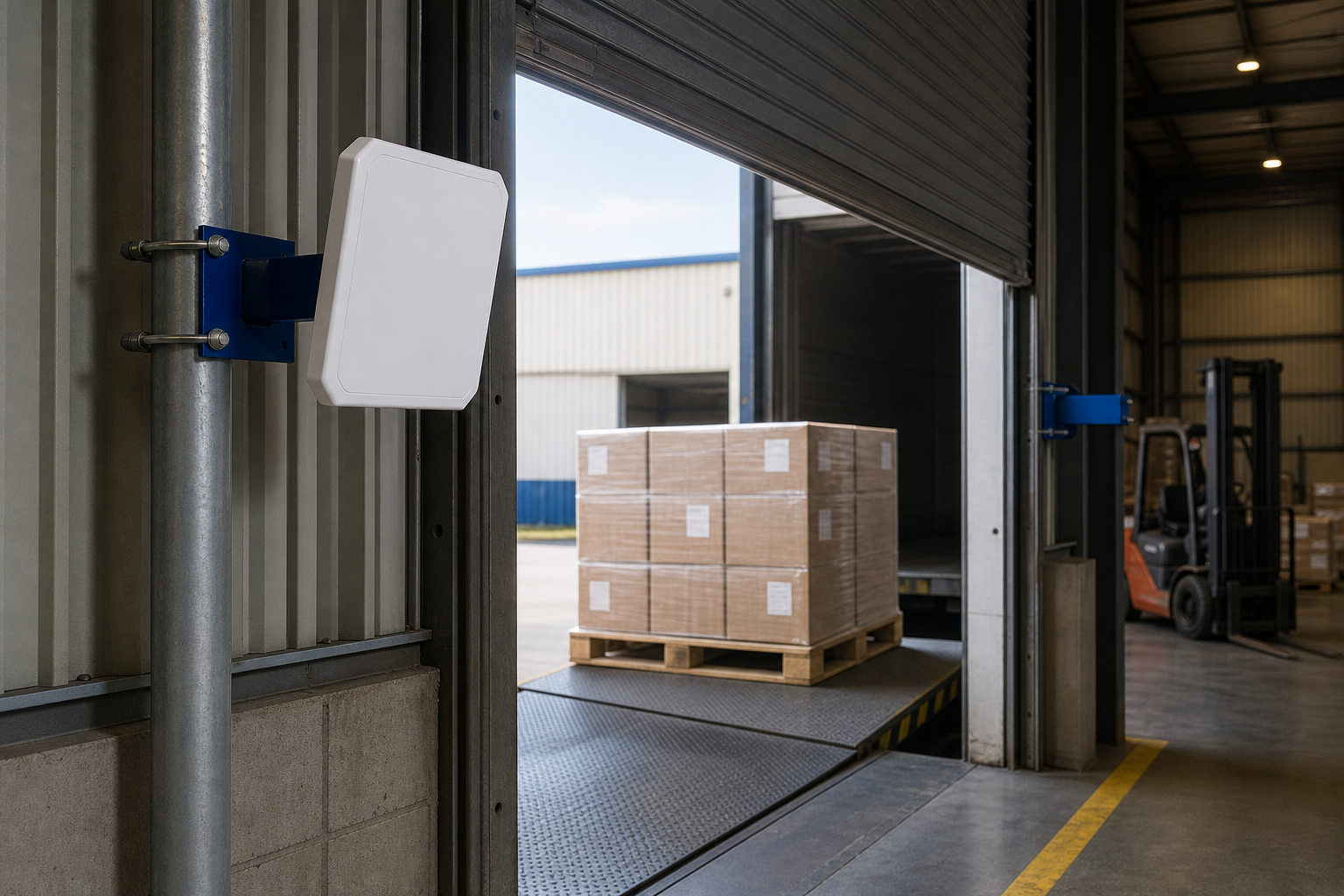
A dock door is the shape this antenna was sized for. Mount it on the frame, angle it across the opening, and every pallet that crosses the threshold passes through the beam. Add a second unit on the opposite frame if the door is wider than about 5 m — and ask us for matching hands, for the reason above.
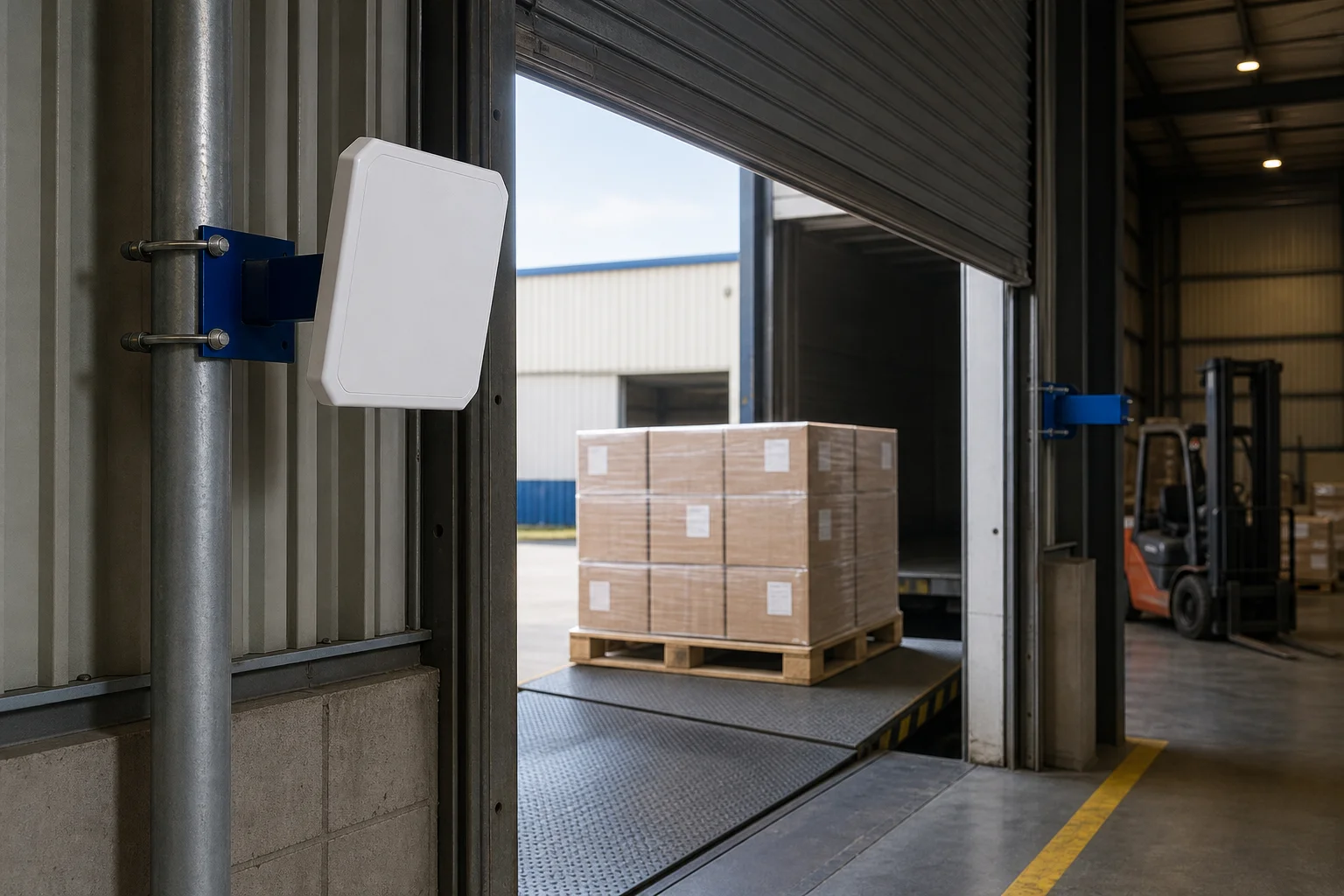
Frame-mounted at a dock door, angled down and across the opening. The bracket on the far side is where the second unit goes.
This is a passive antenna. It has no radio, no power supply, no network port and no software: it connects to a reader with a length of coax and does nothing on its own.
Fixed reader — RS232, RS485, Wiegand, RJ45, WiFi, 4G, 30 dBm output, an SDK and a 200-tag-per-second inventory algorithm. None of that lives in an antenna; it belongs to the reader that drives it. If that is what you need, tell us the read distance, the interface your system expects and the number of antennas per port, and we will quote the reader and the antenna together so the two are matched.
Questions we are asked
Beamwidth is not read range. The beam is about 2.3 m wide at 3 m and 7.7 m wide at 10 m, but how far a tag answers depends on the tag, the reader power, the cable loss and what the tag is attached to. A hard tag on a steel beam and a paper label on a box of liquid behave completely differently at the same distance. Tell us the tag and we will give you a realistic figure rather than the best case.
Circular.
Yes, and it is the normal way to build a portal — but ask us for matching handedness. Circular antennas are right-hand or left-hand, and a right-hand unit facing a left-hand unit rejects most of the signal between them. Two matching units cover the door from both sides properly.
865–868 MHz in Europe, 902–928 MHz in North America, and other bands on request. They are separate builds, not a switch, so state the country you are deploying in when you ask for a quote. Do not order on the assumption that one unit covers both.
The rear photograph shows an N-type female on a 4-hole flange, which is the standard for this class of panel. Confirm it on the quote, because it decides which coax jumper you buy, and the cable matters more than people expect: at these frequencies a thin cable can cost you several dB before the signal reaches the reader.
IP65 means dust-tight and protected against water jets, which covers rain and washdown on a sheltered mounting.
Yes if the antenna goes on a roof or a mast. The antenna is DC-grounded to its reflector, which bleeds static charge to the mast, but that is not surge protection. Fit an arrestor at the point where the coax enters the building, and bond the mast.
Antenna, stainless U-bolt, steel bracket plate and slotted arm. To quote: the country and band, how many units and whether they will be used as a pair, the pole diameter, the cable length to the reader, and the tag you intend to read.
Copyright © ©Copyright 2024 Greatest IoT Technology Co., Ltd all rights reserved - Privacy policy