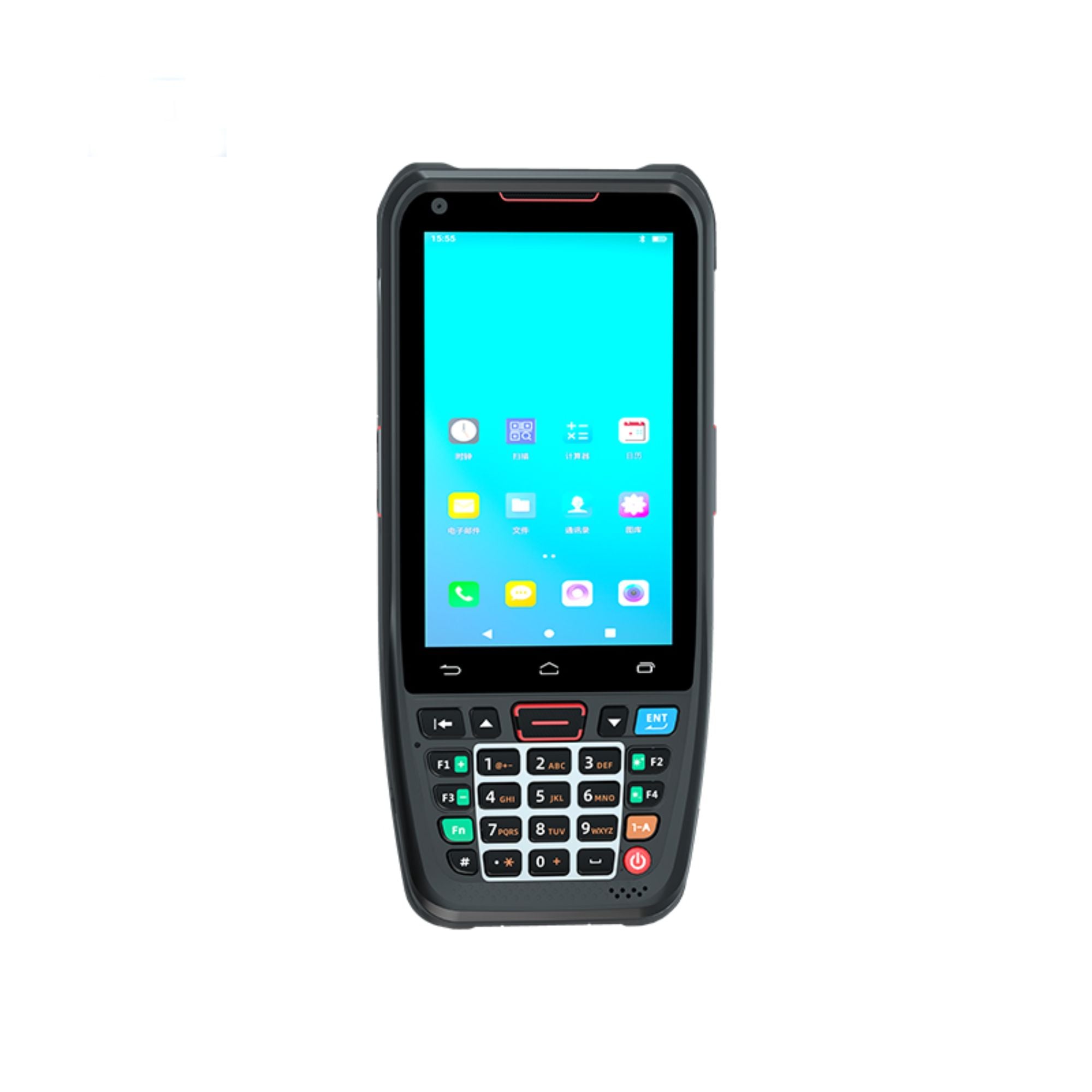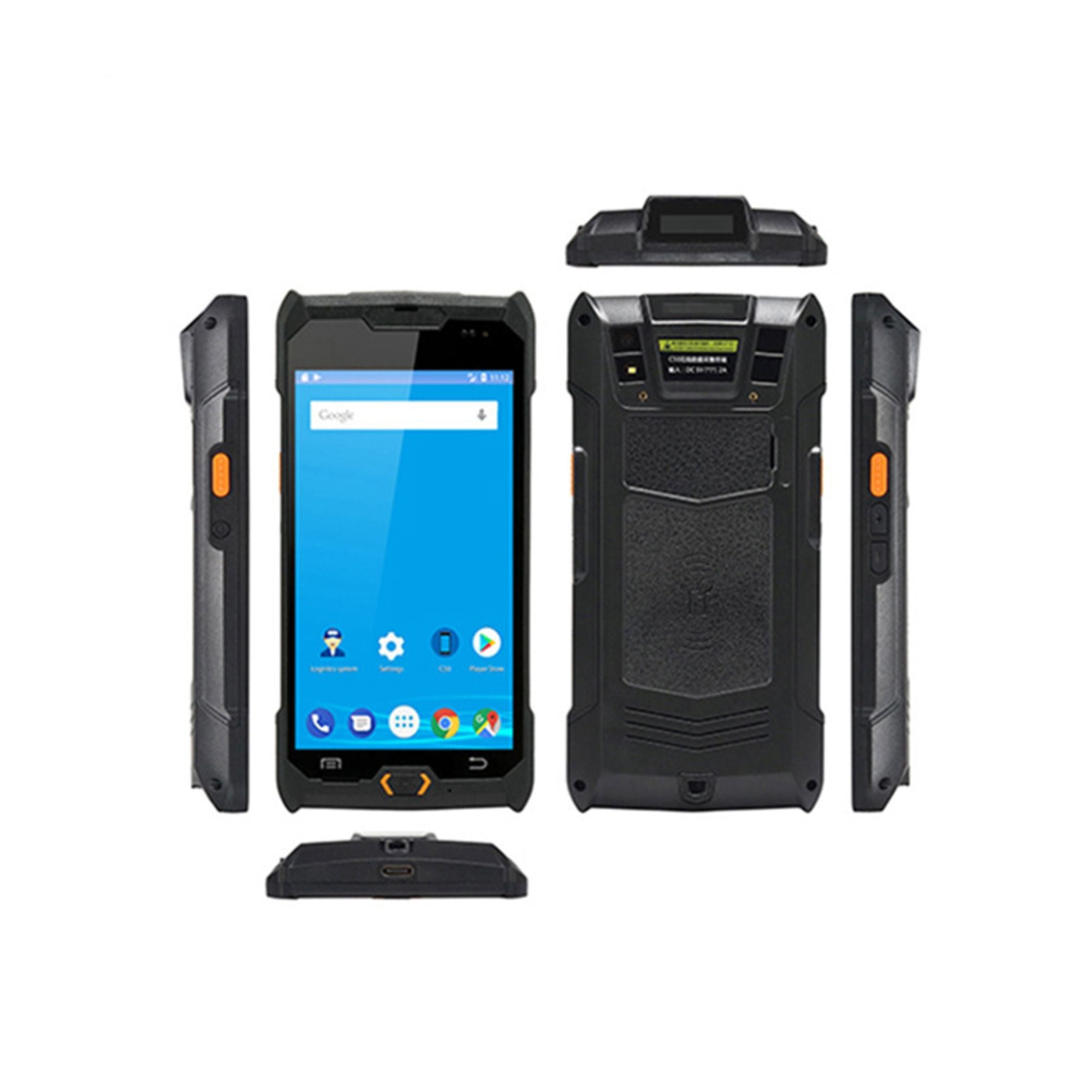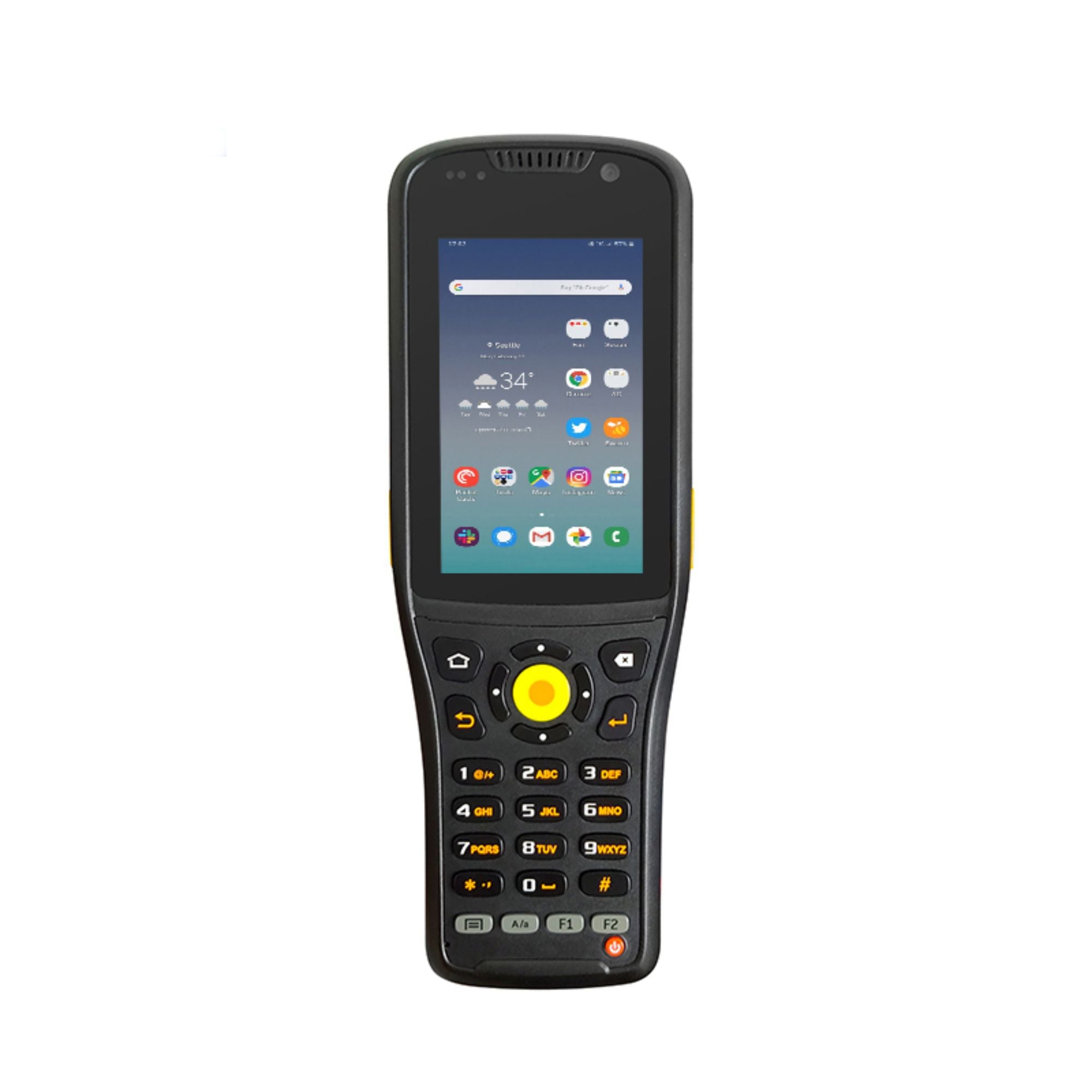

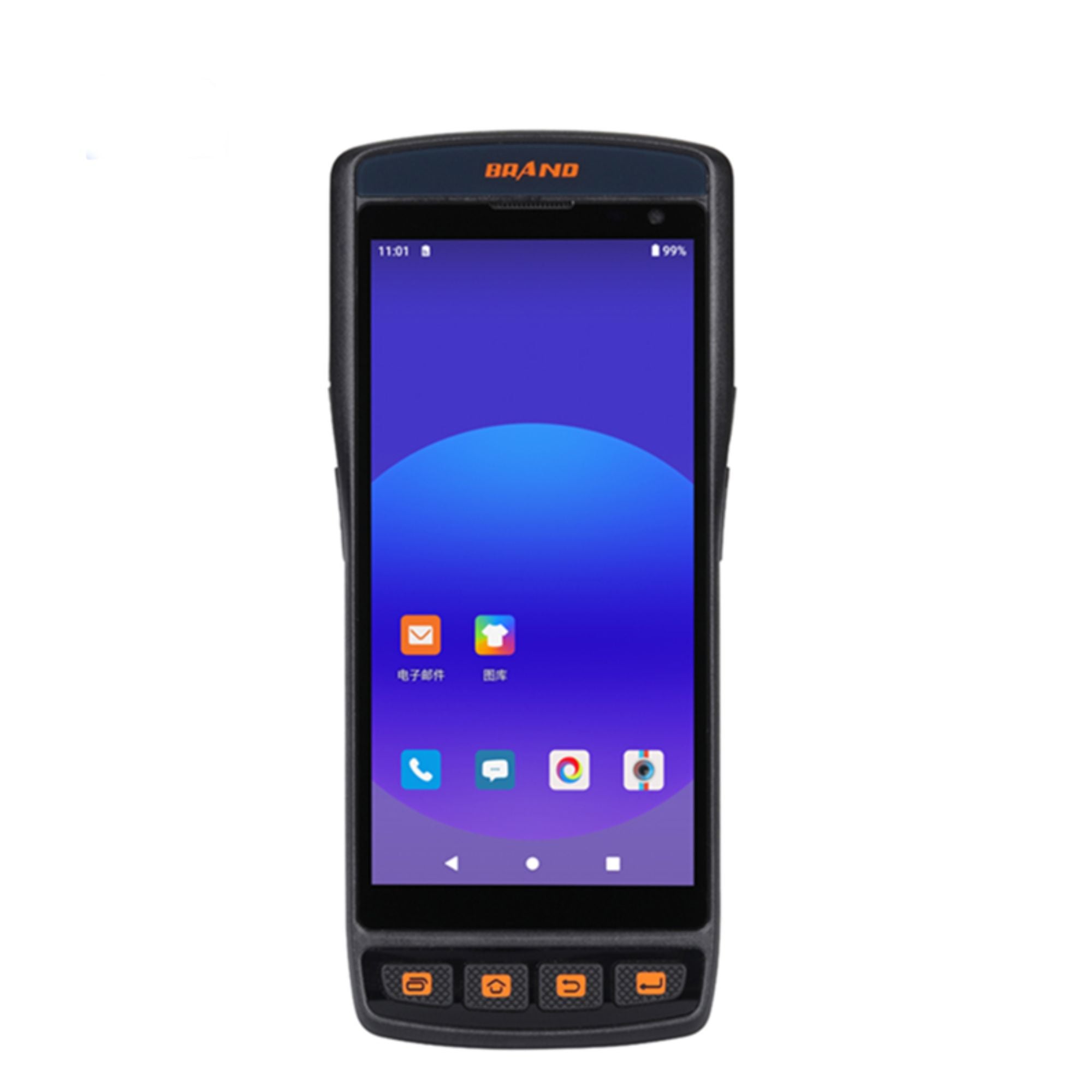
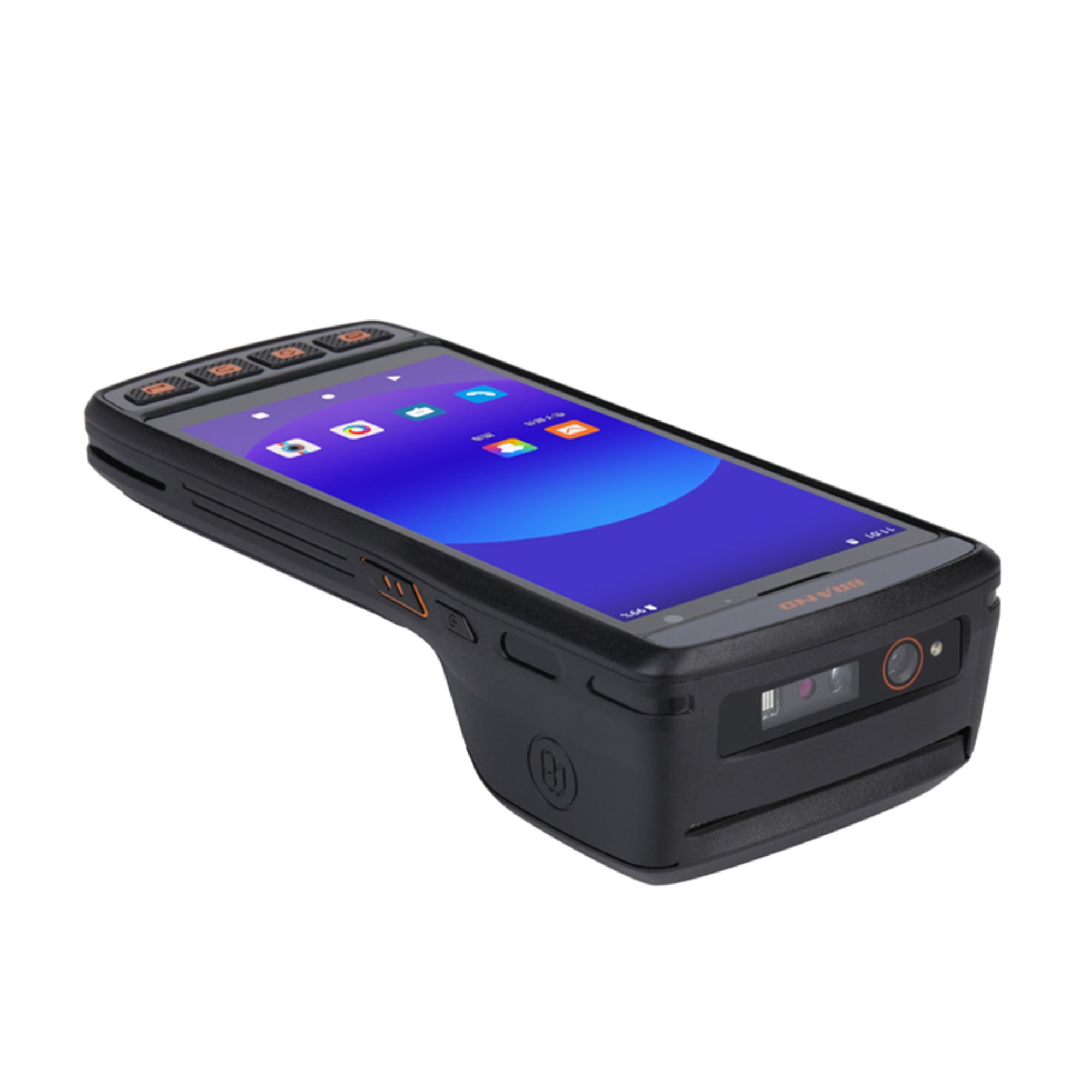
A label printer and a PDA in one hand, so the label gets printed where the work happens.
Most label jobs are done with a handheld and a separate Bluetooth printer: two devices, two batteries, a pairing that fails at the worst moment and a second thing to carry up a ladder. The V800 puts a 58 mm thermal printer in the top of the handheld. 48 mm of print width at 203 dpi, 70 mm per second, sticker or black-mark label stock.
Underneath it is a full Android 11 terminal: a 5.5 in 720 × 1440 screen, an octa-core 2.0 GHz platform, 3 GB + 32 GB (4 + 64 optional), a removable 7.6 V battery rated to more than 13 hours of work, Bluetooth 5.0, dual-band Wi-Fi, 4G with North American bands, and IP65 with 1.2 m drops onto cement on all six faces.
The printer
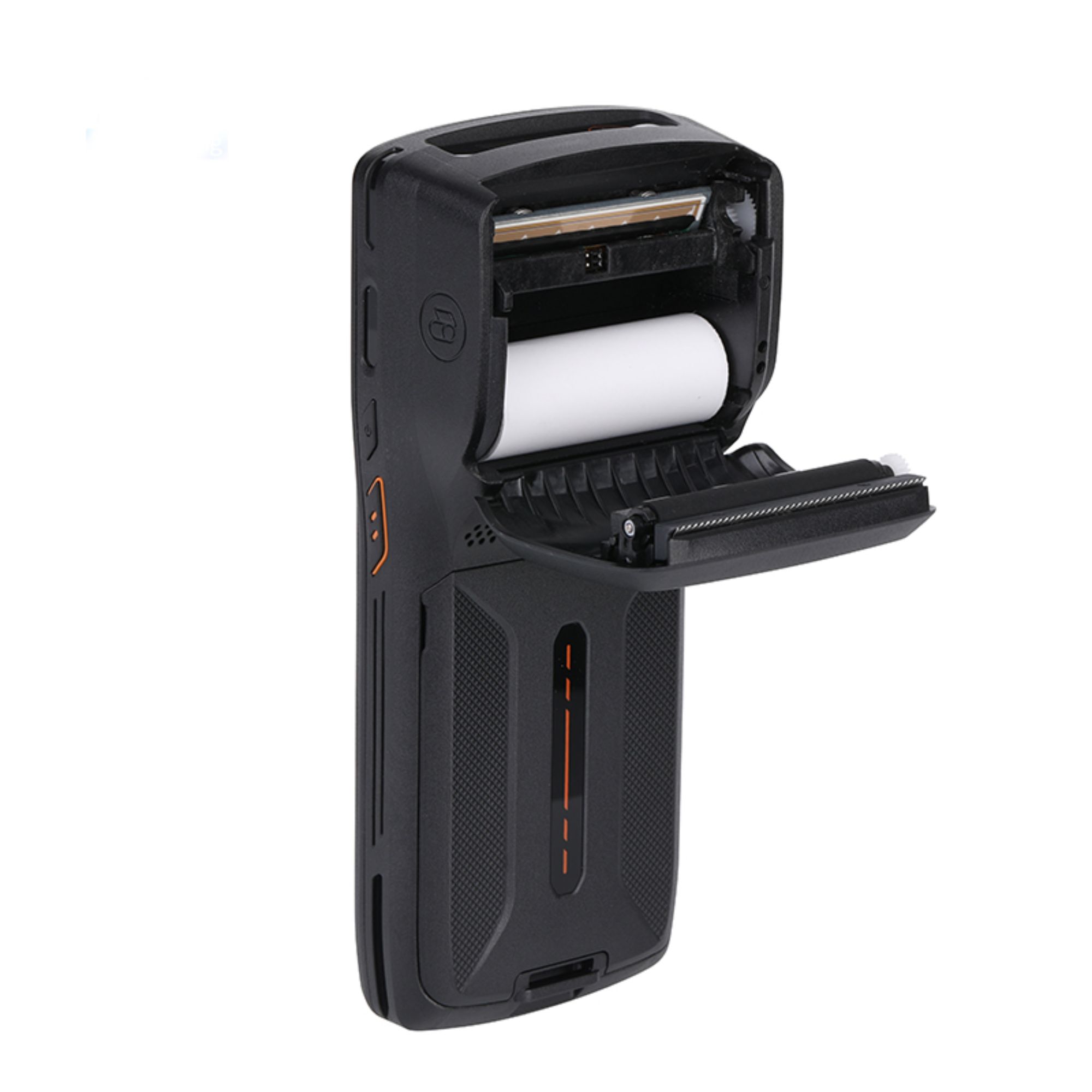
The printer takes standard 58 mm label or receipt stock, and the print head is 384 dots wide. At 203 dpi that is 48 mm of printed width, with 5 mm of margin on each side that stays blank. If your label design assumes 58 mm of usable width, it will not fit.
Paper width and print width are different numbers, and only one of them fits in your label template.
The paper door open. A 58 mm roll drops in and the door forms the tear bar, so a roll change is a few seconds and needs no tools.
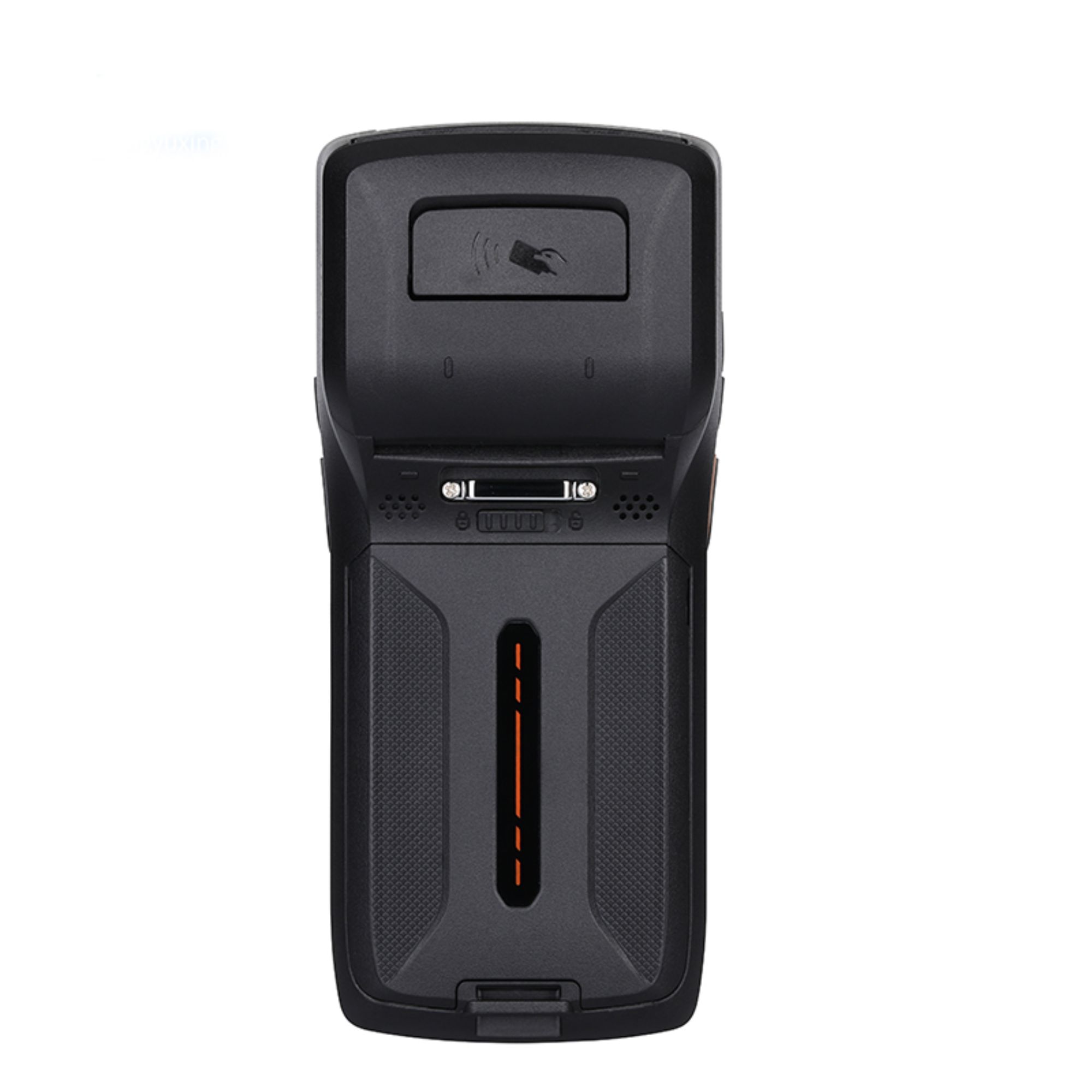
The print exits at the top of the back face, away from your hand, so a label can be peeled with the other hand while the device stays in the same grip.
Size
The datasheet gives 177 × 72.5 × 21.5 mm and then adds “44.5 mm(the printing part)”. Those are two different thicknesses: 21.5 mm where you hold it, and 44.5 mm at the printer end. A holster, a belt clip or a vehicle cradle has to clear the second one.
Power
This one gives capacity, voltage, a runtime in hours, a standby figure and a charge time, and the two capacity figures offered are the same battery described two ways — which they check out as.
| PUBLISHED | WHAT IT MEANS | |
| Battery | 7.6 V 3,000 mAh, removable | 22.8 Wh. The datasheet also quotes it as 3.8 V 6,000 mAh, which is the same energy — 7.6 × 3 = 3.8 × 6. |
| Working time | More than 13 hours | A full shift with hours to spare. |
| Standby | More than 360 hours | About 15 days. Relevant if the devices live in a drawer between jobs |
| Charging | 3 to 4 hours with the standard adapter | Overnight, or a shift change with a spare. Ask for the adapter rating, because 3 hours implies a quick charger rather than a 5 V 1 A phone brick |
The comparison that matters
Almost every label job is done today with two devices. It works, and it is worth being honest about what it costs, because the V800 only makes sense if the second column below is a real annoyance in your operation.
| HANDHELD + BLUETOOTH PRINTER | V800, ONE DEVICE | |
| To carry | Two devices, two batteries, two chargers | One device, one battery, one charger |
| To pair | A Bluetooth link that has to be re-established when one of them sleeps or runs flat | No pairing. The print job is local |
| When it fails | Two vendors to call, and each will blame the other | One part number, one warranty |
| Print speed | Usually faster, and better print quality on a dedicated unit | 70 mm/s at 203 dpi. Adequate for labels and receipts, not for volume ticket runs |
| Roll size | Often 50 mm or more of stock, longer runs between changes | 58 mm paper, 35 mm roll — a small roll, changed more often |
| Choose it when | You print long runs, wide labels or high-resolution graphics | You print a label where the work happens, a few at a time |
User environment
1.2 metres onto a cement floor, on all six faces, across the operating temperature range. That is a real test and it is stated properly — including the part most datasheets leave out, which is that the six sides were each tested.
| TEST | PUBLISHED | READ IT LIKE THIS |
| Drop | 1.2 m to a cement floor, six sides, within the operating temperature range | A working drop from waist height onto concrete. It is not a 2 m rating, so do not plan on shoulder-height drops |
| Roll | 1,000 times from 0.5 m, six sides | The test that finds cracked keypads and loose connectors, which a single drop misses |
| Sealing | IP65 | Dust-tight and jet-resistant. Not immersion rated |
| Operating temperature | −20 to +55 °C | Covers a chilled aisle and a hot loading bay. Not a blast freezer |
| Storage temperature | −40 to +70 °C | Wider, for a device left in a van over a weekend |
| Humidity | 5% to 95%, non-condensing | Standard. Condensation is the thing to avoid, so let a cold device reach room temperature before charging it |
Data capture
The scanner is optional and there are three engines to choose from, which is worth knowing before you compare prices. The two radio options are different products: NFC is a general 13.56 MHz reader, and the ID card option reads Chinese national identity cards.
| WHAT IT IS | NOTE | |
| 2D barcode scanner | Optional. MinDe 660, Honeywell N5703 or Zebra SE4710 | Three engines, three price points. The engine decides how small a code you can read and how far away |
| NFC and HF | Optional. 13.56 MHz, ISO14443A/B, ISO15693, 2–5 cm | A badge, a checkpoint, an asset tag you tap. The general-purpose radio |
| ID card reader | Optional. ISO/IEC 14443 type B with GA450-2003, 0–5 cm, under 1.55 s | GA450-2003 is a Chinese public security standard for second generation resident ID cards. It is a domestic-market module, not a general card reader |
| UHF RFID | No | No UHF radio in this device. For EPC labels and UHF tags, a UHF handheld is a different product |
Wireless
The V800 publishes FDD-LTE B4, B12 and B17 alongside the European set, which covers AT&T and T-Mobile in the United States in most areas. Verizon’s band 13 is not there, and there is no band 2 or 66, so coverage is partial rather than complete.
| SUPPORTED | NOTE | |
| Wi-Fi | Dual band 2.4 and 5 GHz, 802.11ac | That is Wi-Fi 5, and it is stated as ac rather than dressed up as Wi-Fi 6 |
| Bluetooth | 5.0 with BLE, 5–10 m | It pairs with ring scanners and belt printers |
| Cellular | GSM 850/900/1800/1900 · WCDMA 850/900/1900/2100 · LTE FDD B1/3/4/5/7/8/12/17/20 · TDD B38/39/40/41 | Europe, China and most of the US carrier set. Ask us to confirm against your operator before a fleet order |
| GNSS | GPS, Galileo, GLONASS, BeiDou | Four constellations. Fine for vehicle and asset location, not a survey instrument |
Specification
| PARAMETER | VALUE |
| PHYSICAL | |
| Dimensions | 177 mm long × 72.5 mm wide. 21.5 mm thick at the body, 44.5 mm at the printer end |
| Weight | Under 400 g |
| Display | 5.5 in IPS, 720 × 1440, about 293 ppi |
| Keys | Silicone: power, volume up and down, two scan keys |
| Sensors | Gravity, light, proximity, vibration motor |
| Expansion | 2 × Nano SIM, 1 × TF to 256 GB, 2 × PSAM optional |
| Interfaces | USB Type-C with OTG |
| PLATFORM | |
| Operating system | Android 11 |
| CPU | Octa-core 2.0 GHz |
| Memory | 3 GB + 32 GB standard; 4 GB + 64 GB optional |
| PRINTER (STANDARD) | |
| Print method | Thermal, direct |
| Paper width | 58 mm |
| Print width | 48 mm, from a 384 dot head. About 203 dpi |
| Print speed | 70 mm per second |
| Paper roll | Up to 35 mm diameter |
| Media | Sticker and label stock, black-mark printing supported. No cutter; labels are torn and peeled by hand |
| POWER | |
| Battery | Removable 7.6 V 3,000 mAh, 22.8 Wh. Also quoted as 3.8 V 6,000 mAh, the same energy |
| Working time | More than 13 hours |
| Standby | More than 360 hours |
| Charging | 3 to 4 hours with the standard adapter |
| USER ENVIRONMENT | |
| Drop | 1.2 m onto a cement floor, six sides, across the operating temperature range |
| Roll | 1,000 times from 0.5 m, six sides |
| Sealing | IP65 |
| Operating temperature | −20 to +55 °C |
| Storage temperature | −40 to +70 °C |
| Humidity | 5% to 95%, non-condensing |
| DATA CAPTURE | |
| 2D scanner | Optional. MinDe 660, Honeywell N5703 or Zebra SE4710 |
| Camera | Rear 13 MP autofocus with flash, anti-shake and macro. Front 8 MP optional |
| ID card reader | Optional. ISO/IEC 14443 type B with GA450-2003, 0–5 cm, under 1.55 s. This is a Chinese second generation ID card module |
| NFC and HF | Optional. 13.56 MHz, ISO14443A/B, ISO15693, NFC, 2–5 cm |
| UHF RFID | Not fitted in this device |
| WIRELESS | |
| Wi-Fi | Dual band 2.4 and 5 GHz, 802.11a/b/g/n/ac |
| Bluetooth | 5.0 with BLE, 5–10 m |
| Cellular | GSM 850/900/1800/1900; WCDMA 850/900/1900/2100; LTE FDD B1/3/4/5/7/8/12/17/20; TDD B38/39/40/41 |
| GNSS | GPS, Galileo, GLONASS, BeiDou |
| IN THE BOX AND NOT STATED | |
| Accessories | Adapter, data cable, protective film, manual and certificate |
Where it belongs
Two jobs where carrying a printer rather than walking back to one changes the day: a field engineer leaving a label on what he just tested, and a shop assistant repricing a shelf without a trip to the back office.
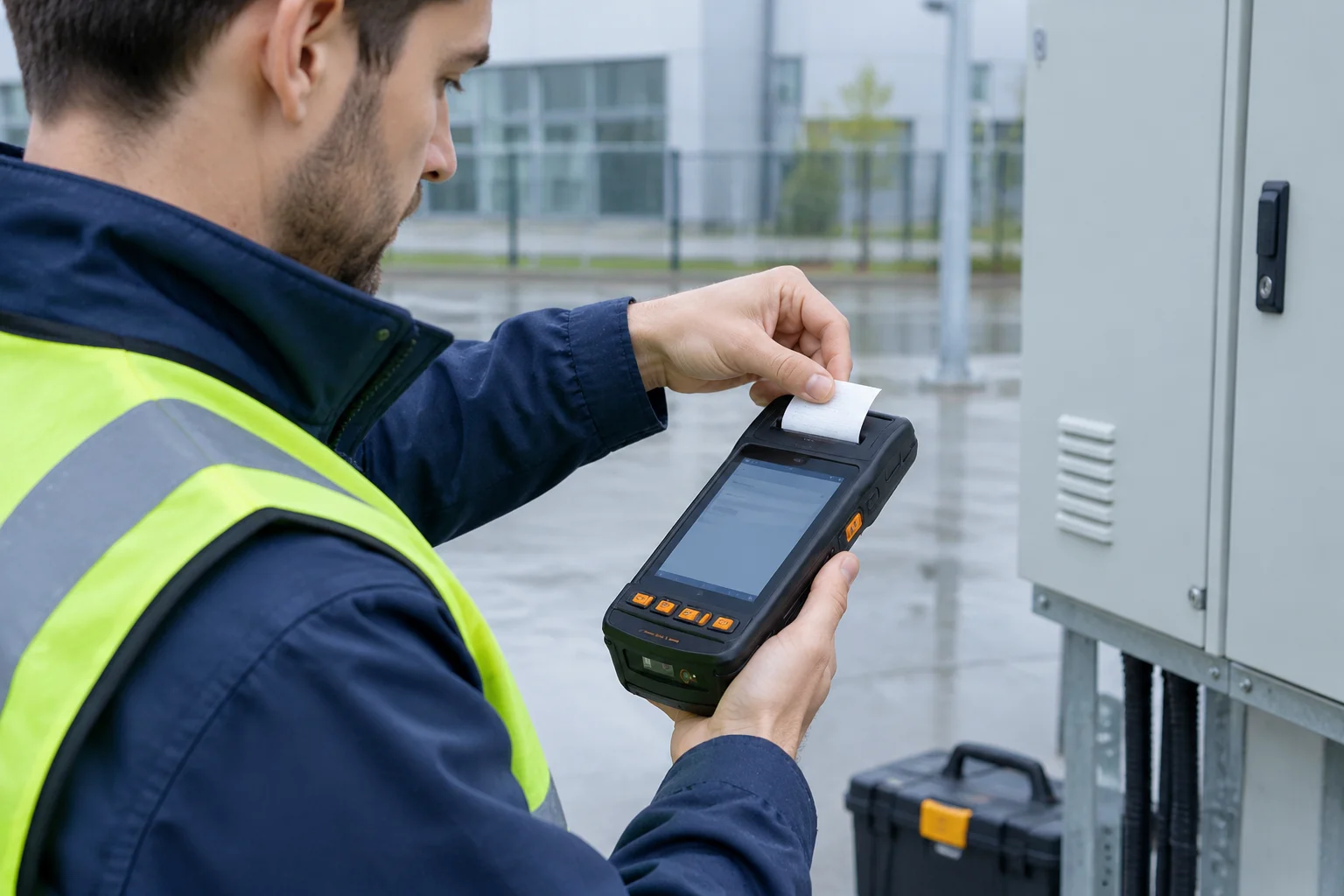
Field work: the label is printed and applied in the same minute as the inspection, so the record is on the equipment rather than in a notebook.
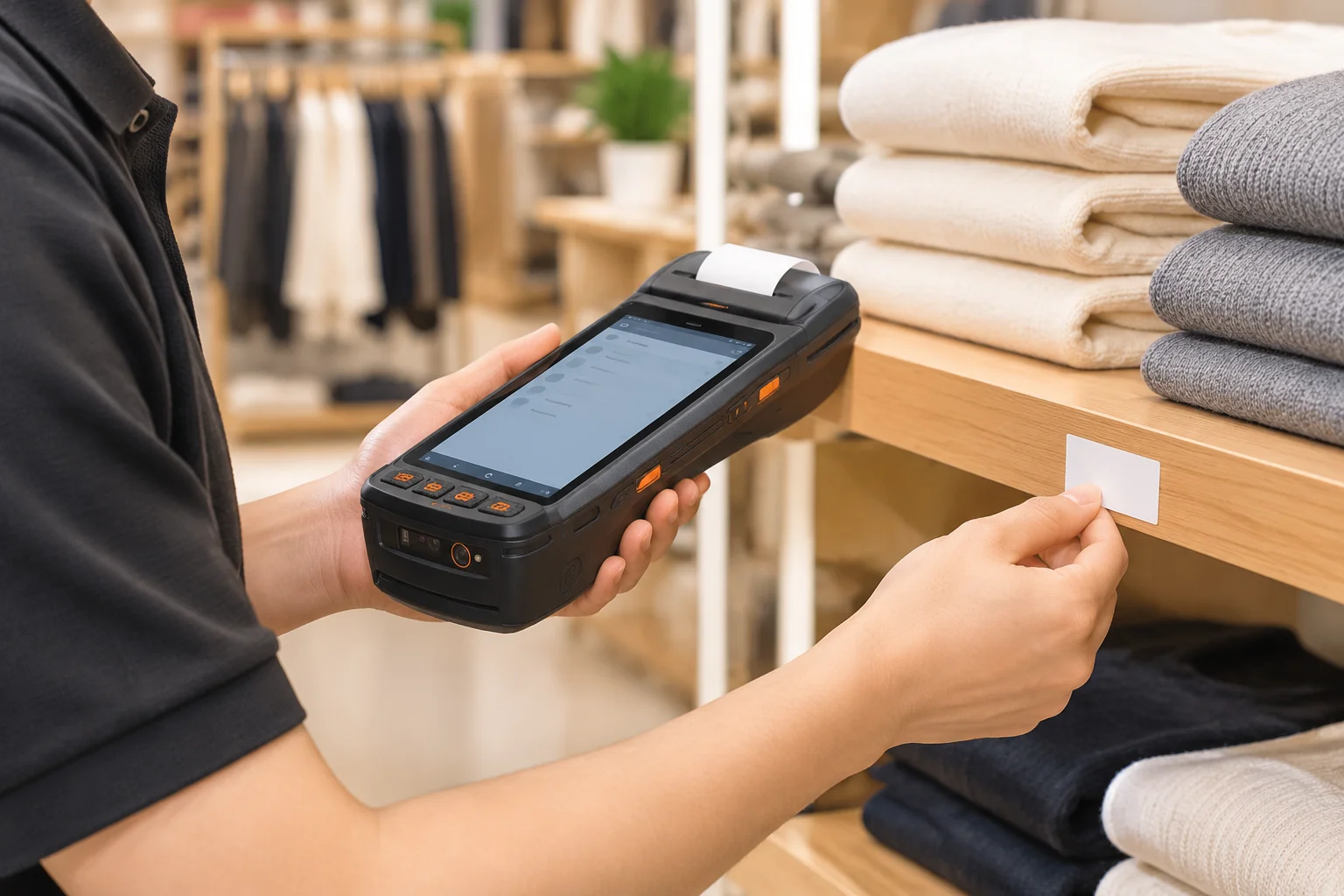
Retail: a markdown label printed at the shelf, one at a time, instead of a batch run and a walk back to the printer.
Questions we are asked
It takes 58 mm roll stock and prints 48 mm wide, at 203 dpi and 70 mm per second. The 10 mm difference is margin: 5 mm on each side stays blank. Design your label template to 48 mm, not 58 mm, and allow for a roll no larger than 35 mm in diameter.
Both.Sticker and label stock with black-mark printing supported. Note there is no cutter, so labels are torn at the bar and peeled by hand, which is normal for this class but worth knowing if you expected automatic dispensing.
More than 13 hours of working time and more than 360 hours of standby, from a removable 7.6 V 3,000 mAh pack — 22.8 Wh. Charging is 3 to 4 hours with the standard adapter. Ask for the runtime with the printer working at your duty cycle, because printing is the largest load on this device.
Under 400 g, 177 mm long and 72.5 mm wide. The body is 21.5 mm thick and the printer end is 44.5 mm, so the part that decides your holster or cradle is the printer end, not the body.
It reads 13.56 MHz NFC and HF cards on ISO14443A/B and ISO15693 if the NFC option is fitted, and it scans 1D and 2D barcodes with one of the three optional engines. It has no UHF radio, so it will not read EPC labels or UHF tags.
Europe and China are covered in full. For North America the LTE set includes B4, B12 and B17, which is the AT&T and T-Mobile set in most areas, but not band 13 or band 66, so coverage is partial. Send us the country and the carrier and we will confirm in writing before a fleet order.
The scanner engine, whether you want NFC or the ID card reader, the memory option, the country and carrier, the label size and stock type, and how many labels an operator prints in a shift. That last number decides whether this device is right or whether a separate printer is.
Copyright © ©Copyright 2024 Greatest IoT Technology Co., Ltd all rights reserved - Privacy policy