
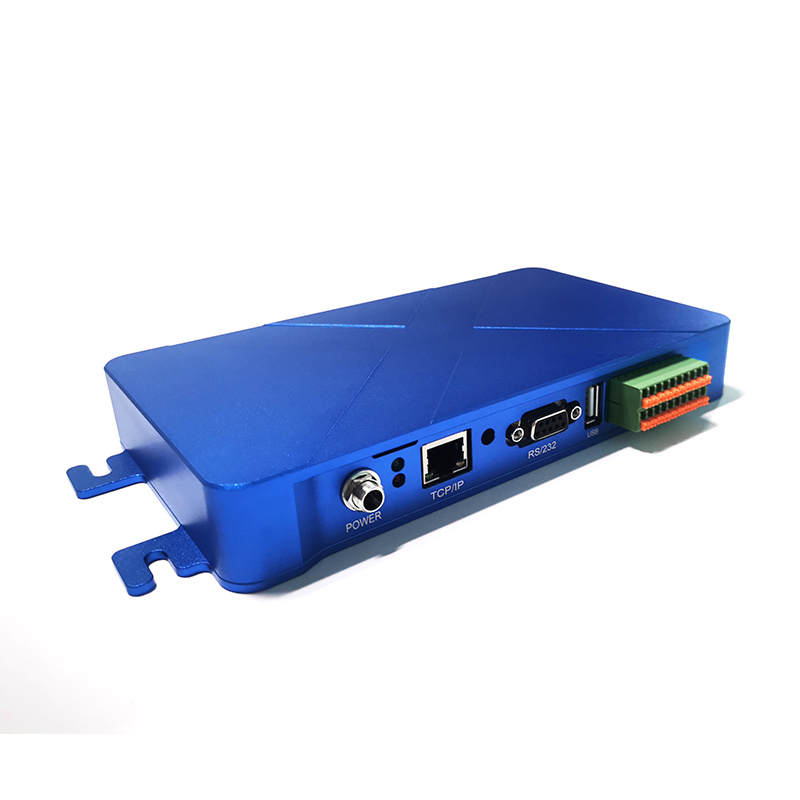
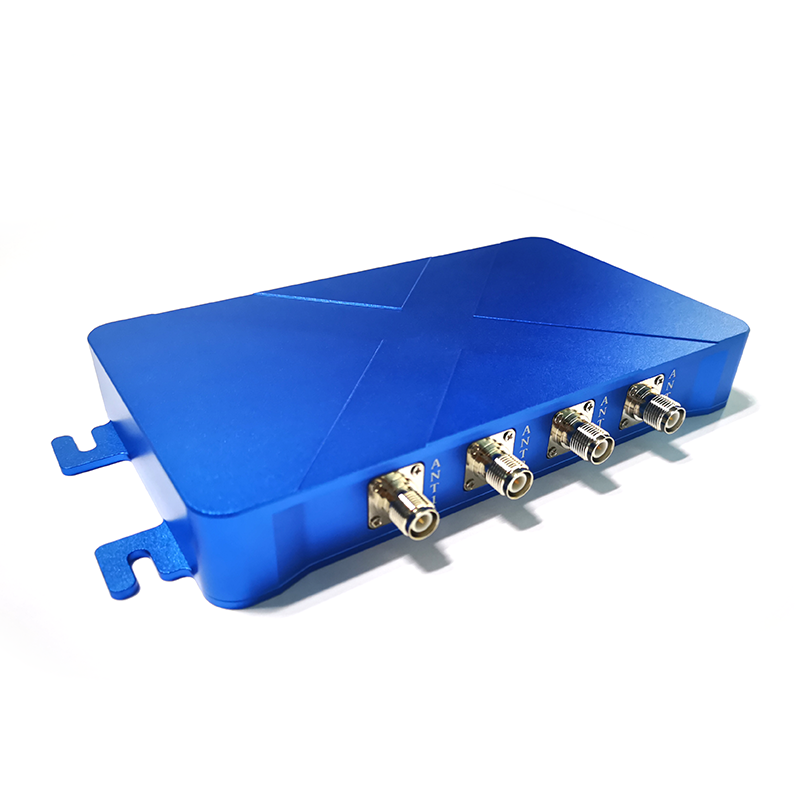
Four ports, one box on the wall, four read zones on one IP address.
The DR-E7004 is a compact industrial fixed reader built on the Impinj E710, in a blue die-cast aluminium body with four flat mounting ears. Four TNC antenna ports at up to 33 dBm mean one device can cover a dock door, a conveyor and two shelf ends without four readers to power, cable and address. 900 tags per second, 30 m on an 8 dBi antenna at 30 dBm, and four isolated inputs alongside outputs that can drive an alarm directly.
Network and serial together: TCP/IP, RS232 and USB on the panel, with Modbus, MQTT, HTTP and TCP on top, optional Wi-Fi, 4G and PoE, and a supply input that accepts 9 to 24 V. Rated −25 to +65 °C.
Interfaces
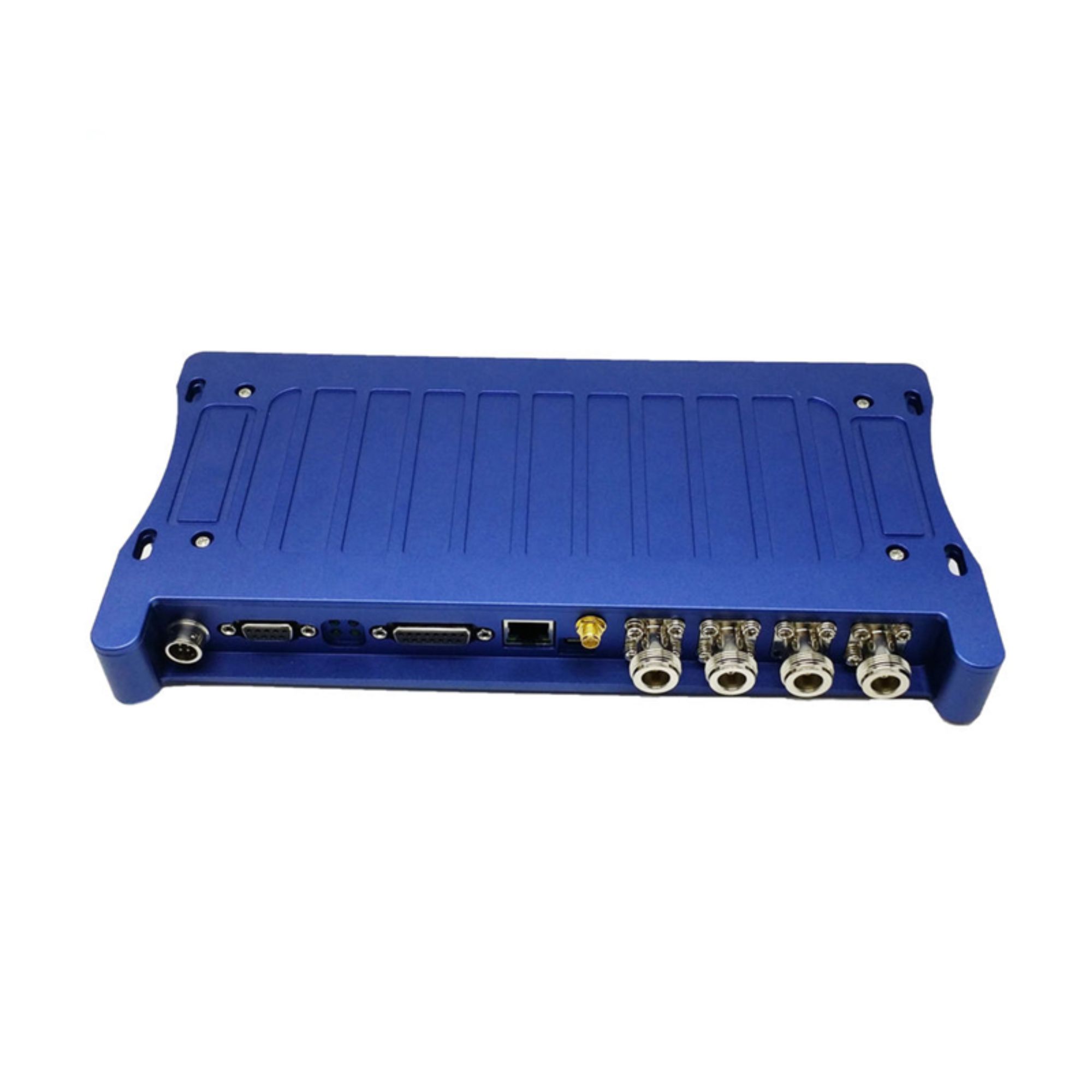
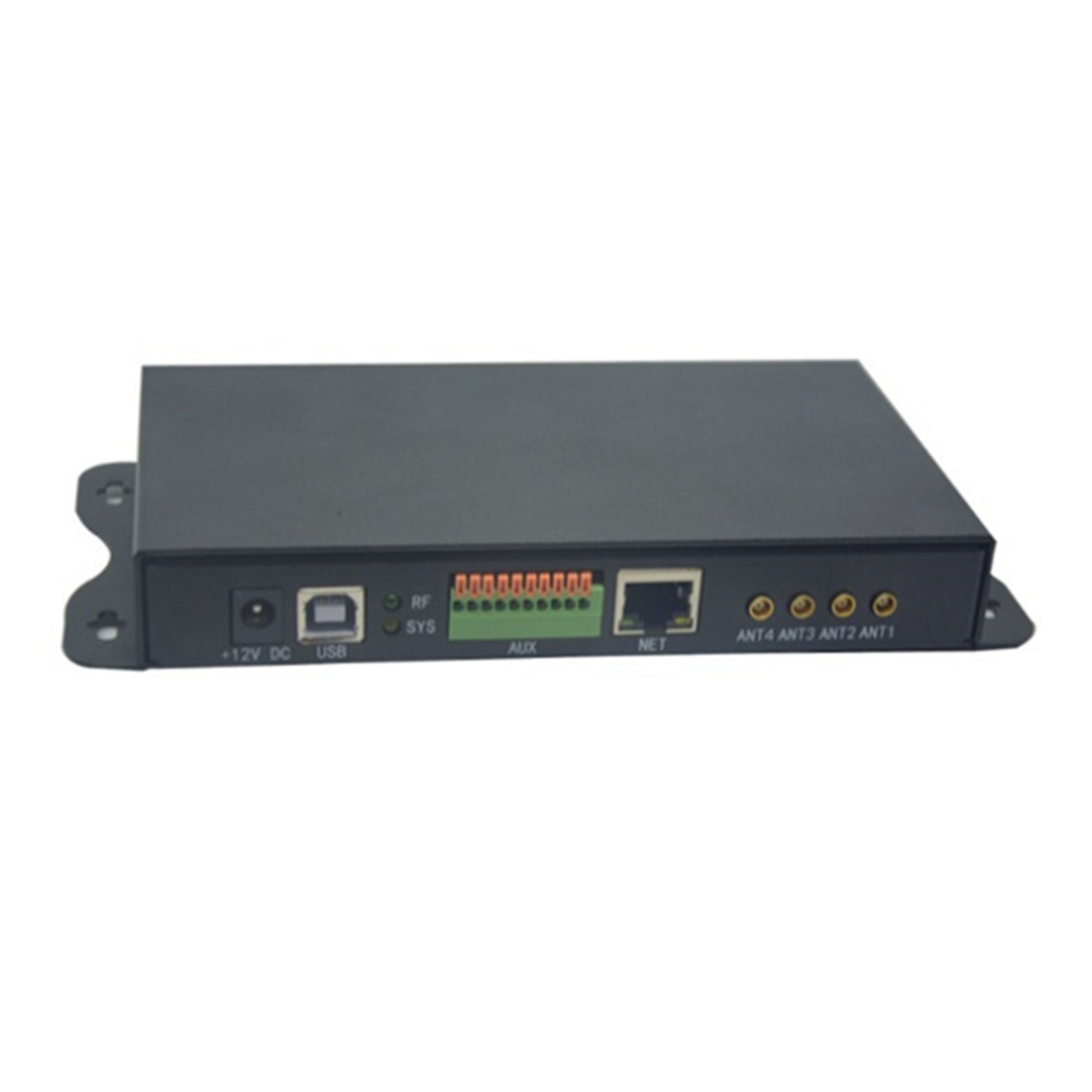
Every connection on the device is on one edge, printed with its function, and the four antenna ports sit on the opposite edge so the coax leaves away from the data cables.
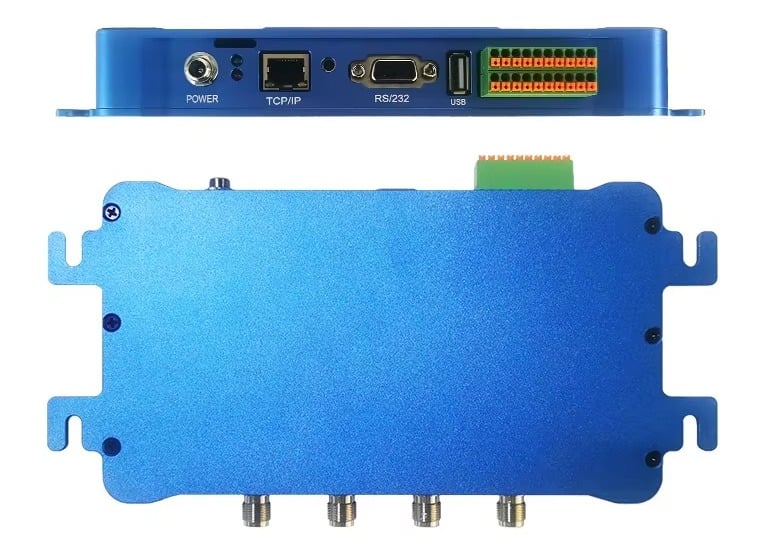
POWER, TCP/IP, RS/232, USB and the terminal block, printed on the casing. The same photograph shows the four antenna ports along the opposite edge.
| PRINTED ON THE PANEL | WHAT IT IS | WHAT IT MEANS FOR YOUR INSTALL |
| POWER | Round locking supply jack | A locking jack does not pull out when someone trips on the cable, which is worth more than it sounds on a dock door |
| Two LEDs | Power and status | Status only. There is no per-port or per-tag indicator, so on a four-port install you cannot see which antenna is reading from the box |
| TCP/IP | RJ45, 10/100 Mbps | 100 Mbps, not gigabit. Ample for tag events, relevant if you also move images or logs over the same link |
| RS/232 | DB9, 9600 to 230400 bps | The retrofit interface: a PLC or a legacy terminal that has no Ethernet |
| USB | USB Type-B device port | Configuration and a direct link. Not a host port, so no keyboard or memory stick |
| GPIO terminal | 16-way, two rows, lever terminals | Four isolated inputs and four outputs in one pluggable block, so nothing has to be soldered |
Antenna ports
The four antenna sockets sit along the opposite edge from the data connectors, each on its own four-hole flange and each moulded with its port number. That matters in the field: when a read zone stops working you know which cable to chase without a manual.
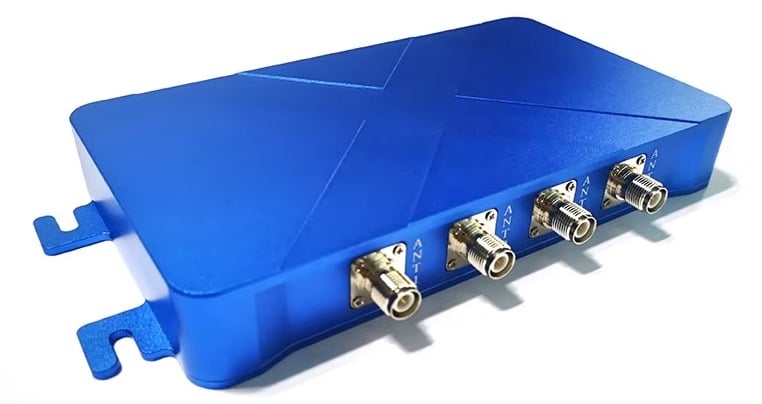
TNC female, four-hole flange, marked ANT1 to ANT4. The flanges are screwed to the casting, so a damaged socket is replaceable without scrapping the reader.
| JOB | ANTENNA TO USE | WHY |
| A dock door or a gate | A 9 dBi panel on the frame, or two of them facing each other | A 70° beam covers the opening without precise aim, and 25 dB of front-to-back ratio ignores the rack behind it |
| A single conveyor point | A 6 dBi panel close to the belt | A narrow beam on a short throw keeps the reader from counting the pallet two bays away |
| A long aisle or a yard | A 12 dBi panel | Same power, concentrated: a tighter pattern and a longer throw, at the cost of aiming it properly |
| Inside a printer or a handheld you build | A ceramic patch on a pigtail | No enclosure, no bracket. It is a component, and the range is metres at best |
Read range
Most fixed-reader pages quote a distance and leave you to guess what it was measured with. This datasheet gives the antenna gain and the output power alongside the figure.
| PUBLISHED | WHAT IT MEANS | |
| Test conditions | 8 dBi antenna at 30 dBm | Three decibels below the reader's maximum. At 33 dBm both figures improve by about 40%, because range scales with the square root of power |
| Read | 30 m | Achievable in free space with a sensitive tag. Indoors, a rack, a wall or a full pallet will cut it, and a tag on a liquid container will cut it a great deal |
| Write | 8 m | Writing needs a stronger field than reading, so the shorter number is the honest one. Ask for the same figure at 33 dBm if you plan to encode on the line |
| Tags per second | 900 | An air-interface rate under ideal conditions. Real throughput depends on how many tags are inside the beam at once and how long each one needs |
Inputs and outputs
| SIGNAL | PUBLISHED | TYPICAL USE |
| 4 inputs | Isolated GPI | A door contact, a presence sensor or a conveyor position switch, so the reader only reads when something is there |
| 3 outputs | Relay contacts | Drive an alarm beacon, a barrier or a reject arm directly |
| 1 output | Non-relay output | A logic-level signal to a PLC or a controller |
Network and power
TCP/IP, RS232 and USB are all on the panel at the same time, which is why this reader suits a retrofit as well as a new line: the PLC keeps its serial link while the WMS talks over Ethernet.
Power budgets at the powered device. The margin under 802.3af is thin if the operating figure was taken below full RF power.
| SUPPORTED | NOTE | |
| Wired | TCP/IP 10/100, RS232 to 230400 bps, USB to 921600 bps | Serial and Ethernet at the same time, which is how you retrofit a line that already has a PLC |
| Protocols | Modbus, HID, HTTP, HTTPS, MQTT, TCP | MQTT is the useful one: the reader can publish tag events straight to a broker without middleware |
| Optional | Wi-Fi 2.4 GHz, 4G, PoE 802.3af or 802.3at | Factory options, so state them at order time rather than adding them later |
Specification
| PARAMETER | VALUE |
| RFID | |
| Air protocol | EPCglobal UHF Class 1 Gen 2 / ISO 18000-6C |
| Reader chip | Impinj E710 |
| Antenna ports | 4, software switched, marked ANT1 to ANT4 on the casing |
| Antenna connector | TNC female on four-hole flanges, as photographed. |
| Frequency | Hardware range 840–960 MHz. European band 865–868 MHz, North American band 902–928 MHz, other bands to order. Fixed frequency or FHSS |
| RF output power | Up to 33 dBm ± 1 dB, about 2 W |
| Power step | 1 dBm |
| Read range | 30 m with an 8 dBi antenna at 30 dBm |
| Write range | 8 m under the same conditions |
| Read rate | 900 tags per second, conditions not stated |
| RSSI | Supported |
| INTERFACE | |
| Network | RJ45, 10/100 Mbps |
| Serial | RS232 on the DB9, 9600–230400 bps. |
| USB | USB Type-B device port, 9600–921600 bps |
| Digital I/O | 4 isolated inputs and 4 outputs (3 relays) on a 16-way lever terminal block. |
| Protocols | Modbus, HID, HTTP, HTTPS, MQTT, TCP |
| Optional | Wi-Fi 2.4 GHz, 4G, PoE 802.3af or 802.3at |
| Indicators | Power and status LEDs on the panel; no per-port or per-read indicator |
| ELECTRICAL AND ENVIRONMENT | |
| Supply | 12 V DC nominal, accepts 9 to 24 V, locking jack |
| Consumption | 1.6 W standby, 10.8 W operating. The RF power at which the operating figure was taken is not stated |
| Operating temperature | −25 to +65 °C |
| Storage temperature | −40 to +85 °C |
| Humidity | Below 95% RH at +25 °C, non-condensing |
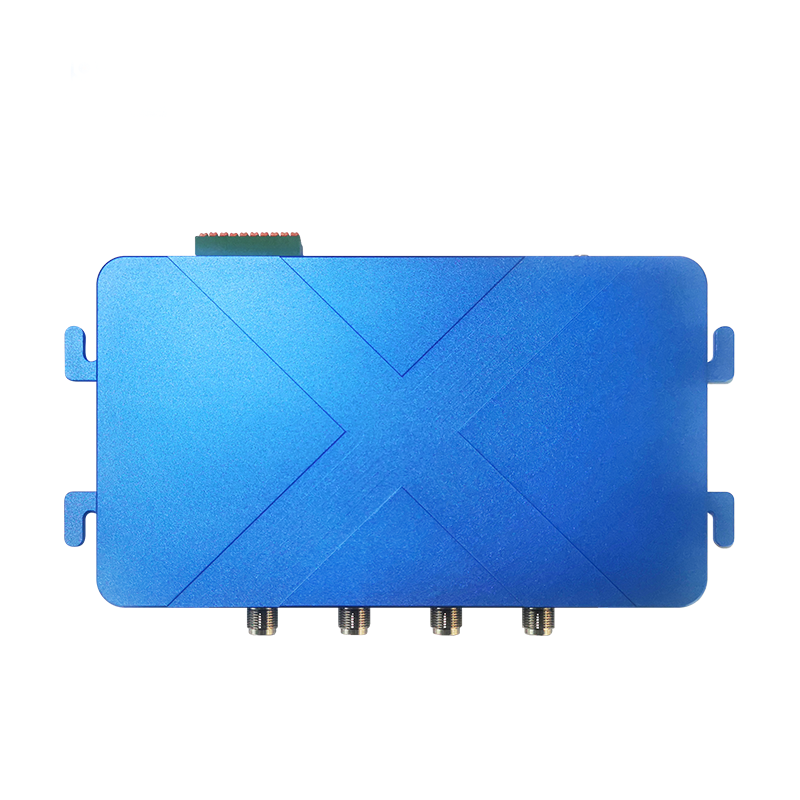
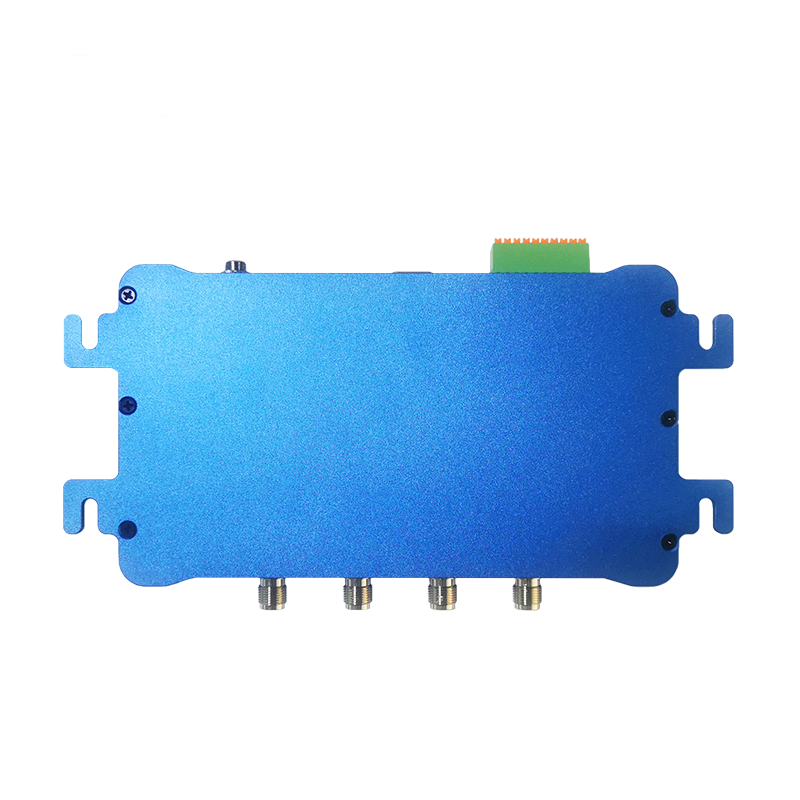
| Enclosure | Blue die-cast aluminium, X-ribbed lid, flat mounting ears at each end. Wall plate or cabinet shelf mounting |
| Certification | CE |
Where it belongs
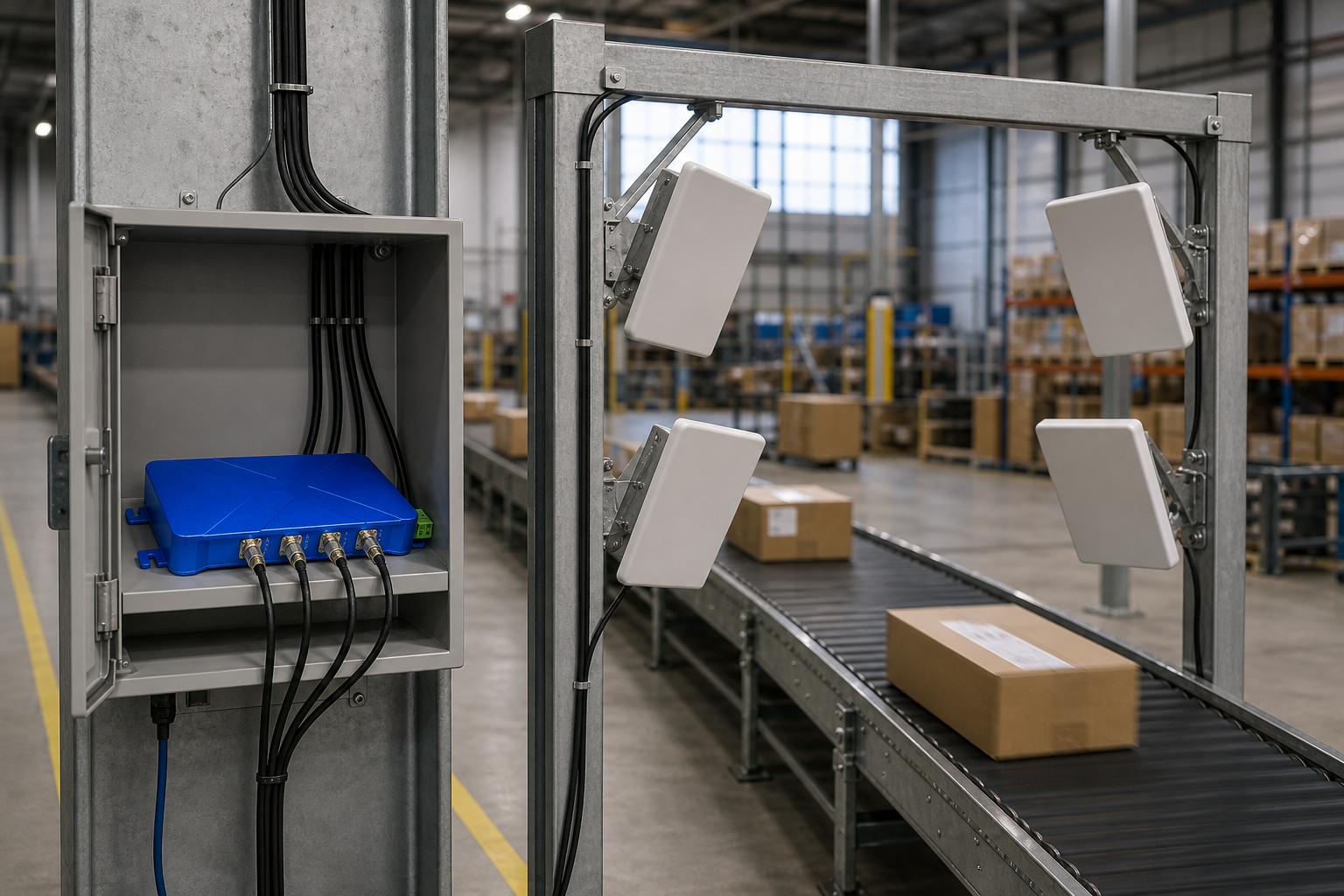
A conveyor portal is the classic four-port job: two antennas across the belt, one down the infeed and one over the outfeed, all switching through a single reader in a cabinet on the frame. One power drop, one network point, one address to manage.
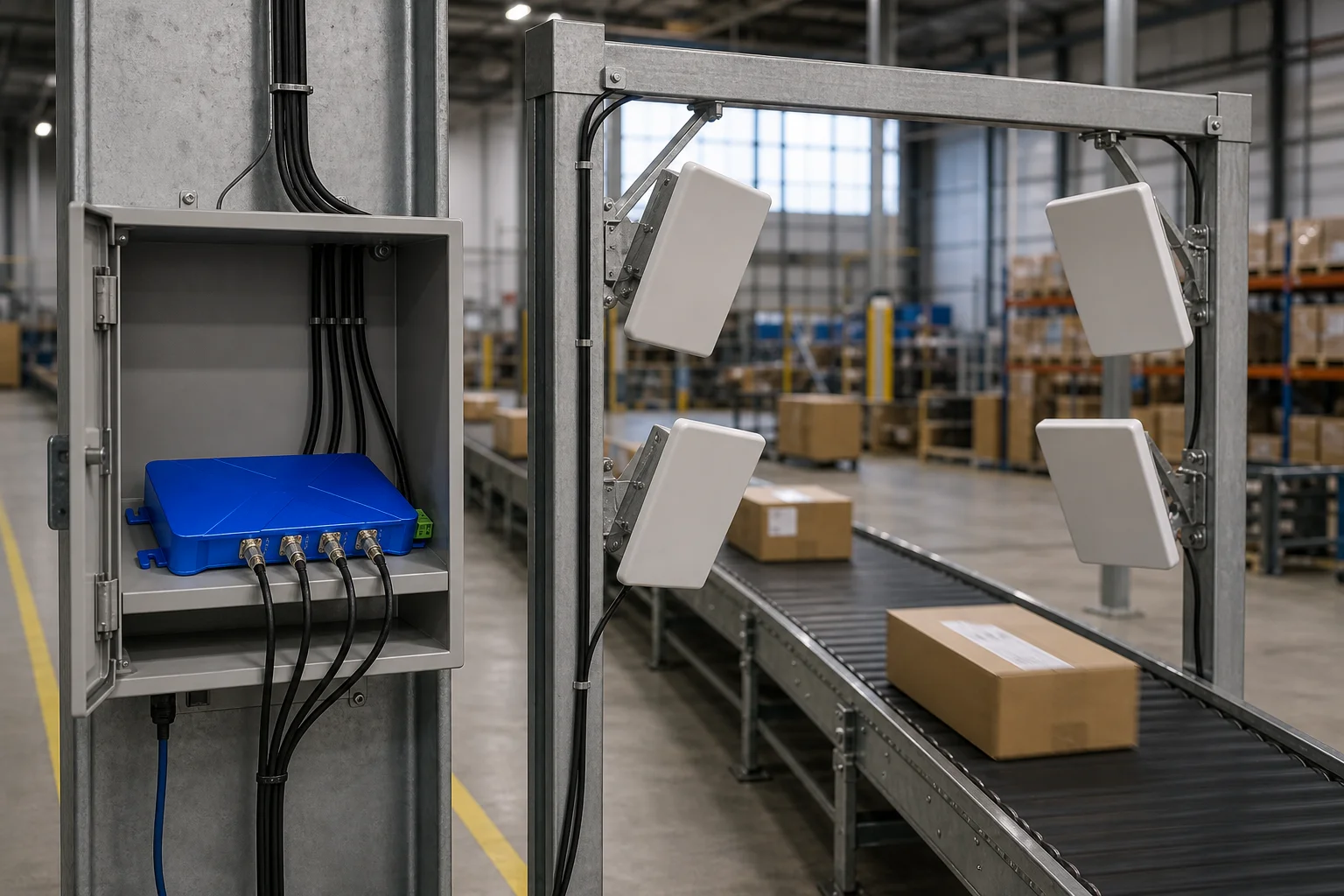
Four antennas, one reader, one cabinet. The coax leaves the reader and goes straight up the upright, strain-relieved at the frame rather than hanging from the connector.
Questions we are asked
The E710 is the reader chip inside the DR-E7004. One is a component made by Impinj, the other is the finished four-port reader. If you have been searching for an E710 reader, this is one; if you need the chip on its own for your own design, we can quote that separately.
TNC female, on four-hole flanges, marked ANT1 to ANT4 on the casing.
30 m is quoted with an 8 dBi antenna at 30 dBm, which is the right way to state it, and it assumes a sensitive tag in the clear. Indoors, expect the figure to fall with distance through racking, and a tag on a liquid or metal container will fall further. Send us the tag and the layout and we will give you a realistic number rather than the best case.
It serves them in turn, switching between ports, not simultaneously. For a portal or a multi-zone installation that is what you want, because a tag is only in one antenna's field at a time. Ask for the switching interval if your line speed is high, because it sets how long each port listens.
It speaks Modbus, MQTT, HTTP, HTTPS, TCP and HID, which covers most modern integrations and the PLC case well.
Yes, as a factory option, over 802.3af or 802.3at. The device draws 10.8 W operating against a 12.95 W budget under 802.3af, which is 2.15 W of headroom.
Three of the four outputs are relays, so yes in principle.
The reader and its terminal block connector; antennas, jumpers and the power supply are separate. To quote: how many ports you will use, the antennas and their connector type, the cable runs, whether you need Wi-Fi, 4G or PoE, your site supply voltage, and which interface your system speaks.
Copyright © ©Copyright 2024 Greatest IoT Technology Co., Ltd all rights reserved - Privacy policy