


The product is the foam. A spacer lifts the antenna off the steel so the tag sees a reflector instead of a short circuit, and every other property follows from that gap: the thickness, the curvature it will follow, the printer it will not go through.
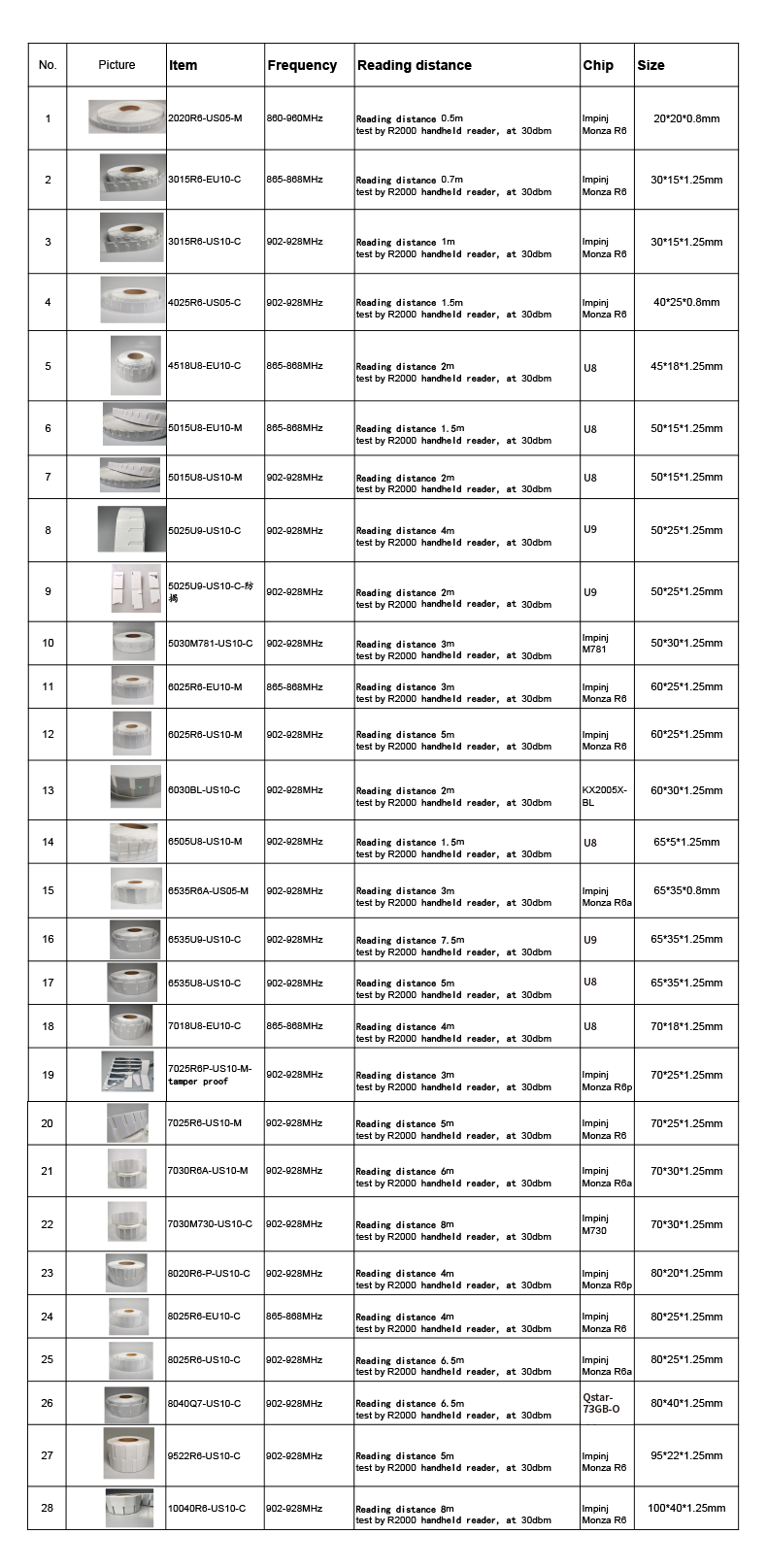
Twenty sizes from 20 × 20 mm to 100 × 40 mm, two thicknesses, four chips, roll or sheet. Below: what the spacer actually does, how much curve it tolerates, which size belongs on which asset, and what to check before you print a thousand of them.
Why it works
Put an ordinary UHF inlay flat on a steel plate and the metal cancels the field: the tag is shorted out and the read distance collapses to a few centimetres. Lift the same inlay a millimetre off the surface and the steel becomes the second half of the antenna. That is the entire trick, and it is why these labels are 0.8 or 1.25 mm thick instead of 0.05 mm.
Cross-section, not to scale. The spacer does two jobs at once: it keeps the conductor out of the steel, and it sets the resonant frequency back where the tag was tuned.
If your asset is not metal, this is the wrong product. For cardboard, plastic and glass the standard wet inlay is the right starting point, and the rigid anti-metal tag is the right answer when the surface is flat and you can drill two holes.
How much curve it will follow
That it is for “flat or slightly curved” ones. A foam spacer conforms to a single, gentle curve. It does not conform to a weld seam, a corner, or a surface curved in two directions at once — in those places the foam compresses at one edge, the gap closes, and the read disappears exactly where the label lifted.
| The surface | What happens | What to do |
| Flat steel, 2 mm or thicker | Ideal. The gap is uniform and the tag reads at its rated distance. | Nothing special. Degrease the surface and apply at room temperature. |
| Drum or cylinder, diameter 300 mm and up | A single gentle curve. The label follows without edge lift. | Apply with the long side across the curve, so the label wraps rather than spans it. |
| Cylinder 150 to 300 mm | Works on the short and medium formats; long labels start to bridge and lift at the ends. | Drop one size. A 70 mm label on a 200 mm drum bends through 20 degrees, which a foam label handles; a 100 mm one does not. |
| Pipe or cylinder under 150 mm | Only the narrow formats. Expect the ends of a wide label to stand off. | Use the 80 × 20 or 95 × 22 formats, or a flag tag mounted on a cable tie. |
| Corner, weld seam, pressed rib, double curvature | Will not sit. The foam compresses on one side and the gap opens on the other. | This is a hard tag job, not a label job. See the comparison further down. |
A starting rule, not a specification. Keep the label’s long side under about a quarter of the cylinder diameter, and apply across the curve rather than along it. That rule comes from how much a foam label can bend before the ends lift, and it is worth testing with one label on your actual drum before you order a roll — the surface finish and the paint thickness both change the answer.
Choosing a size
| Asset | Format to start with | Why |
| Server, switch, laptop lid | 40 × 25 or 50 × 25 mm, 0.8 mm | A flat lid with no curve and often a shallow gap behind the rack rail. The thin version fits where the thick one fouls. |
| Hand tool, returnable bin, jig | 30 × 15 or 45 × 18 mm, 1.25 mm | Small steel, short range, read by a handheld at arm’s length. Nothing is gained by going larger. |
| Steel drum, gas cylinder, keg | 65 × 35 or 70 × 30 mm, 1.25 mm | Enough length for range, short enough to wrap a drum without edge lift. The 1.25 mm spacer does the work on a curved surface. |
| Pipe, tube, conduit | 80 × 20 or 95 × 22 mm, 1.25 mm | Narrow and long: it wraps around a pipe instead of spanning across it. |
| Boiler, container, steel cabinet, machine frame | 100 × 40 or 80 × 40 mm, 1.25 mm | Flat and large, so the biggest format is available and this is where a long read distance actually happens. |
| Small device, instrument face, tag on a bracket | 20 × 20 mm, 0.8 mm | A near-field label. It is read by a handheld held against it, not from across a yard. |
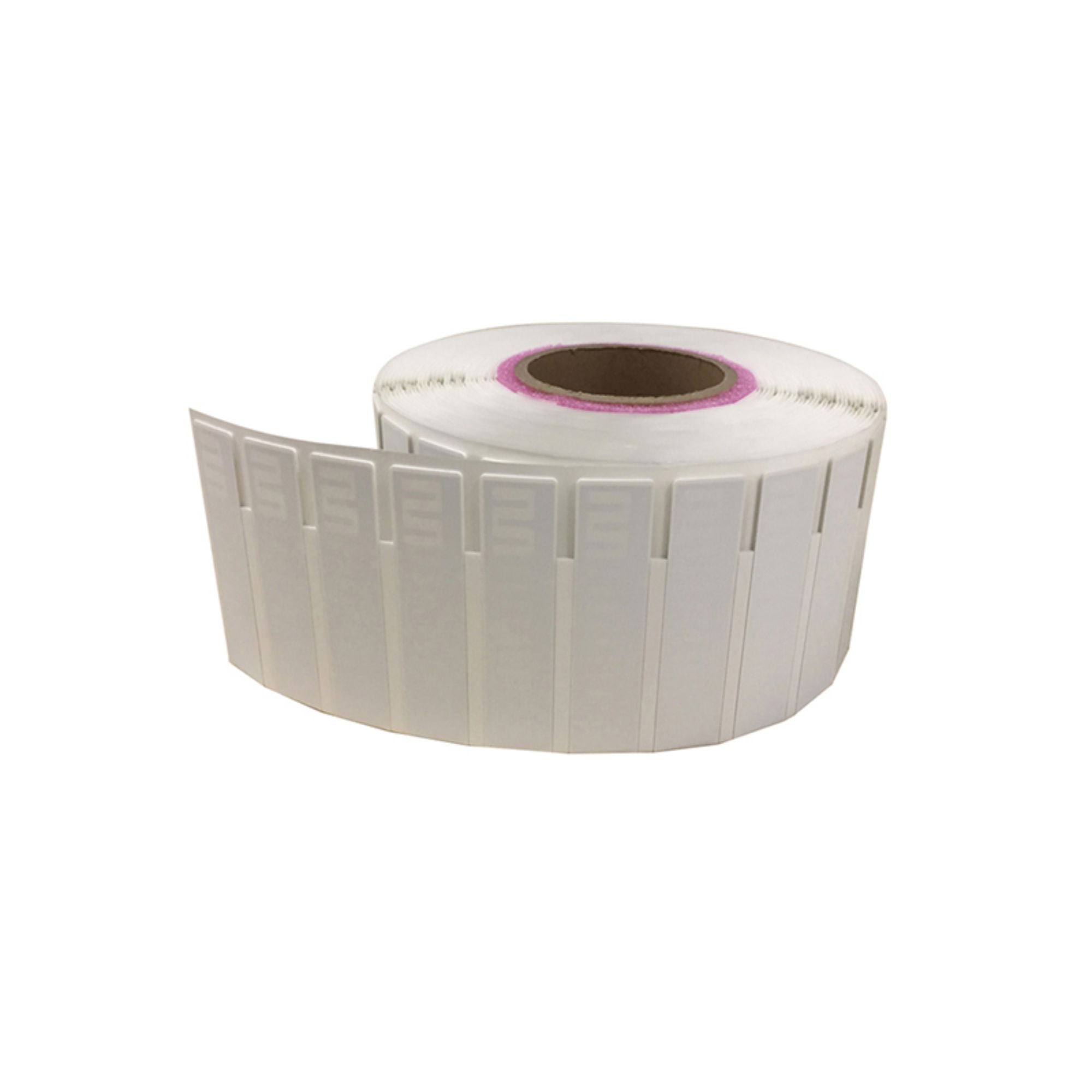
A different die on the same construction: longer and narrower, which is the family used on pipe and tube. The foam edge at the die cut is the same 1.25 mm, and it is the reason the label sits proud of the surface rather than flush.
The chip decides what you can write
| Chip | EPC | User memory | TID | When to pick it |
| NXP UCODE 8 | 128 bit memory | 32 bit | 48 bit | The default when the customer writes data to the tag. Best balance of read sensitivity and usable memory. |
| NXP UCODE 9 | 96 bit | None | 96 bit | Faster to read and usually cheaper, but there is nowhere to store your own field. A write to user memory will fail, not degrade. |
| NXP UCODE 9xe | 128 bit | None | 96 bit | Buys back EPC room without adding user memory. Useful when the EPC must carry more than a serial number. |
| Impinj Monza R6 | 96 bit | None | 48 bit | Good read performance at a low price point, and a well understood part in this industry. |
| Impinj Monza R6-P | 96 bit | 32 or 64 bit | 48 bit | The Monza option that does have user memory. Worth naming separately, because R6 and R6-P are not interchangeable for a writing project. |
Specification
| CONSTRUCTION | |
| Structure | Printable PET face, aluminium foil antenna, foam spacer, adhesive, release liner. The foam is the functional layer: it sets the electrical distance between the antenna and the metal, and it is why the label is 0.8 or 1.25 mm rather than a film |
| Thickness | 0.8 mm and 1.25 mm |
| Format | Die-cut on a roll. |
| SIZES | |
| Twenty formats | 20 × 20 × 0.8 · 30 × 15 × 1.25 · 40 × 25 × 0.8 · 45 × 18 × 1.25 50 × 15 × 1.25 · 50 × 25 × 1.25 · 50 × 30 × 1.25 · 60 × 25 × 1.25 60 × 30 × 1.25 · 65 × 35 × 0.8 · 65 × 35 × 1.25 · 70 × 18 × 1.25 70 × 25 × 1.25 · 70 × 30 × 1.25 · 80 × 20 × 1.25 · 80 × 25 × 1.25 80 × 40 × 1.25 · 95 × 22 × 1.25 · 100 × 40 × 1.25 · 65 × 5 × 1.25 (confirm) L × W × thickness in mm. Nineteen formats plus one entry, 65 × 5 mm, that is a 5 mm wide strip and should be confirmed before it appears on a quotation. |
| RADIO | |
| Air protocol | ISO/IEC 18000-6C |
| Frequency | 902 to 928 MHz for the FCC version and 865 to 868 MHz for the ETSI version. |
| Chips | NXP UCODE 8, UCODE 9, UCODE 9xe and Impinj Monza R6. Monza R6-P is the variant with user memory and is worth listing separately. See the memory table above for what each one can store |
| Read range | 1-8m on metal |
| Data retention | More than 10 years |
| Write cycles | 100,000 erase and write cycles |
| ENVIRONMENT | |
| Operating temperature | −40 °C to +85 °C on the tag |
| Recommended storage | 23 ± 3 °C and 50 ± 15 % RH. |
| PRINTING | |
| Method | Thermal transfer onto the PET face, with a wax-resin or resin ribbon. Direct thermal is not suitable for an asset label that has to last outdoors |
| Customisation | Logo, barcode, sequential and variable data, and EPC encoding at the factory. Custom sizes and antenna designs are offered, which is worth stating plainly if you want to be the supplier for a non-standard asset |
Where it fits
| Asset | Why this product suits it | Test before you specify |
| IT assets: servers, switches, network gear | Flat steel lids, often in a rack where a rigid tag would foul the rail. A 0.8 mm label adds almost no height. | Heat and airflow. A rack lid runs warm and the adhesive has to hold there for years; put one label on a running unit for a month before committing a data centre. |
| Steel drums, gas cylinders, kegs | This is the format’s best case: a single gentle curve, an all-metal surface, and a reader at a gate reading it in passing. | Curvature and paint. Measure the drum diameter and drop a size if it is under 300 mm. Glossy powder coat is a low-energy surface and needs the right adhesive, not more pressure. |
| Pipes, tube, conduit, cable trays | The narrow formats wrap a pipe rather than spanning across it, which is the only way the foam stays in contact. | Direction. A label wrapped along the pipe reads differently from one wrapped around it. Test both orientations with your reader before you fix a size. |
| Boilers, containers, machine frames | Large flat steel, where the biggest formats give the longest read distance and the label is protected by being out of the traffic. | Heat and impact. A boiler casing and a container side are both hostile to adhesive; ask for the service temperature of the adhesive and consider a hard tag where a forklift can hit it. |
| Tools, jigs, returnable bins | Small, cheap, single-use per asset, and the label can carry the asset number in print as well as in the chip. | Abrasion. The face stock takes the wear, not the chip. If the tool is thrown in a bin, expect the print to go before the tag does — which is a reason to keep the data in the chip and not rely on the barcode. |
In use
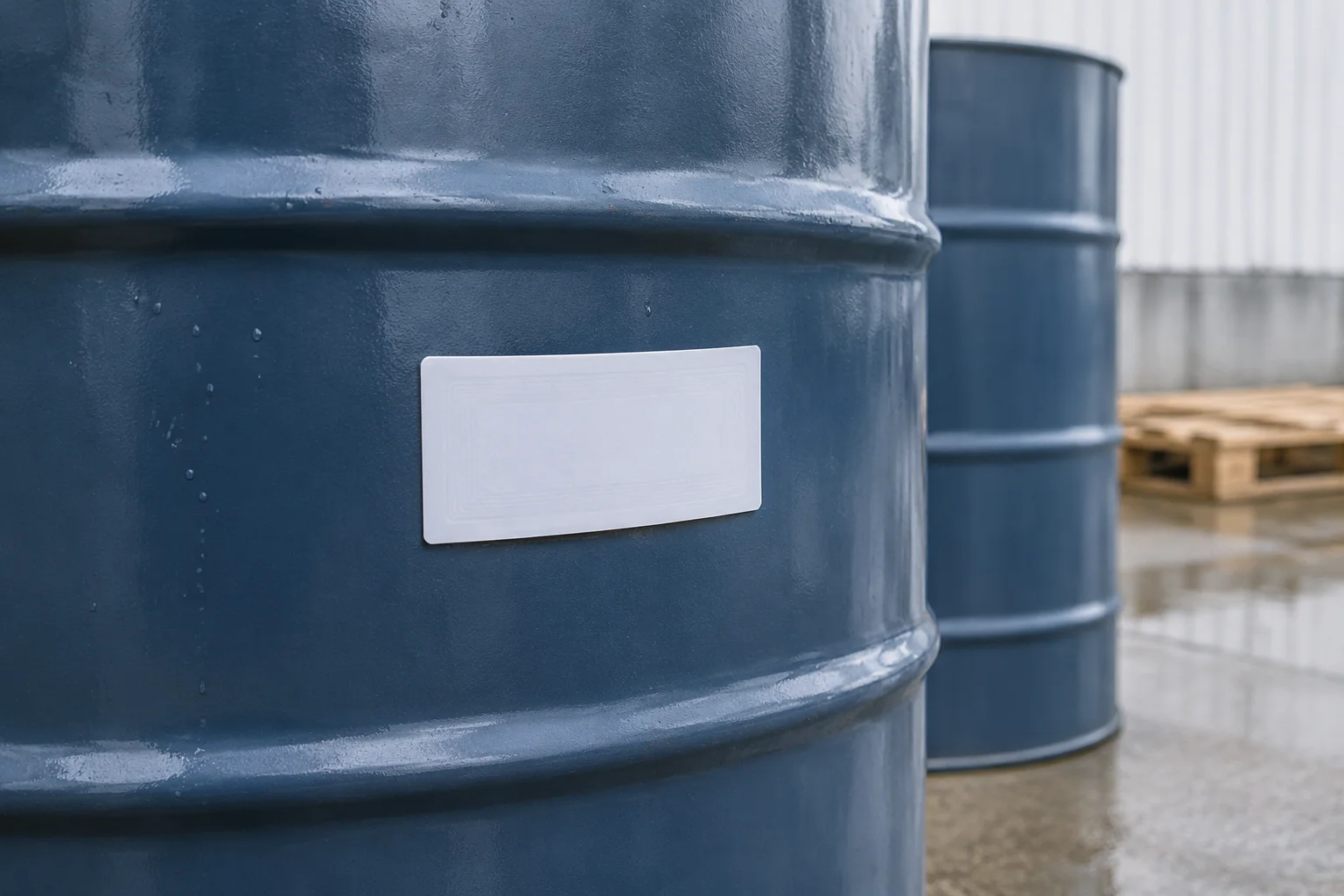
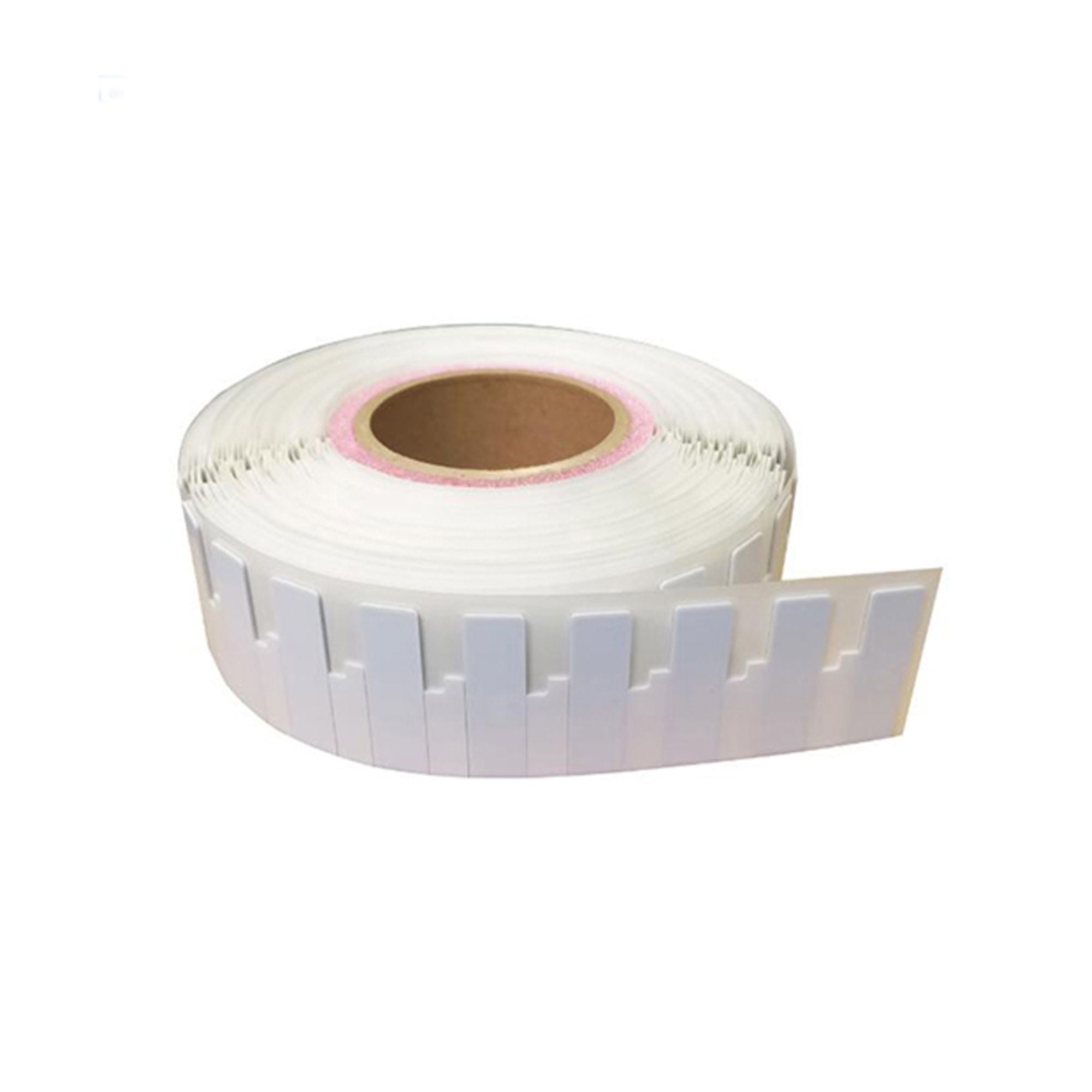
A drum. The label bends around one axis only, which is what the foam spacer tolerates. The gap you can see at the bottom edge is the 1.25 mm doing its job — that edge is also the first thing to lift if the adhesive is wrong.

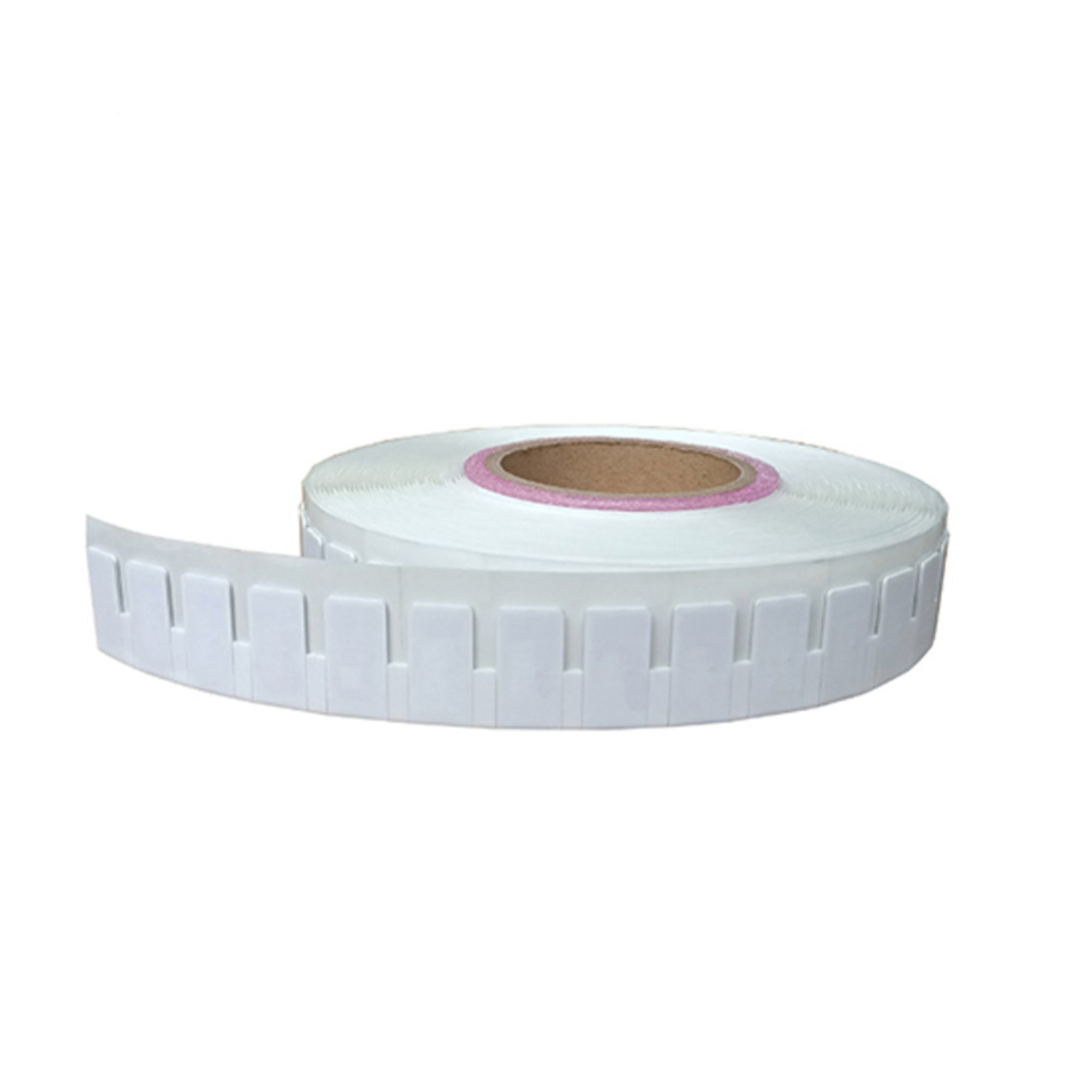
A server lid. Flat, and only a fraction of a millimetre is available before the unit fouls the rack, which is the case for the 0.8 mm format rather than the 1.25 mm one.
The alternative
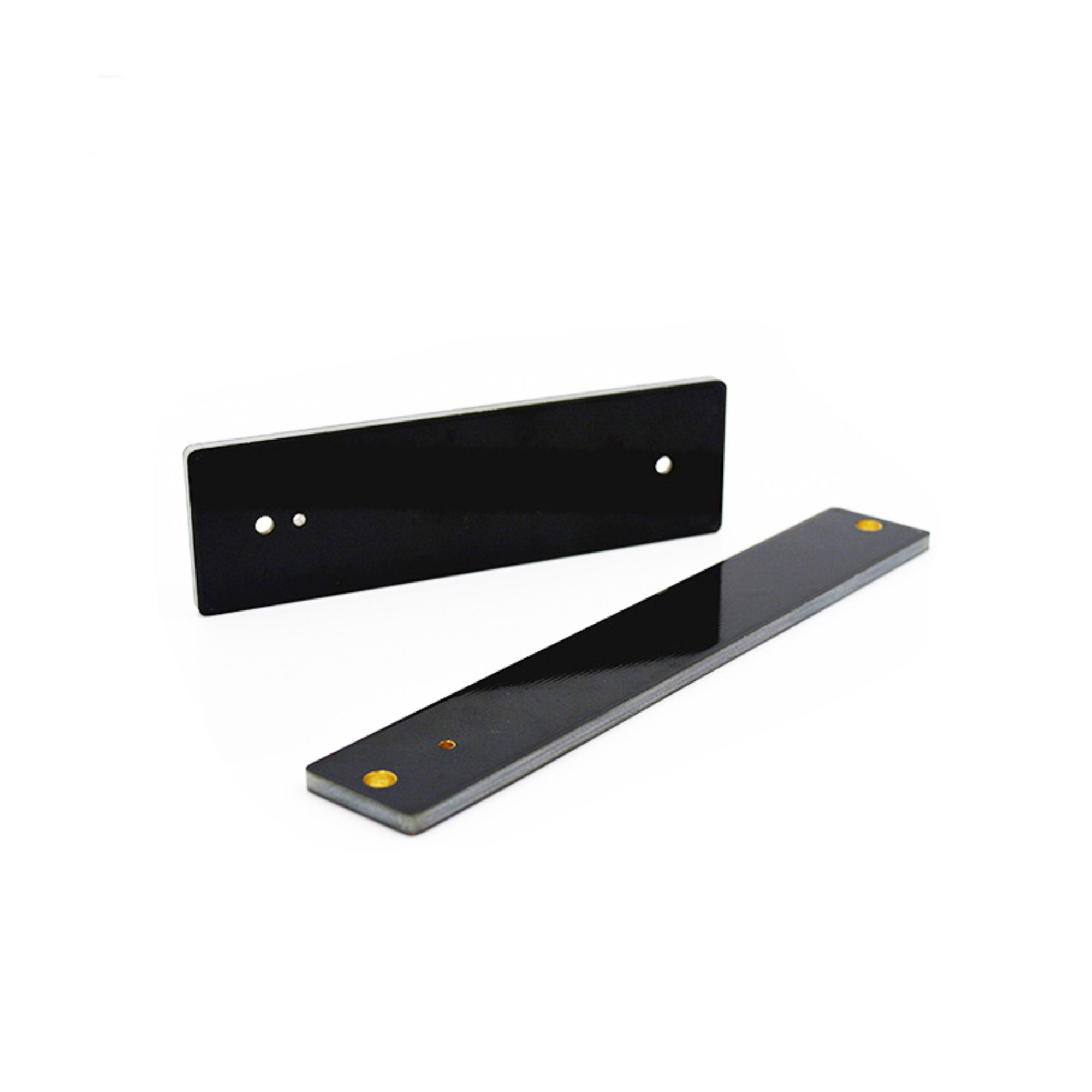
The same catalogue also sells a rigid anti-metal tag, and the two are ordered for the same asset more often than you would think. The label is cheaper and faster to apply; the rigid tag survives things the label does not.
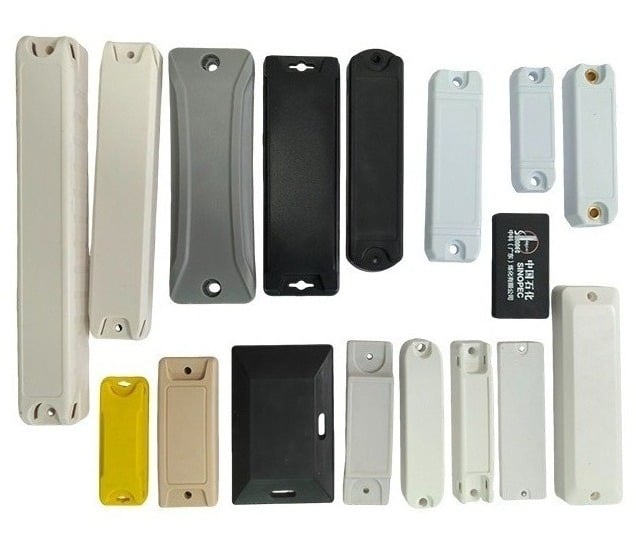
The rigid version, for comparison. Note the mounting holes: it is screwed or riveted on, which is a different decision from sticking a label on.
| Flexible label — this page | Rigid anti-metal tag | |
| Thickness | 0.8 or 1.25 mm | Typically 5 to 10 mm, in a moulded or potted housing |
| Surface | Flat or one gentle curve | Flat only. The whole base has to sit down |
| Fixing | Adhesive | Screws, rivets, or a cable tie through the holes |
| Reusable | No. Once it is on, it is on | Yes, within the limits of the holes |
| Survives | Weather, water, a solvent wipe | Impact, vibration, heat cycling, a forklift scraping past |
| Unit cost | Lower | Higher, and there is labour in fitting it |
| Choose it when | The asset is flat or gently curved and nothing is going to hit it | The asset is flat and something will |
The full range of rigid tags is on the RFID anti-metal tag page. If your asset is a corner, a weld seam, or a surface curved in two directions, that is the page you want, not this one.
Questions we are asked
| Question | Answer |
| Will it work on a plastic or wooden asset? | It will read, but far shorter than on metal, because the foam gap is tuned against a metal backing and there is nothing to compensate when the backing is plastic. For a mostly non-metal asset the ordinary wet inlay is the right product; this one is for steel, aluminium and other conductors. |
| How curved can the surface be? | One gentle curve, in one direction. As a starting rule keep the label’s long side under about a quarter of the cylinder diameter, and apply it across the curve rather than along it. A corner, a weld seam or a surface curved in two directions will not work: the foam compresses at one edge and the gap opens at the other, and the read dies exactly where the label lifted. |
| Can I write my own data into the tag? | Depends on the chip, and this is where a project usually goes wrong. UCODE 8 has 32 bits of user memory; Monza R6-P has 32 or 64. UCODE 9 and UCODE 9xe have none at all, so a write to user memory fails rather than degrading. If you need to store an expiry date or an inspection result on the tag, specify the chip for it at the quotation stage. |
| Can it be printed with our logo and a serial number? | Yes, by thermal transfer with a wax-resin or resin ribbon onto the PET face, and the serial or EPC can be encoded at the same time. Send artwork and the numbering rule. Direct thermal is not a good choice for an asset label: it fades in sunlight and wipes off with solvent. |
Copyright © ©Copyright 2024 Greatest IoT Technology Co., Ltd all rights reserved - Privacy policy