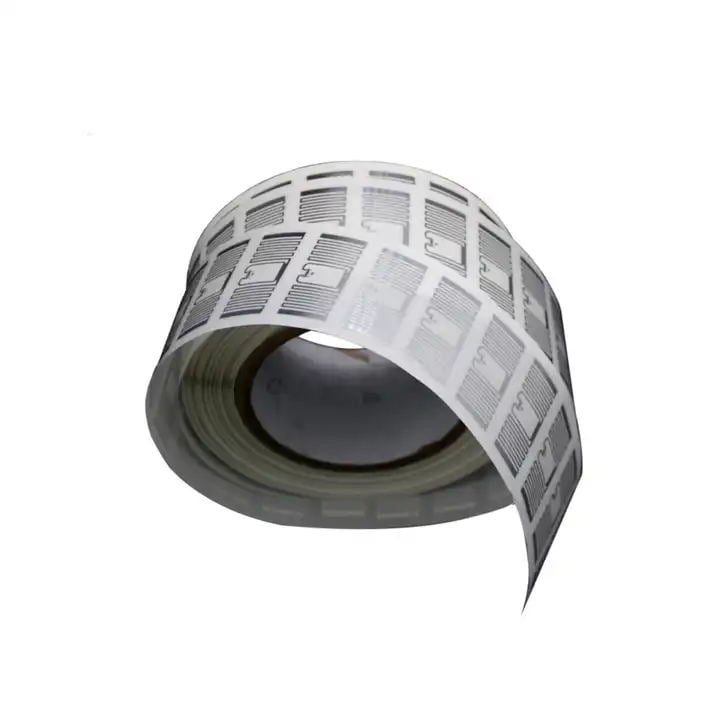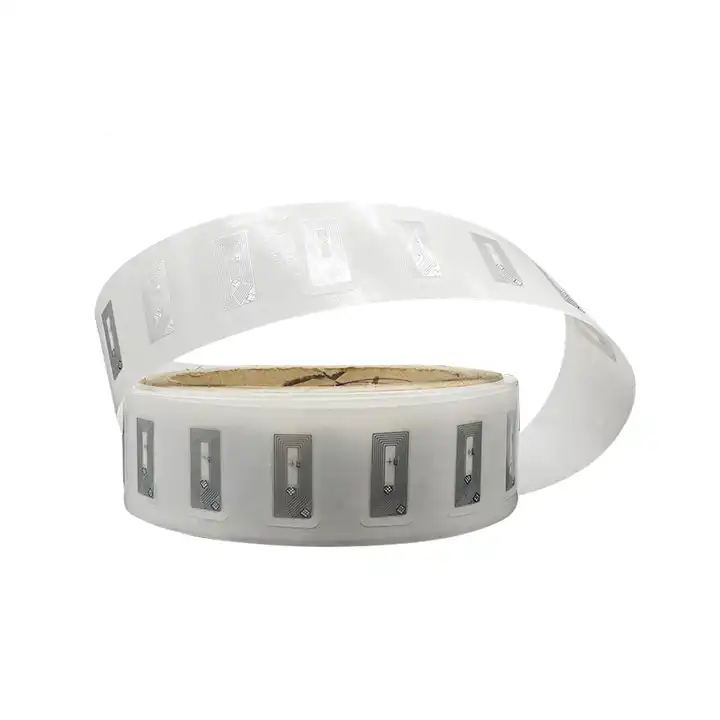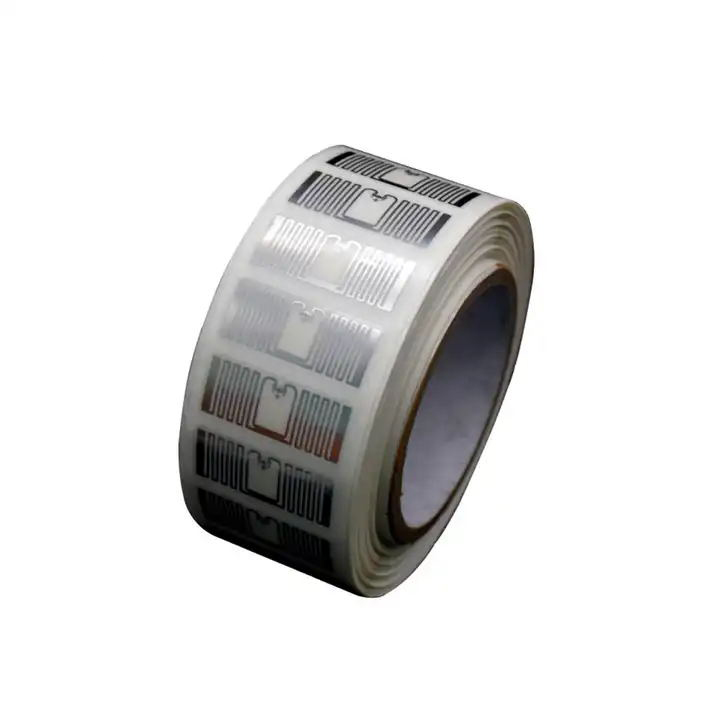

RFID Wet Inlays are passive RFID tags with an adhesive backing, allowing them to function as ready-to-use, peel-and-stick RFID labels. Unlike dry inlays, which require embedding or lamination, wet inlays are pre-laminated onto a release liner with an adhesive layer, allowing immediate application to products, packaging, and equipment surfaces. This format is optimized for environments that demand speed, accuracy, and minimal manual processing.
Each wet inlay contains an RFID chip and antenna mounted on a thin PET or paper substrate. These components operate through passive backscatter communication: the antenna harvests the electromagnetic energy emitted by an RFID reader, powering the chip and enabling it to modulate and return a signal containing its stored data. This battery-free mechanism supports rapid scanning, high read rates, and reliable identification across standard HF and UHF frequency bands.
Why RFID Wet Inlays are a Popular Choice
RFID wet inlays are widely used due to their:
Adhesive backing for fast application
Compatibility with various materials and surfaces
Streamlined deployment for item level tagging
Broad use in inventory management, logistics, and supply chain management
Support for passive RFID technology
Compliance with EPC Class 1 standards
Should You Choose a Wet Inlay or Dry Inlay?
Choosing between a wet inlay and a dry inlay hinges on key application factors:
Adhesion Requirements
If you require instant adhesion to a surface, an RFID wet inlay with adhesive backing provides a ready-to-use solution. This is especially useful for labels, packaging, or tags used in inventory or logistics operations.
Integration Complexity
Dry inlays offer greater customization for embedding within specific materials, while wet inlays are easier to apply directly. For streamlined manufacturing, a wet RFID inlay is often preferable.
Application Environment
Environments exposed to moisture or temperature fluctuations may benefit from wet inlays because of their secure adhesion and excellent performance on various surfaces.
Deployment Speed
When deployment speed is critical—like in large-scale inventory management or supply chain rollouts—a wet RFID inlay ensures fast and efficient application.
Cost Considerations
While wet inlays may come with slightly higher initial costs due to the adhesive layer, they reduce labor time. Dry inlays, though more labor-intensive, can offer cost effectiveness in high-volume or embedded applications.
Applications
RFID wet inlays are widely used in retail labeling, shipping and logistics, consumer goods, apparel tagging, asset tracking, pharmaceutical authentication, and medical equipment identification. Their adhesive-backed construction enables high-speed automated labeling, simplifies large-scale tagging operations, and reduces handling effort when thousands or millions of items need consistent, accurate RFID marking.

Why Choose greatestiot?
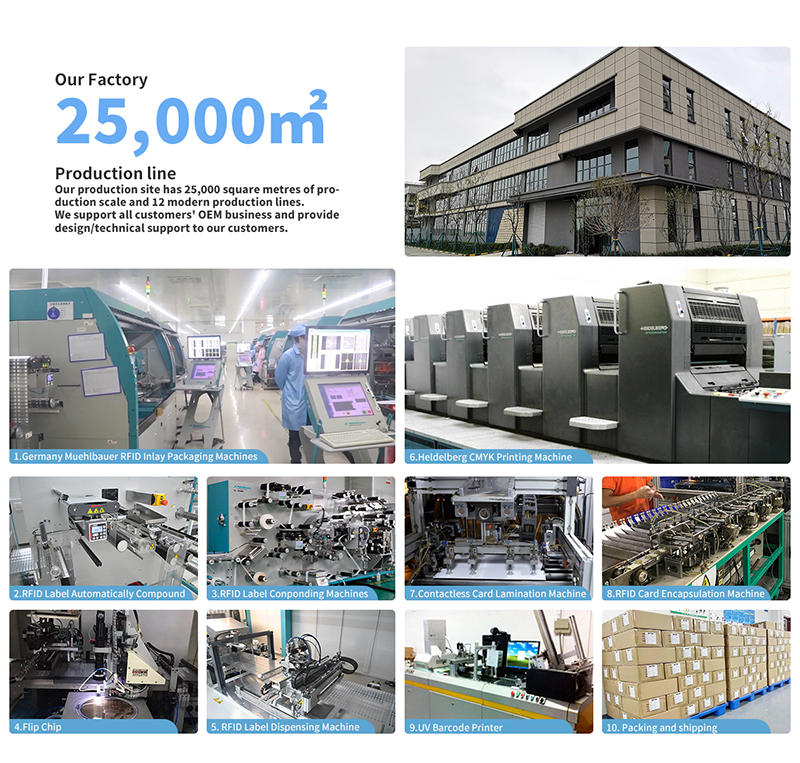
greatestiot is one of the largest RFID inlay&label manufacturers in China
greatestiot has a production capacity of one billion inlays per year
greatestiot use the Mühlbauer produce the RFID inlay
greatestiot has the strong chips supply chain, main RFID chips brands are our strategic partners.
In addition, we can provide the euivalent/alternative chips to solve the chip shortage problem