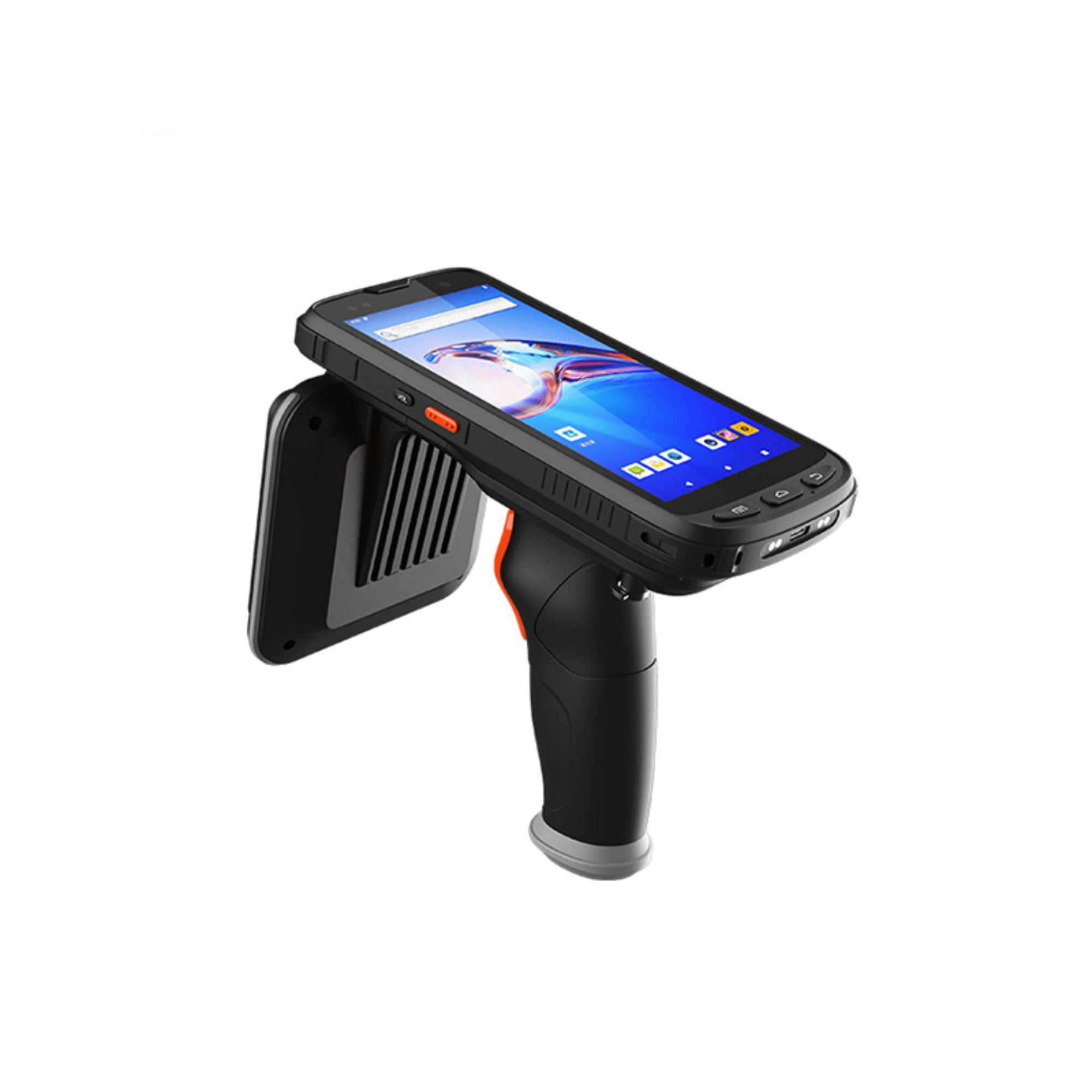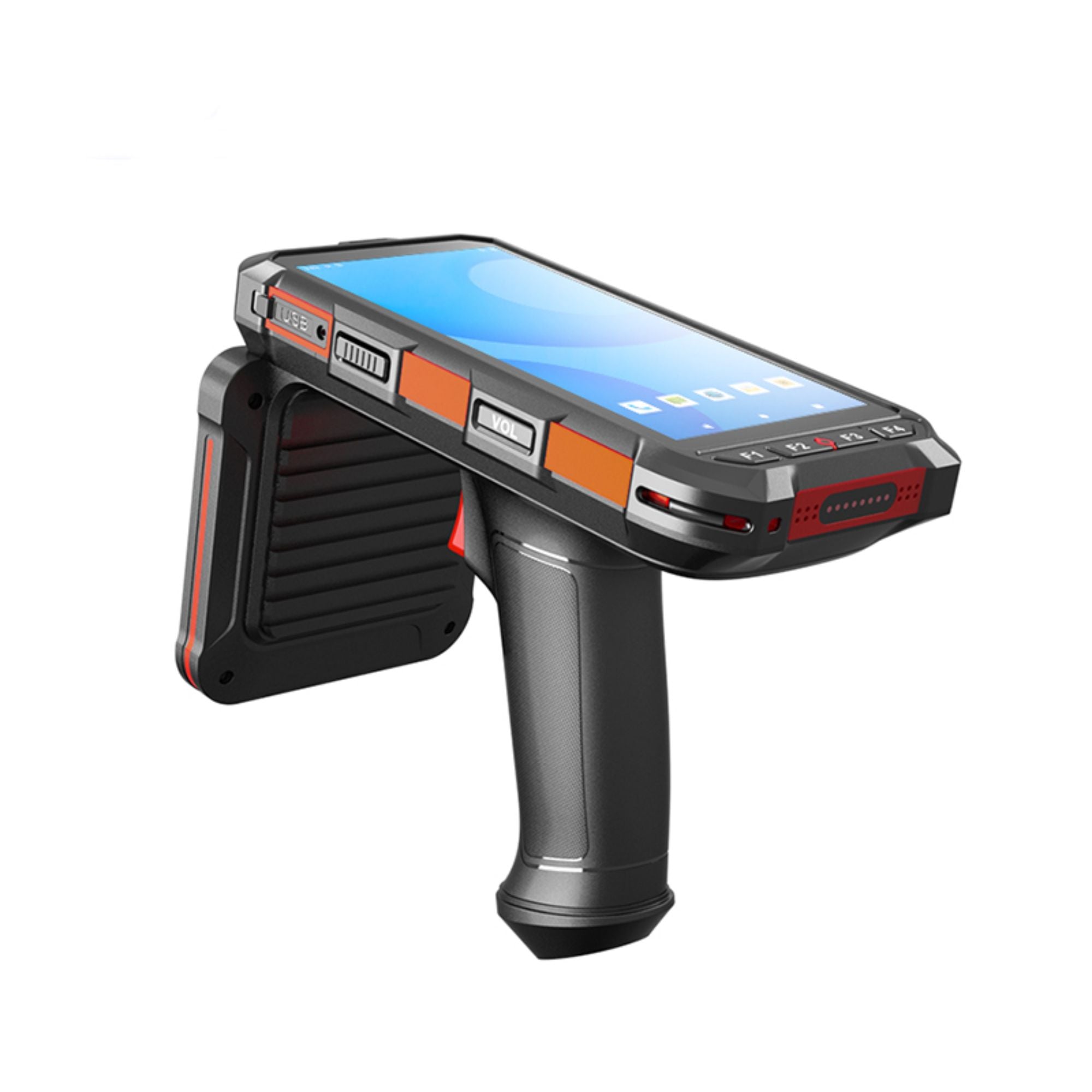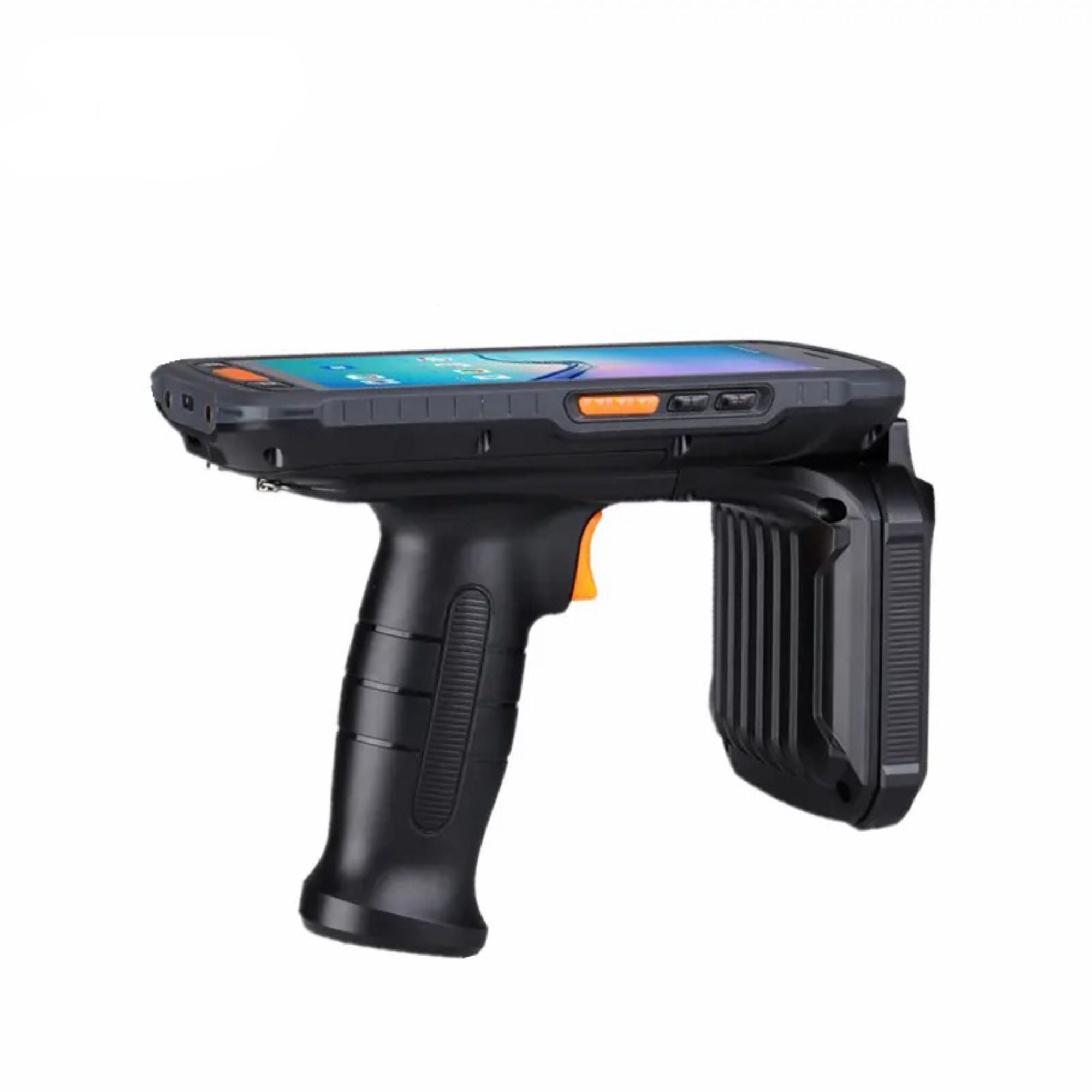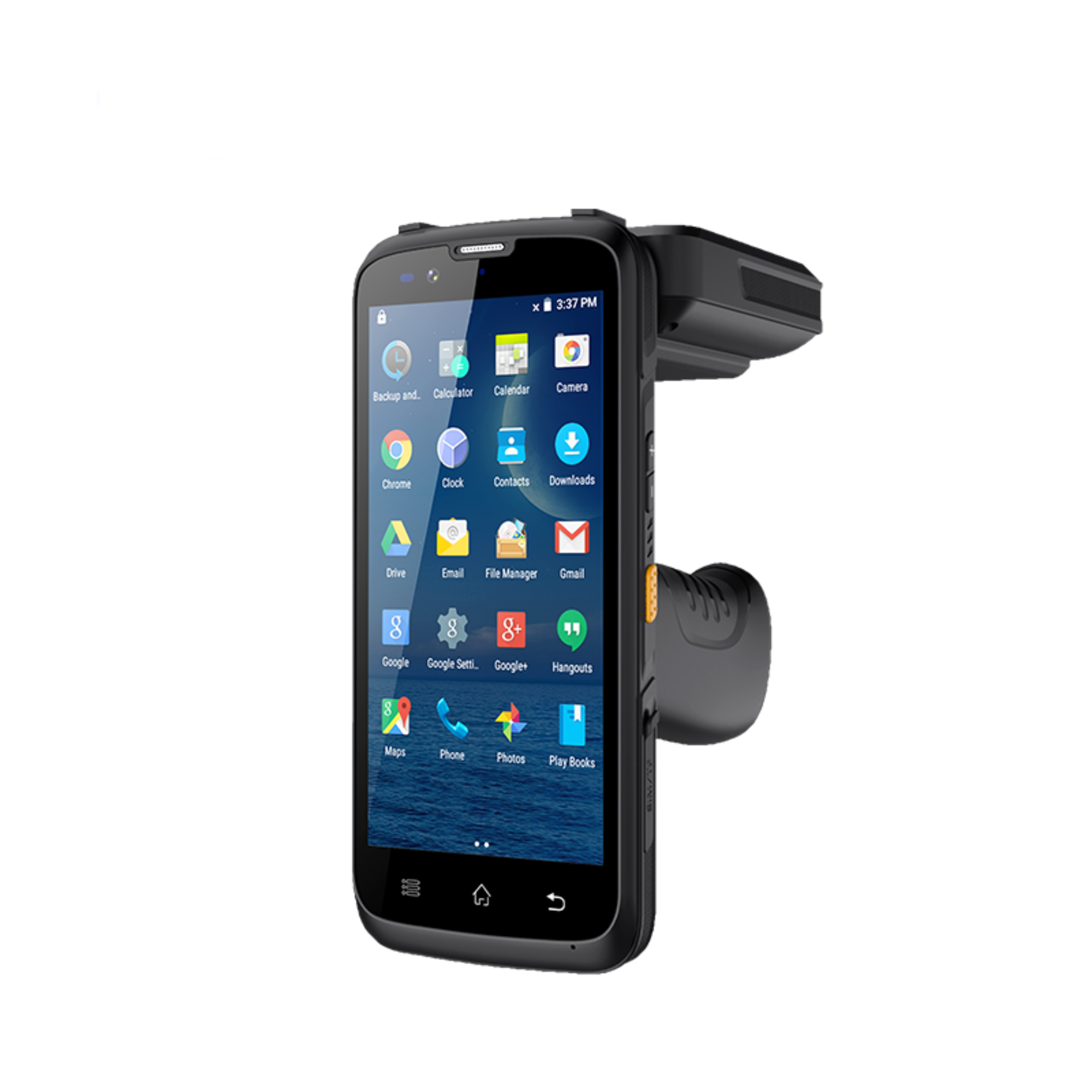

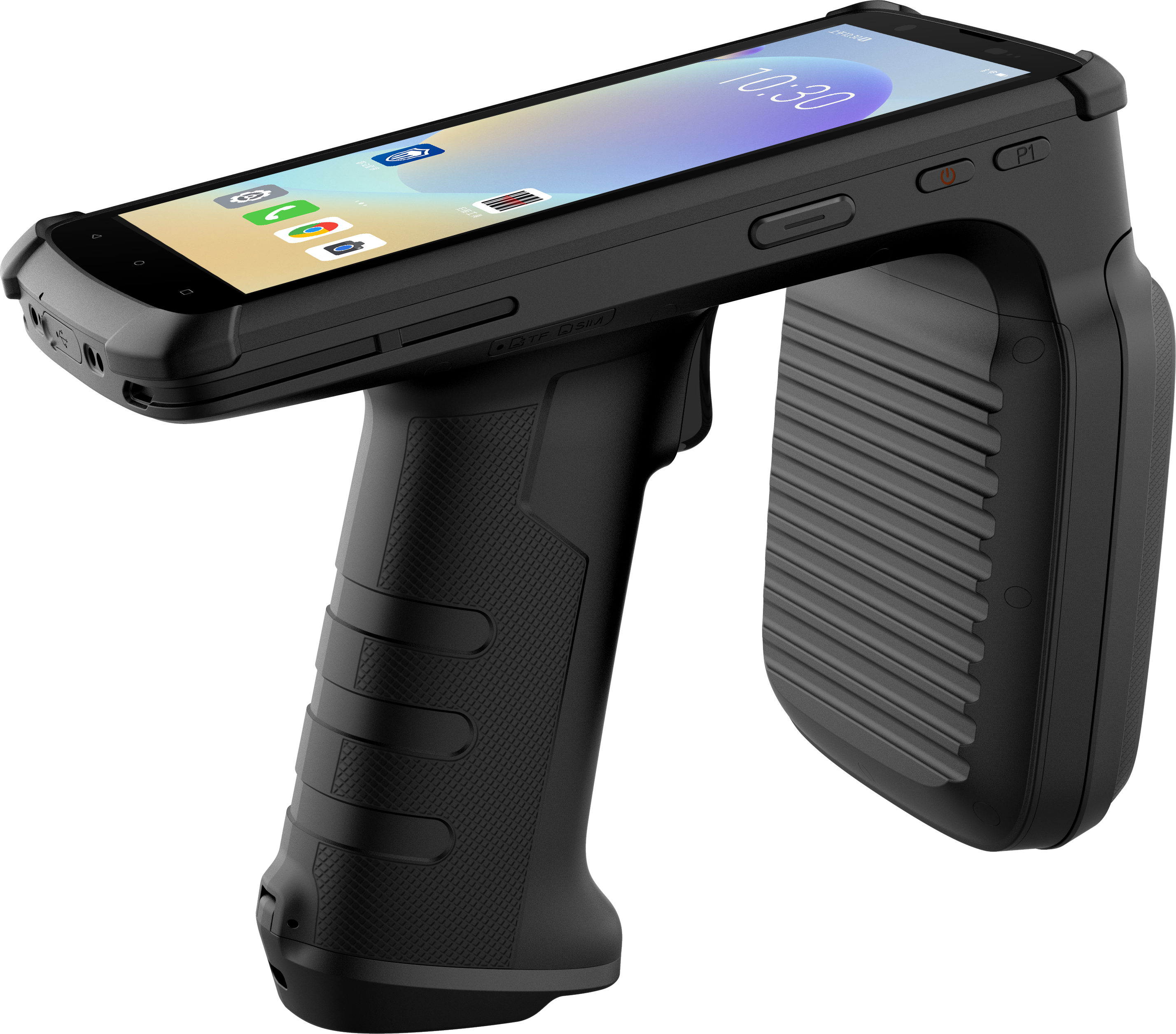
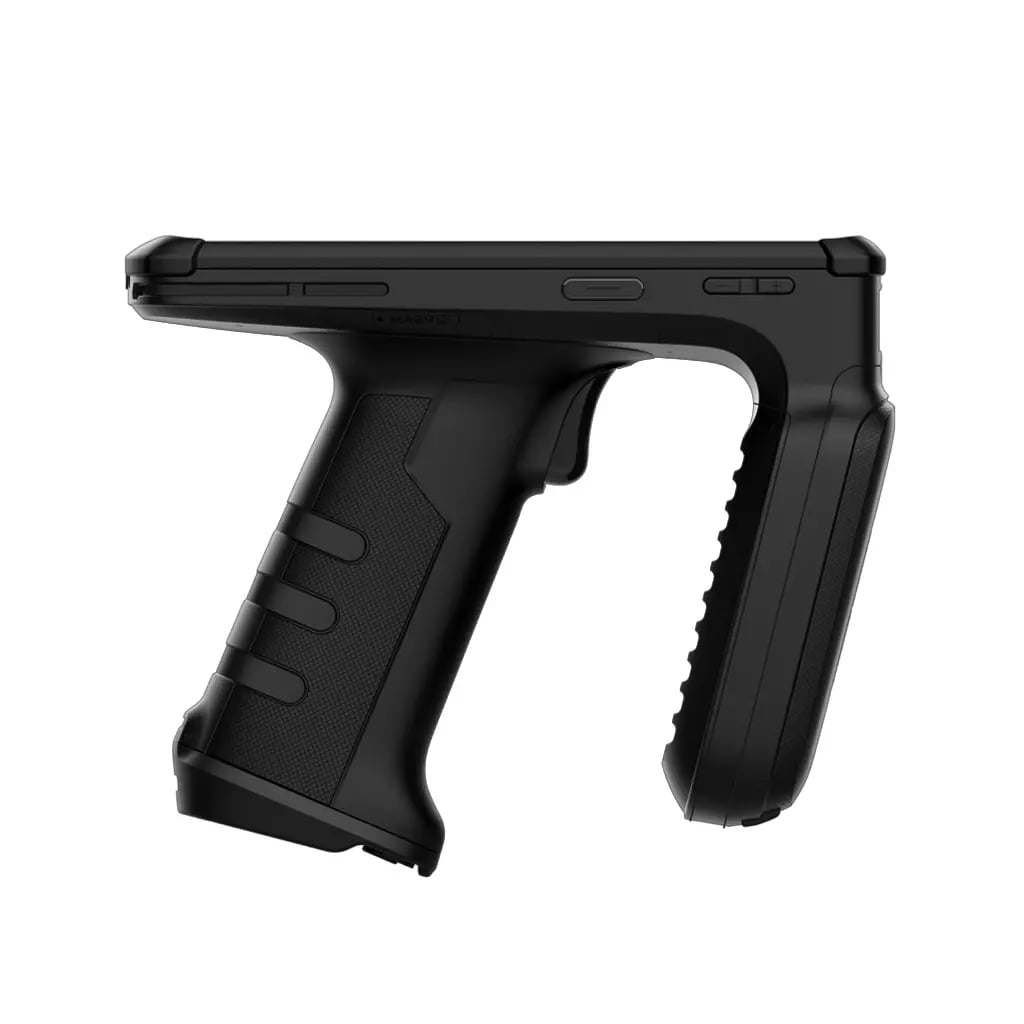
A pistol-grip Android handheld with an Impinj E710 radio, a 5 dBi circular antenna and 1–33 dBm of output, rated IP67 and 2 m drop, carrying a 6700 mAh replaceable battery in a 580 g body. It reads UHF at up to 10 m on an Impinj H47 label, reads HF/NFC at pocket range, scans 2D codes, and logs GPS — one device for a stockroom, a yard and a route.
The number every buyer over-estimates
The table says ≥10m @impinj H47, which is honest — it names the tag. But a buyer reads “10 m” and plans a read zone accordingly, then finds they get two metres in their own building and blames the device.
5 dBi circular polarisation reads tags at any rotation, which is the right choice for garments on a rail or cartons at unknown angles. The cost is roughly half the power — a linear antenna would give more metres on a label whose orientation you control.
The engine, and what it actually buys you
“Built-in Impinj new-generation E710 engine”
Impinj publishes a comparison across its reader ICs, and the figures are the ones that predict how a handheld behaves in a real aisle rather than in a datasheet.
| READER IC | RECEIVE SENSITIVITY | POSITION |
| E910 | −103 dBm | flagship |
| E710 — this device | −98 dBm | high-volume handheld |
| E510 | −93 dBm | mid-range |
| E310 | −84 dBm | short range, embedded |
Why sensitivity is the number to quote. Sensitivity is how faint a tag reply the radio can still resolve. Every 6 dB is roughly a doubling of theoretical range in free space, so the E710's −98 dBm sits between the flagship and the mid-range — which is exactly what a 580 g pistol-grip handheld at 10 m should be. Put the figure in your table and a technical buyer can place the product without calling you.
Impinj defines Gen2X as an enhancement to the RAIN air interface, and it bundles four things that each answer a different customer objection:
Two of those four — Authenticity and Protected Mode — are the reason a brand-protection or luxury-retail buyer should choose a Gen2X reader over a cheaper one.
Form factor
Specification
| PARAMETER | |
| PHYSICAL AND ENVIRONMENTAL | |
| Dimensions | 170 mm L × 80 mm W × 132.7 mm H incl. grip × 16.4 mm body thickness |
| Weight | 580 g with battery |
| Sealing | IP67 |
| Drop | Multiple drops from 2.0 m / 6.6 ft to concrete |
| Operating temperature | −20 °C to +50 °C (−4 °F to +122 °F) |
| Storage temperature | −40 to +60 °C with battery; −40 to +70 °C without |
| Humidity | 5% to 95% RH, non-condensing |
| Electrostatic discharge | ±15 kV air discharge, ±8 kV contact discharge |
| Sensors | G-sensor, light sensor, distance sensor, electronic compass, gyroscope |
| PERFORMANCE | |
| Processor | MediaTek Octa-core 2.0 GHz |
| Operating system | Android 12 |
| Memory | 4 GB RAM / 64 GB flash standard; 8 GB / 128 GB optional |
| Expansion | microSD, up to 256 GB |
| Display | 5.5 in capacitive touch, 1440 × 720 |
| Keys | Power, volume + and −, UHF, SCAN, custom, on/off |
| UHF RFID — STANDARD CONFIGURATION | |
| Air interface | ISO/IEC 18000-63 / EPCglobal Gen2v2 |
| Reader IC | Impinj E710, −98 dBm receive sensitivity, supports Impinj Gen2X |
| Antenna | 5 dBi, circular polarisation Reads at any tag rotation. Costs roughly half the power versus a linear antenna |
| Frequency | 840–960 MHz; default 902–928 MHz; regional variants to order |
| Output power | 1–33 dBm Software-settable |
| Read range | ≥10 m on an Impinj H47 label, practical distance subject to label and environment |
| Write range | 0–6 m on a 9662 white card, practical distance subject to label and environment |
| Inventory rate | Achieve 1300 frames/sec |
| Read rate | About 12 ms per 32-bit word |
| Write rate | About 60 ms per 32-bit word |
| Impinj Gen2X | Performance, FastID, Authenticity (cryptographic tag authentication), Protected Mode |
| HF / NFC | |
| Air interface | ISO/IEC 15693, ISO/IEC 14443A and 14443B |
| Frequency | 13.56 MHz |
| Read range | >5 cm (ISO 15693), >4 cm (14443A), >1.5 cm (14443B), label dependent |
| Encryption | None — UID only |
| SCANNING AND IMAGING | |
| Scan engine | Mid-range 2D imager |
| Symbologies | 1D and 2D symbologies supported |
| Front camera | 5 MP, fixed focus |
| Rear camera | 13 MP autofocus, dual flash, PDAF phase focusing |
| Notifications | Sound, vibration, LED indicator |
| CONNECTIVITY | |
| Wi-Fi | 802.11 a/b/g/n/ac (Wi-Fi 5); 2.412–2.472 GHz and 5.180–5.825 GHz, regional |
| Wi-Fi security | WPA2-Personal, WPA2-Enterprise, EAP-TLS, EAP-TTLS/MSCHAPv2, PEAPv0/EAP-MSCHAPv2, PEAPv1/EAP-GTC, EAP-SIM, EAP-AKA, EAP-AKA Prime |
| Cellular | SIM slot present |
| Bluetooth | 5.0 |
| Positioning | GPS + GLONASS + BeiDou with AGPS; GPS L1/L5, BeiDou B1, GLONASS L1/L5; 5–10 m open sky |
| USB | USB-C, USB 2.0 High Speed, OTG |
| Audio | Built-in speaker, dual microphones with noise cancellation |
| POWER | |
| Battery | 6700 mAh, replaceable, QC3.0 fast charging |
| Charging method | USB-C or dock as well |
| COMMERCIAL | |
| Warranty | 1 year |
| MOQ, lead time, price band | 1MOQ, 3-day delivery, 309-339 USD/pcs |
| Spares and accessories | spare batteries, single and multi-bay docks, holster, lanyard |
The five rows a buyer reads first Impinj E710 with −98 dBm sensitivity · ≥10 m on an Impinj H47 · IP67 and 2 m drop · 6700 mAh replaceable · 5.5 in screen.
In use
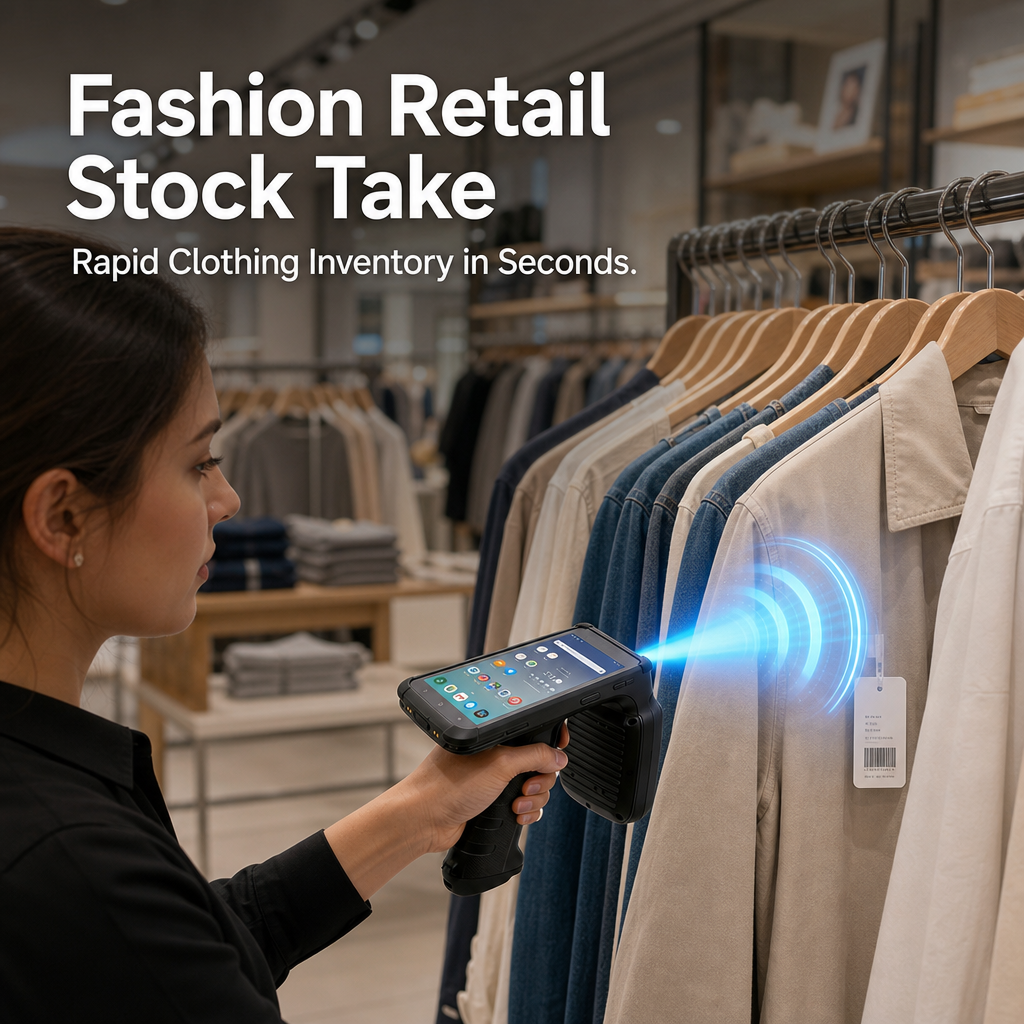
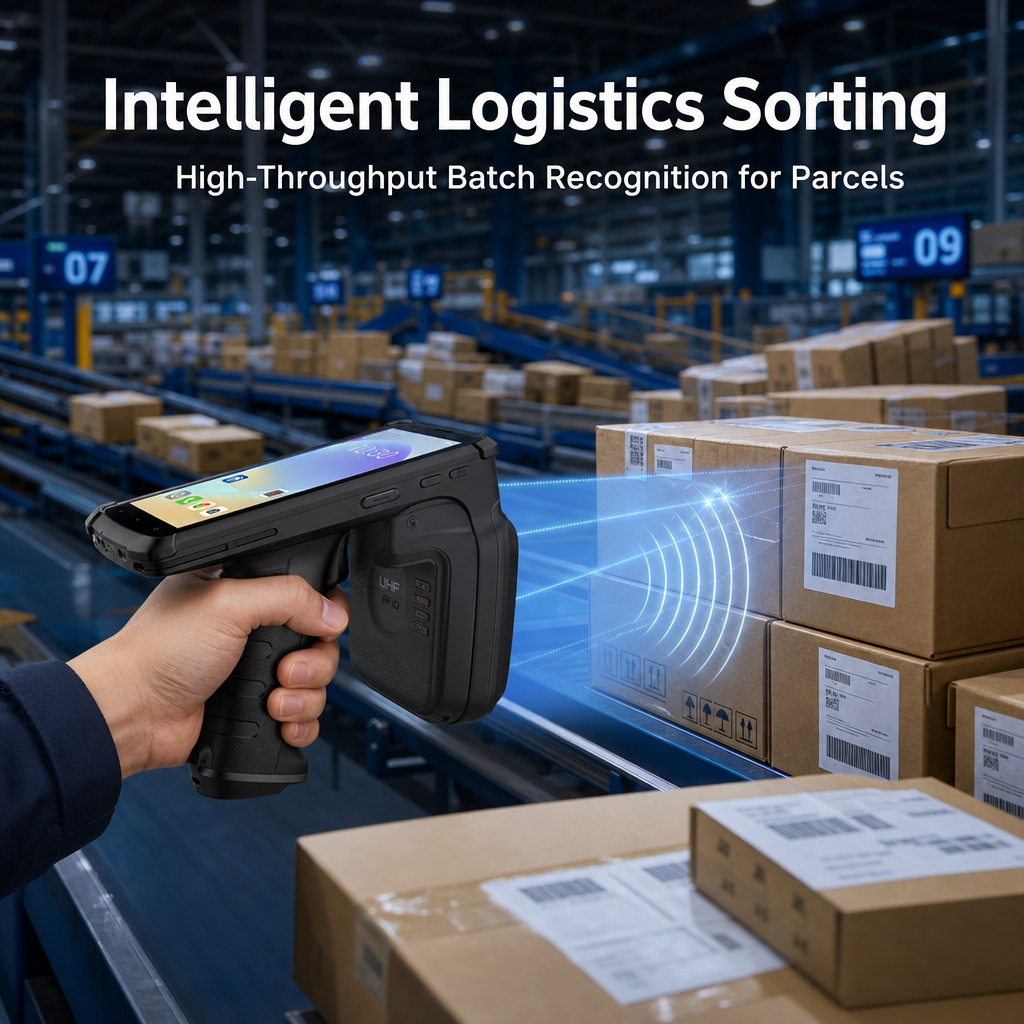
Clothing retail, warehouse management, power inspection ,asset management and file management. All five are real. The first two are where the device's particular strengths — 10 m range, circular antenna, IP67.
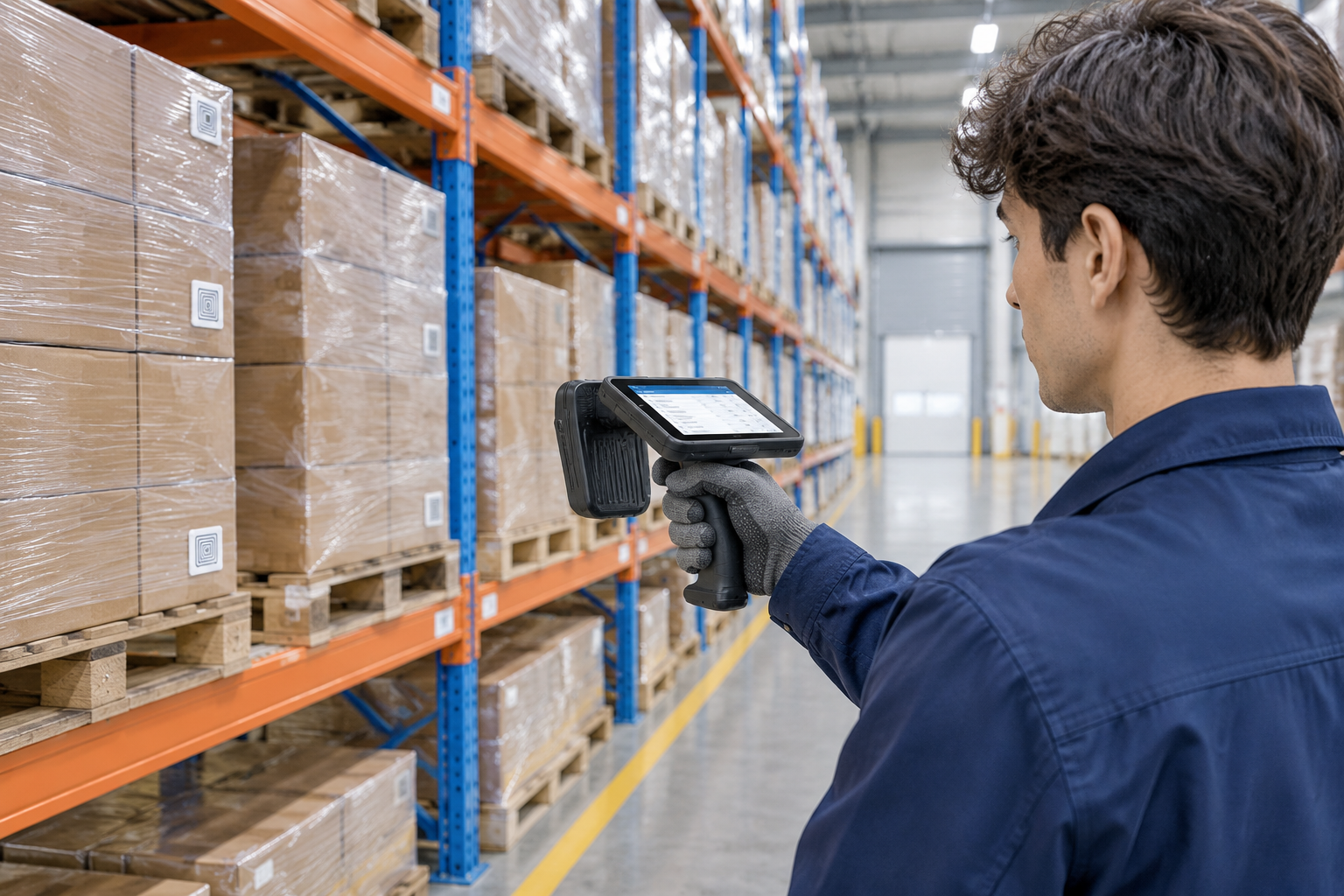 Warehouse and yard — this is what 10 m is for
Reading a full pallet face from the aisle floor is the case where range matters and where a circular antenna pays for itself, because carton labels face in every direction. It is also where the honest caveat belongs: shrink-wrap and stacked cartons absorb and shadow UHF, so a pallet of liquid or foil will read far worse than a pallet of cardboard. Say it, and the buyer plans a walk-past rather than expecting a scan from the door.
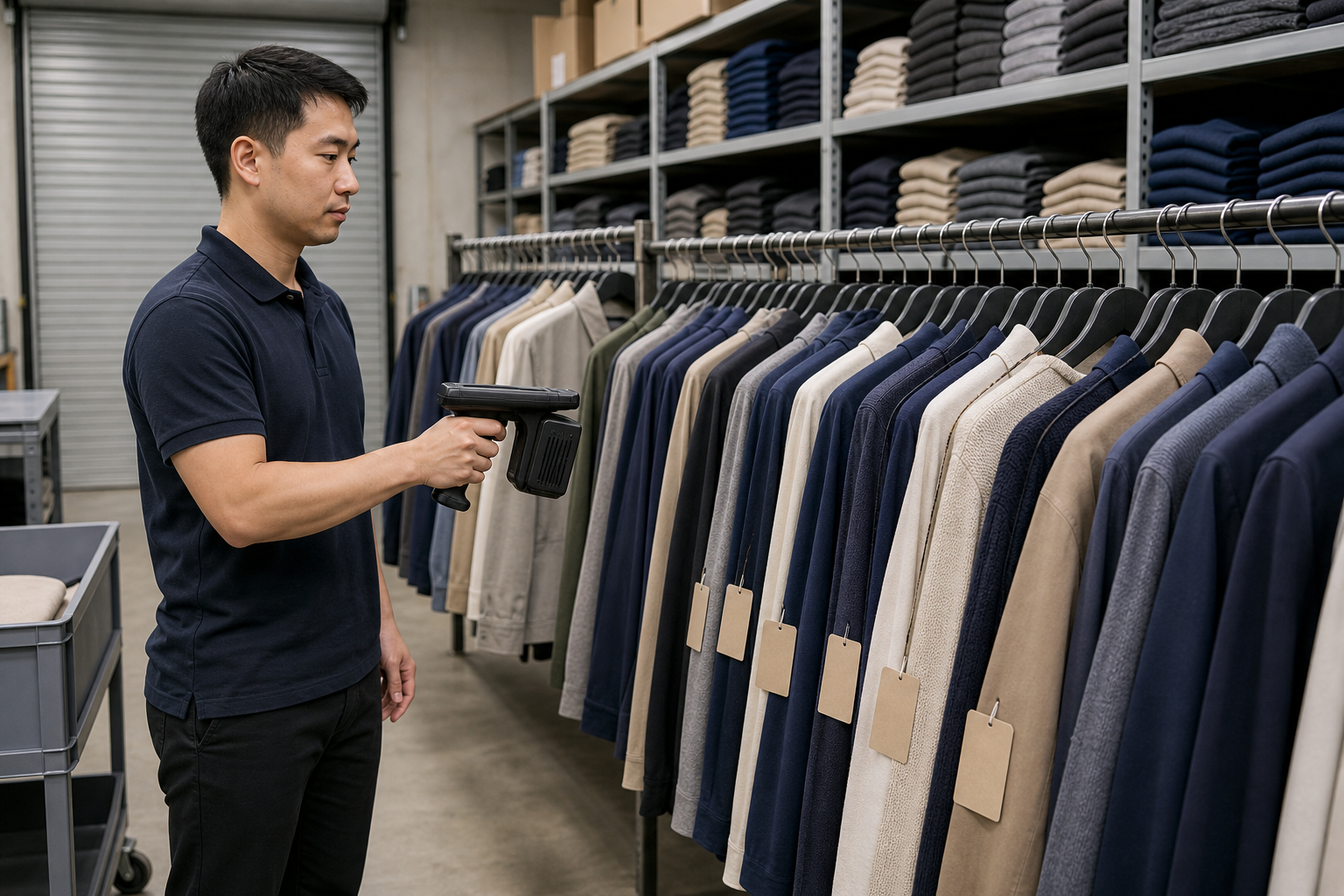 Apparel retail — this is what Gen2X Authenticity is for
Item-level retail is the densest tag population in any of these applications, and the reason Impinj built FastID. Stock counts that took a morning take minutes, and the same device reads the shelf and the stockroom. The under-used argument is brand protection: a Gen2X reader can authenticate a tag cryptographically, which is how a counterfeit garment with a copied serial gets caught at the rail rather than at the returns desk.
Questions we get asked
Yes, on an Impinj H47 label, held steady, with a clear line of sight and the power set to 33 dBm. In a real building expect less: a smaller tag, a label at an angle, stacked cartons and metal shelving all reduce it, and a tag on liquid can drop to around a metre. Establish your own figure with a site test before you commit to a read zone — we will send sample tags matched to your product for exactly that.
No. The HF reader takes the UID from ISO 15693 and ISO 14443A/B tags and does not implement the encryption protocols, so MIFARE Classic protected sectors, DESFire applications and payment cards are out of reach. That is the right design for stocktaking and asset identification, and it is the wrong device for access control, canteen payments or any card whose data is protected.
Four things: better receive sensitivity during inventory rounds, faster identity reads through FastID, cryptographic tag authentication through Impinj Authenticity, and tag data protection through Impinj Protected Mode. The first makes stocktaking faster, the last two are how you defeat cloned tags and unauthorised rewriting — which is the argument for this reader over a cheaper one in retail and brand protection.
580 g is the sum of a 5 dBi antenna array, a 6700 mAh battery and a housing rated to IP67 and 2 m drops. Nothing in that list is optional for this class of device. The pistol grip exists because it moves the load into the palm instead of the wrist — plan a holster or lanyard for the walking between reads rather than expecting to hold it out for a whole shift.
IP67 covers rain and dust, and the operating range is −20 °C to +50 °C, so an outdoor yard in most climates is fine. A blast freezer below −20 °C is outside the rating, and repeatedly moving a cold device into a warm humid room causes condensation inside the housing — which is the failure mode that IP67 does not address. For cold-chain work, ask us about the specific temperature profile before specifying.
Four things: what you are reading (cartons, garments, assets), the tag you intend to use or whether you need us to recommend one, whether the site has metal or liquid near the tags, and how many devices with what accessories. Those four answers set the model, the antenna, the accessory kit and the spares quantity — and they are the same four questions we would ask on a call.
Copyright © ©Copyright 2024 Greatest IoT Technology Co., Ltd all rights reserved - Privacy policy