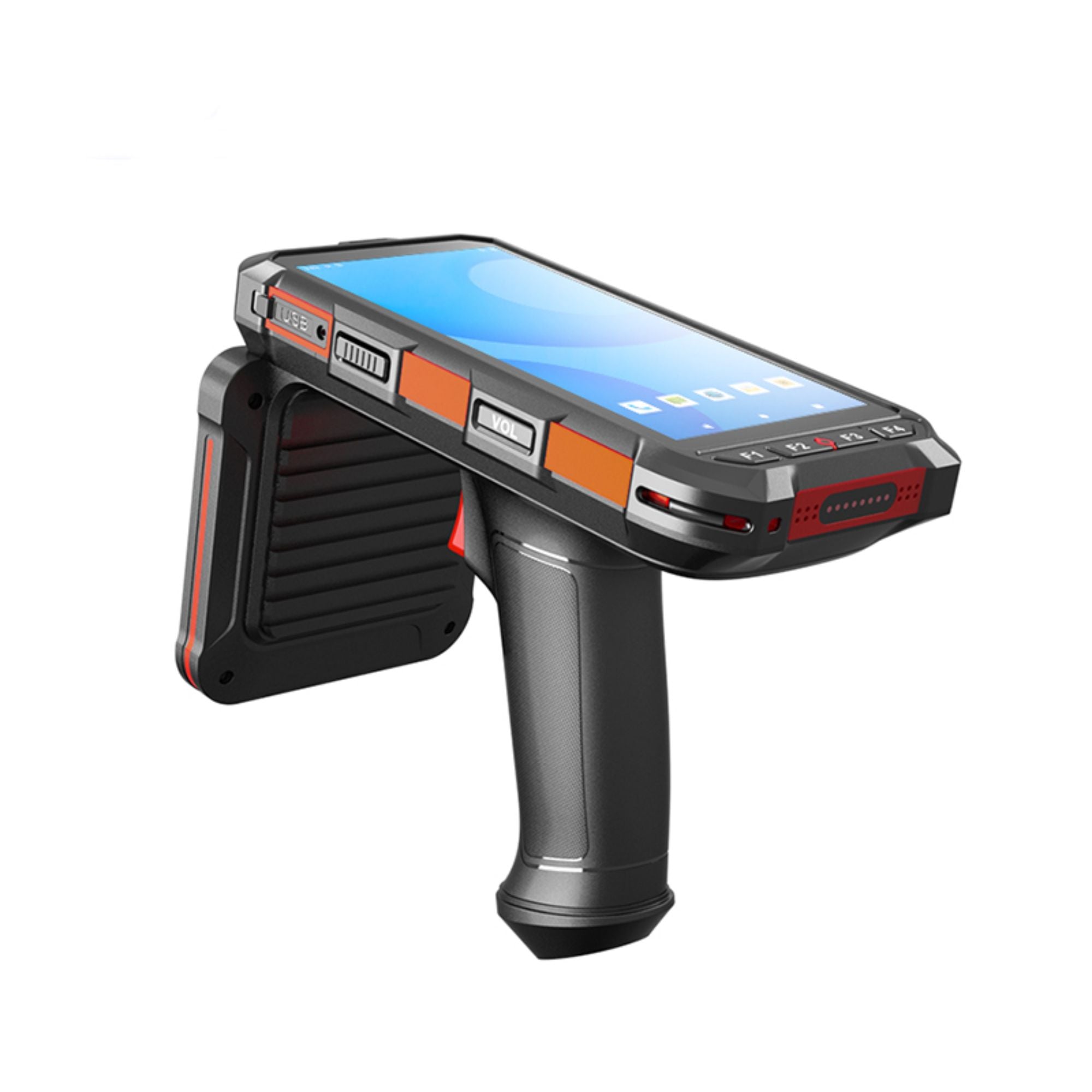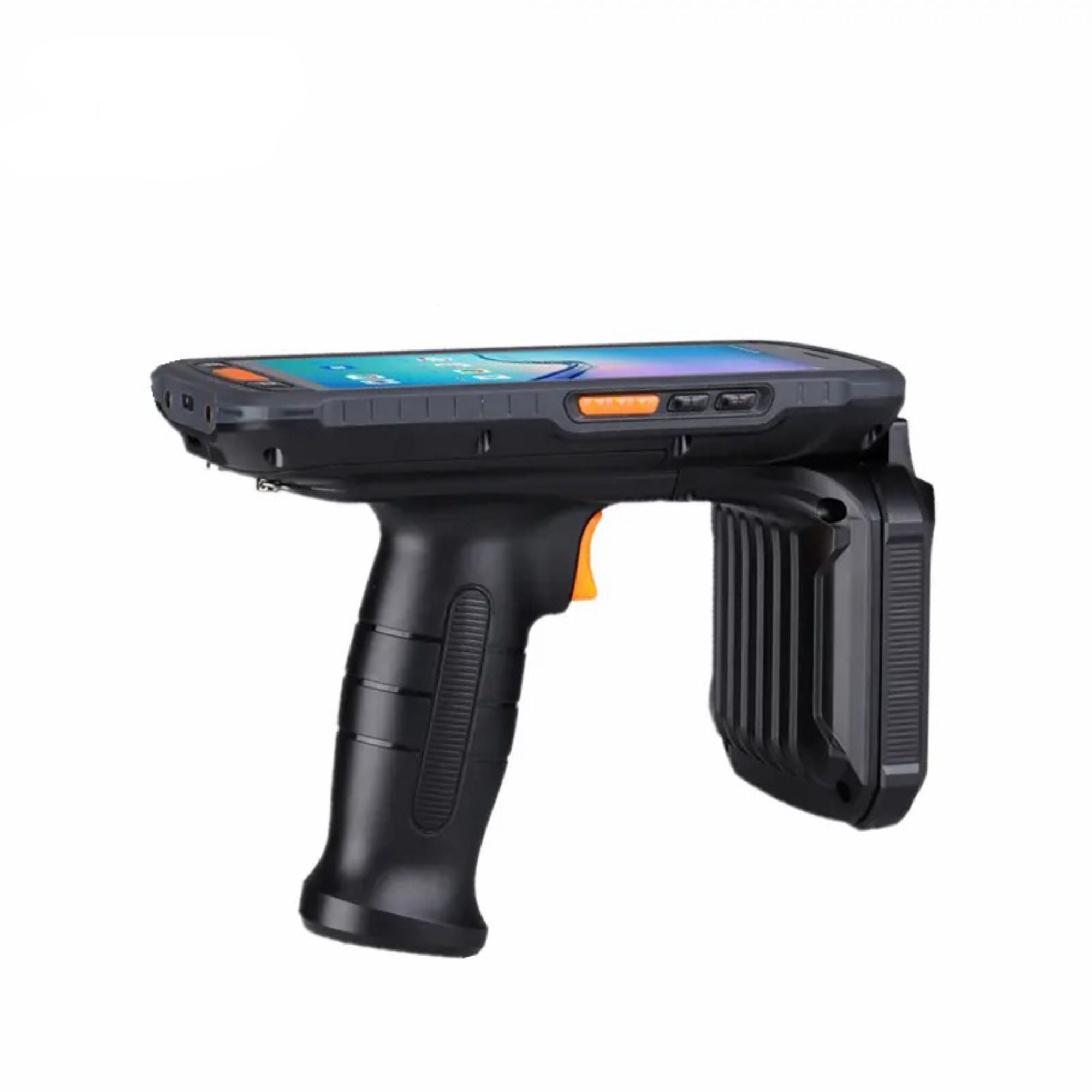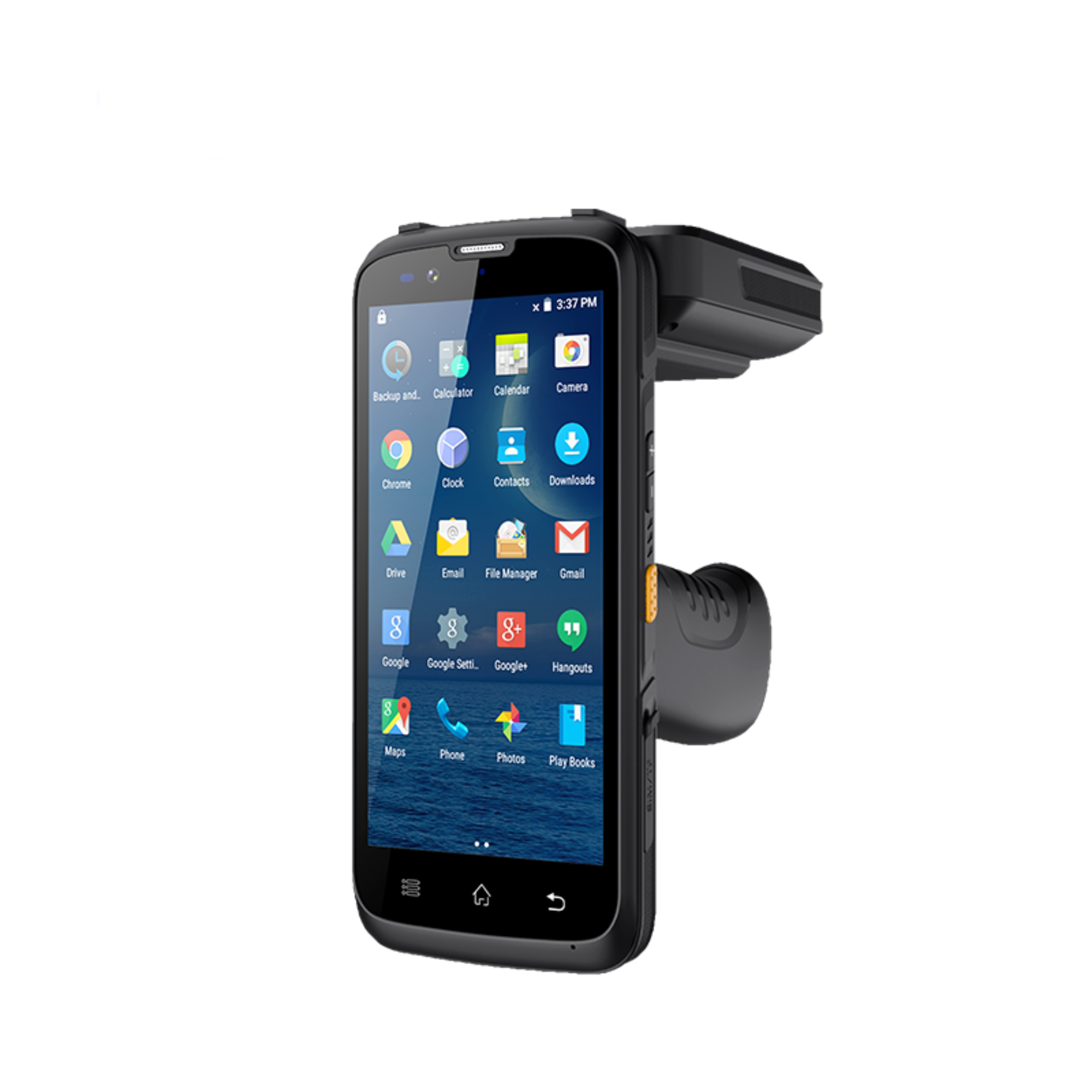

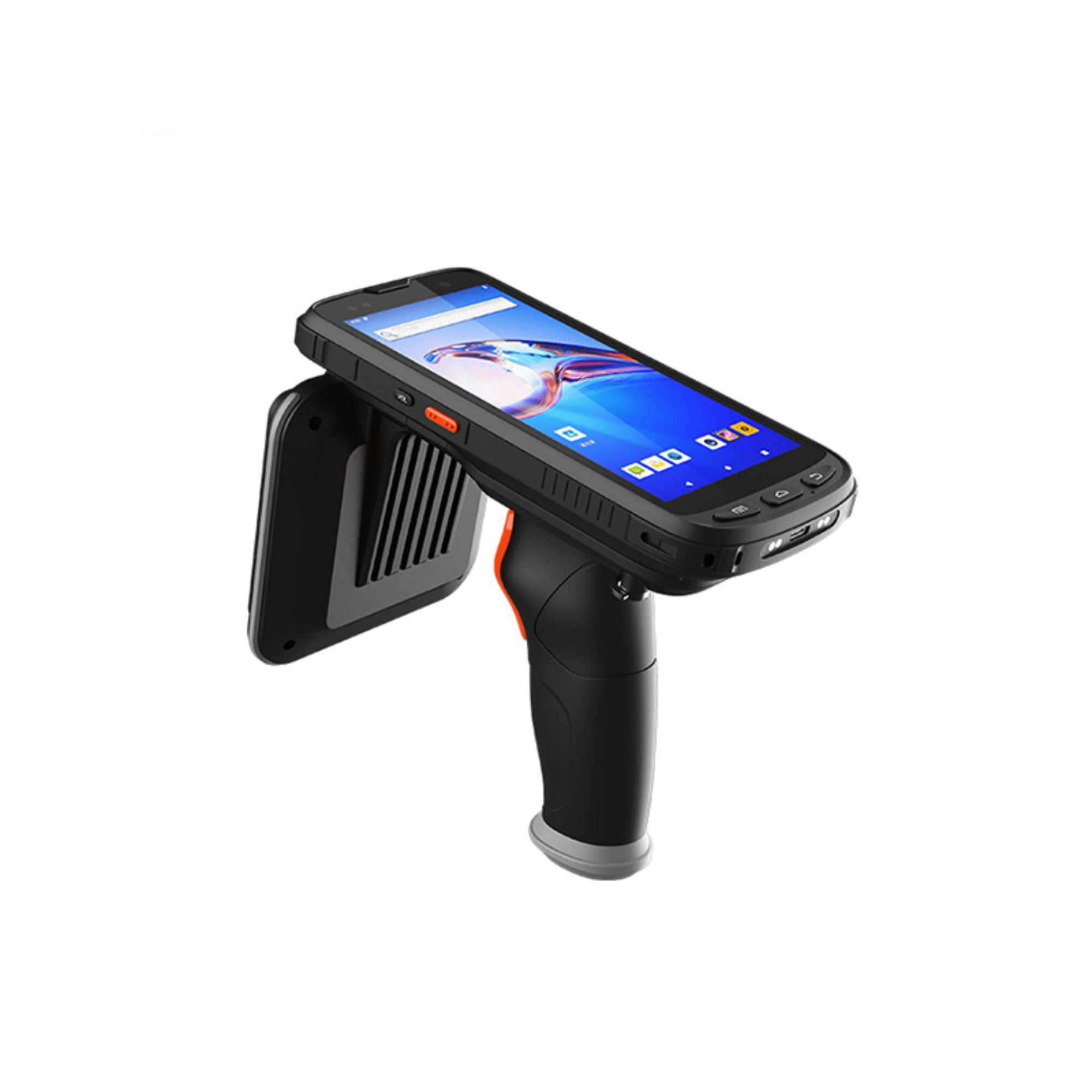
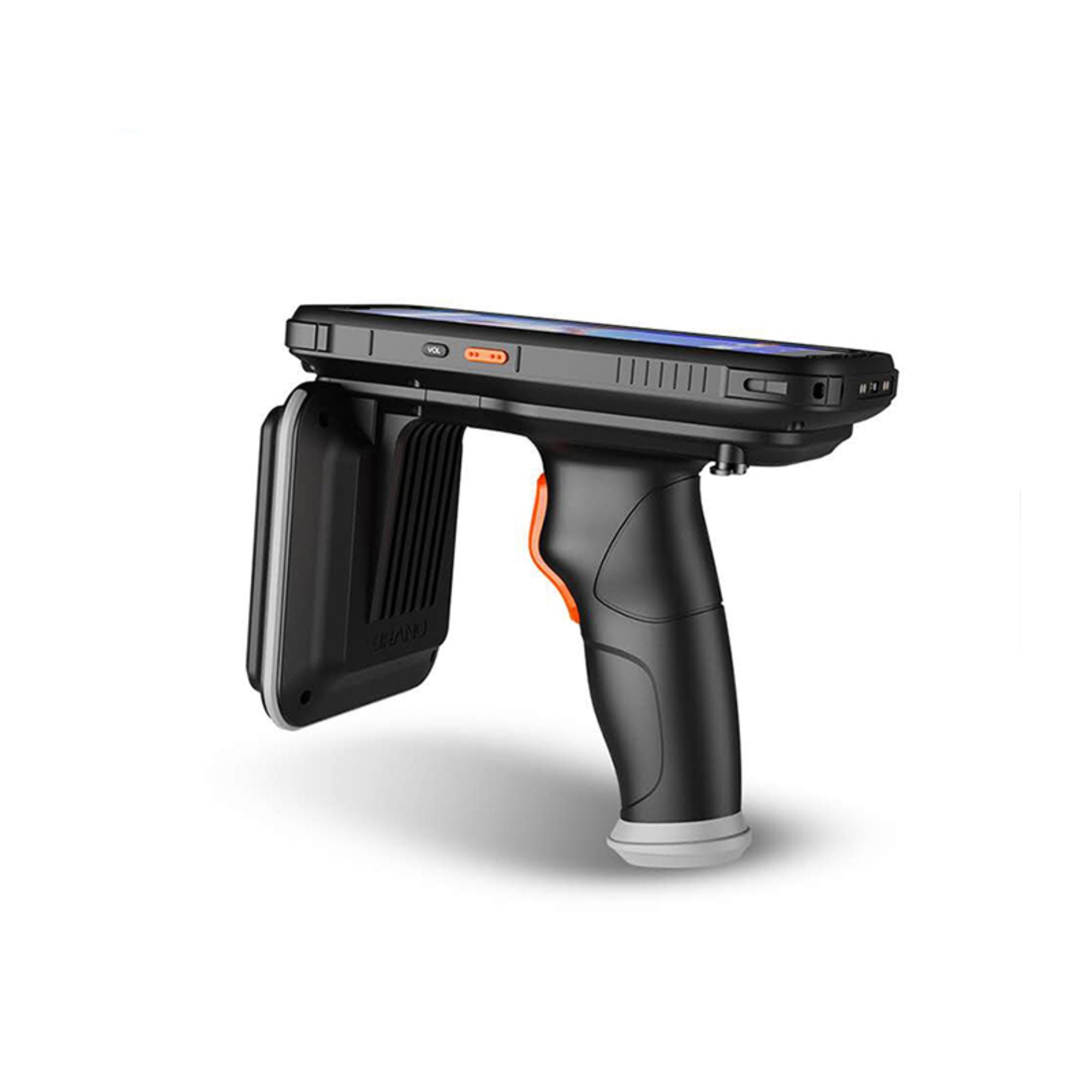
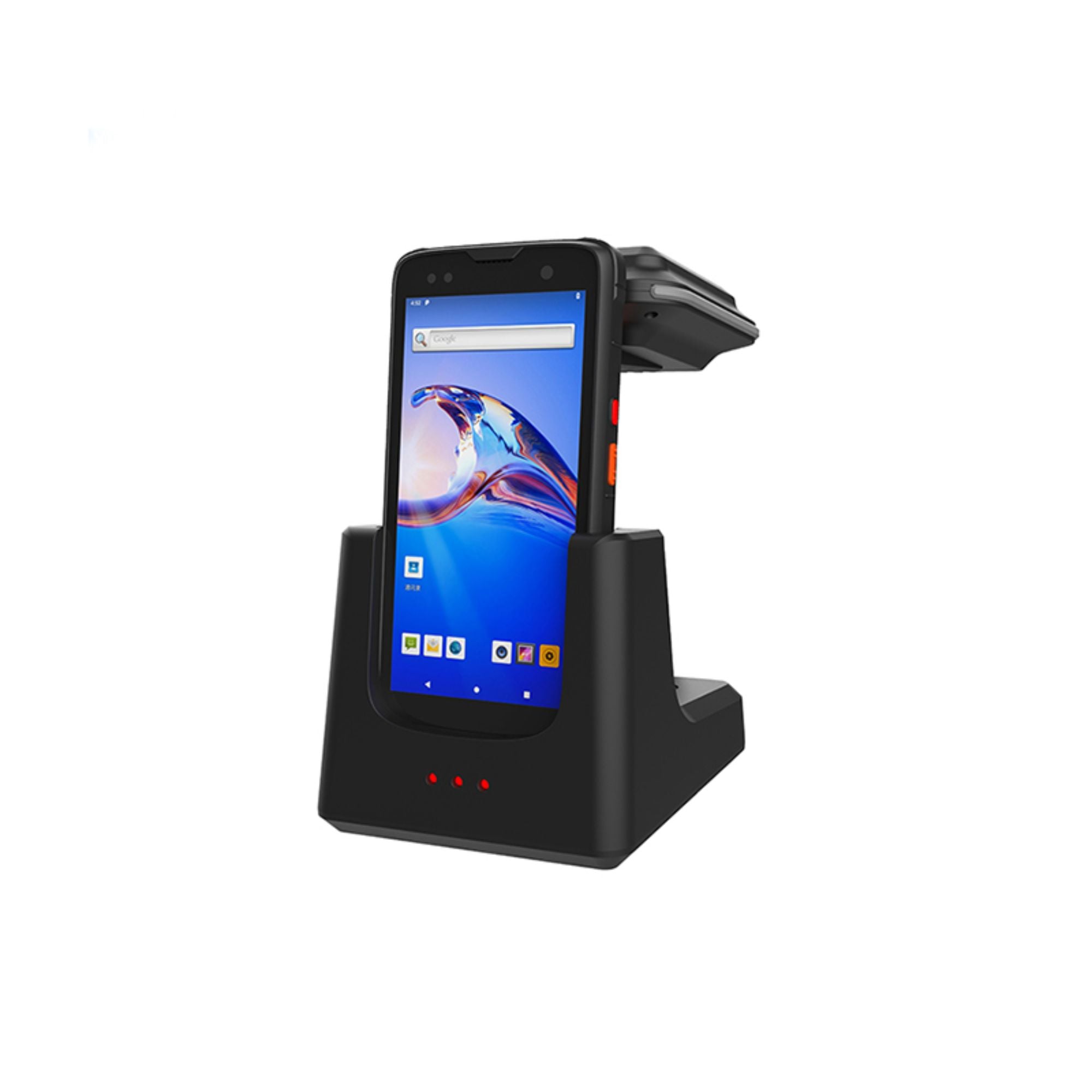
An industrial Android handheld built around a 9000 mAh battery and an IP65 over-moulded body: UHF RFID, a Zebra SE4710 or Mindeo ME5600 2D imager, 13.56 MHz NFC, 4G with a full carrier band list, GPS, and — unusually in this class — a PSAM slot for secure-element applications.
Read range
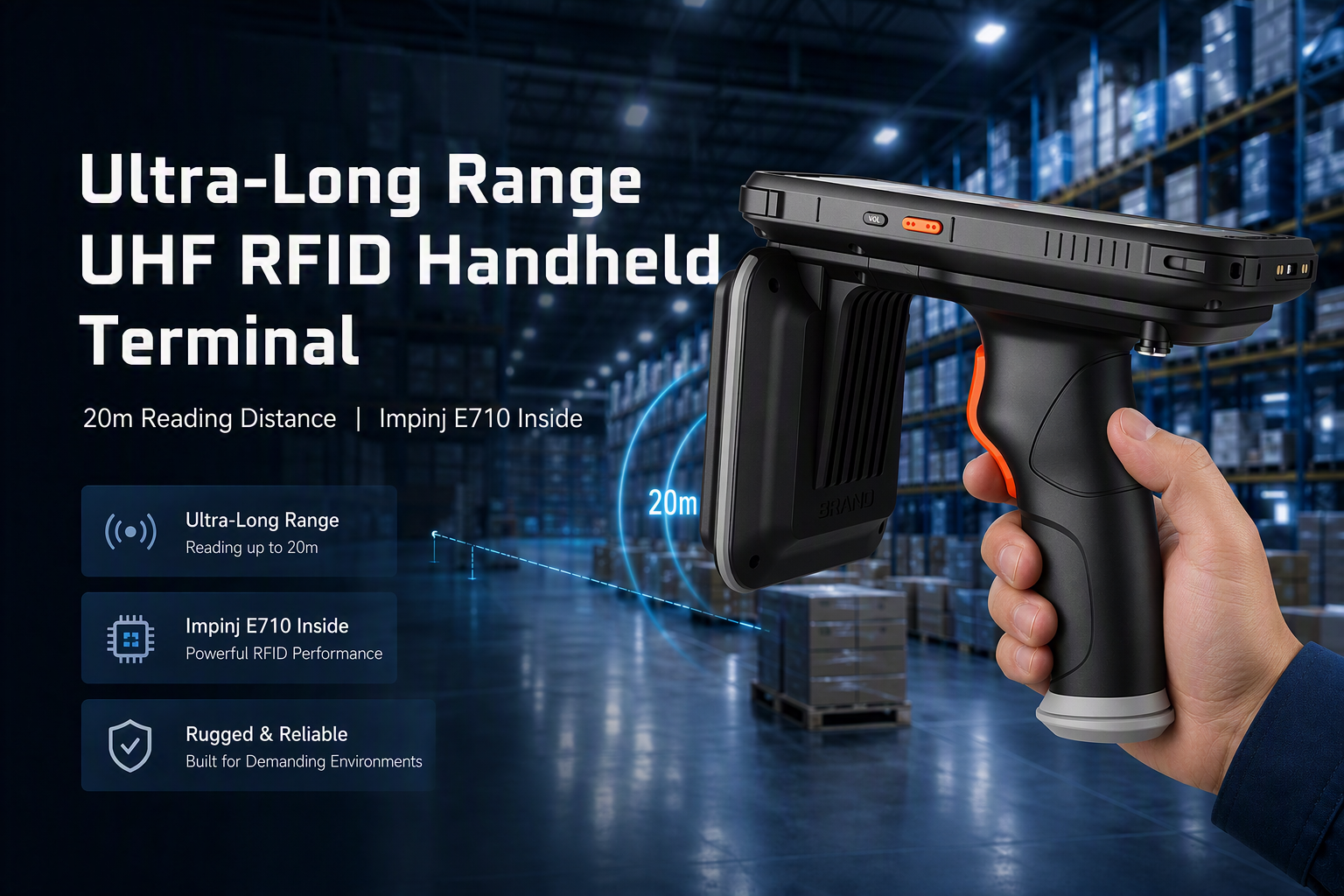
20 m is the best case, not the promise. It needs a large label, a clear line of sight and the output turned up. Most sites see less, and a tag on liquid or metal can fall to around a metre.
That is not a limitation of this device — it is how UHF behaves. The table below shows what the same reader delivers when only the tag and the surroundings change.
| SITUATION | TYPICAL RANGE | WHY |
| Quoted figure | 10–20 m | large label, aimed, clear sight line, high output power |
| Your own tag | about 70% | a smaller antenna has less gain to give |
| Label at an angle | about 50% | the circular antenna reads in any rotation, at a cost in distance |
| Stacked cartons | about 30% | near labels shadow the ones behind them |
| Liquid or metal | about 10% | bottles, cans, foil and steel shelving detune the tag |
A 4 dBi circularly polarised antenna reads a tag at any rotation — the right choice for garments on a rail or cartons facing every direction. The cost is roughly half the power a linear antenna would put in one direction. It is why this device reads a pallet face without being aimed, and why a linear-antenna reader quoting a longer distance on an aligned label is not lying: it is selling a different compromise.
Two handhelds, one range
We supply both pistol-grip readers. They overlap less than they appear to, and the choice usually comes down to one question: do you need a secure element and a documented cellular radio, or a newer operating system and a tougher enclosure?
Everything below comes from the published specification of each device.
| SPECIFICATION | BX6100 | uTouch2-C |
| Operating system | Android 10.0 | Android 12 |
| Memory | 2 GB / 16 GB or 4 GB / 64 GB | 4 GB / 64 GB or 8 GB / 128 GB |
| Battery | 9000 mAh, 3.8 V | 6700 mAh, QC3.0 quick charge |
| Weight | 600 g with battery and wrist strap | 580 g with battery |
| Sealing | IP65 — dust-tight, water jets | IP67 — includes temporary immersion |
| Drop rating | 1.5 m to concrete across the operating range | 2.0 m |
| UHF reader IC | Impinj reader IC | Impinj E710, −98 dBm sensitivity |
| UHF antenna | 4 dBi circular | 5 dBi circular |
| UHF read range | up to 20 m, tag dependent | ≥10 m on an Impinj H47 label |
| PSAM secure element | Yes — ISO 7816 | Not offered |
| Cellular bands | Full band list published | SIM slot, bands not documented |
| Barcode engine | Zebra SE4710 or Mindeo ME5600 | Mid-range 2D imager |
| SDK | Free Java SDK with sample code | On request |
Choose the BX6100 for payment-adjacent work, identity verification, long shifts without a battery swap, and any project where your integrator needs a documented cellular radio, a named barcode engine and a free SDK. It is the more complete platform of the two.
Choose the uTouch2-C for harsher environments — wet floors, open yards, food processing — for a longer software support window, and where the radio specification has to stand up in a tender. It is the tougher and newer device.
Specification
| PARAMETER | VALUE |
| PHYSICAL | |
| Dimensions | 166 mm H × 79 mm W × 31 mm D, ±2 mm |
| Weight | 600 g net, including battery and wrist strap |
| Display | 5.5 in TFT-LCD, 720 × 1440, capacitive touch, Gorilla Glass 3, 9H, LED backlight |
| Expansion | 1 PSAM, 1 SIM, 1 microSD (TF) up to 256 GB |
| Battery | Rechargeable lithium-ion polymer, 3.8 V, 9000 mAh |
| PERFORMANCE | |
| Processor | Cortex-A73 octa-core, 2.0 GHz |
| Operating system | Android 10.0 Ask us for the security patch level of the build we ship |
| Memory | 2 GB RAM / 16 GB storage, or 4 GB RAM / 64 GB storage |
| ENVIRONMENT | |
| Operating temperature | −20 °C to +50 °C |
| Storage temperature | −20 °C to +70 °C |
| Humidity | 5% to 95% RH, non-condensing |
| Drop rating | 1.5 m to concrete, across the full operating temperature range |
| Sealing | IP65 to IEC 60529 — dust-tight, protected against water jets Not rated for immersion; specify the IP67 uTouch2-C where a device can fall into standing water |
| Electrostatic discharge | ±15 kV air discharge, ±8 kV contact discharge |
| UHF RFID — OPTIONAL | |
| Frequency | 865–868 MHz or 920–925 MHz Ask about a 902–928 MHz variant for North America |
| Air interface | EPCglobal Class 1 Gen 2 / ISO 18000-6C |
| Reader IC | Impinj reader IC Exact part number supplied with every quotation |
| Antenna | Circular polarisation, 4 dBi |
| Read range | Up to 20 m, depending on tag and environment |
| HF / NFC — OPTIONAL | |
| Frequency | 13.56 MHz |
| Protocol | ISO/IEC 14443A, ISO/IEC 15693, NFC-IP1, NFC-IP2 |
| Read and write range | 2 cm to 5 cm |
| BARCODE — OPTIONAL | |
| Engine | 2D CMOS imager — Zebra SE4710 or Mindeo ME5600 |
| 2D symbologies | PDF417, MicroPDF417, Composite, DataMatrix, QR Code, Micro QR, Aztec, MaxiCode |
| 1D and postal | RSS, TLC-39, US PostNet, US Planet, UK Postal, Australian Postal, Japan Postal, Dutch Postal Standard retail and logistics 1D codes including Code 128 and EAN/UPC are supported — confirm against your own label |
| CONNECTIVITY | |
| Cellular | TDD-LTE bands 38, 39, 40, 41; FDD-LTE bands 1, 2, 3, 4, 7, 17, 20; WCDMA 850 / 1900 / 2100 MHz; GSM / GPRS / EDGE 850 / 900 / 1800 / 1900 MHz Compare against your operator's bands before specifying |
| Wi-Fi | 2.4 GHz and 5 GHz, IEEE 802.11 a/b/g/n/ac |
| Bluetooth | 2.1 + EDR, 3.0 + HS, 4.2 |
| GPS | GPS with embedded A-GPS, 5 m accuracy |
| PSAM SECURITY — OPTIONAL | |
| Protocol | ISO 7816 |
| Baud rates | 9600, 19200, 38400, 56000, 57600, 115200 |
| Application support | Payment, identity verification, transit and tax-control schemes use a secure access module Tell us the scheme and we will confirm the module you need |
| DEVELOPMENT | |
| SDK | Handheld Wireless Software Development Kit, free, with sample code |
| Language and IDE | Java, Android Studio |
| OEM / ODM | Customised baseband and software available |
In use
 Advantages of having PSAM slots
Almost no handheld in this price band offers an ISO 7816 secure element. Where a SAM matters — mobile payment, identity verification, transit top-up, tax-control invoicing — its absence disqualifies a device outright, and its presence means the buyer does not need a second terminal.
Questions we get asked
Twenty metres is achievable with a large label, a clear line of sight and the output turned up, but it is a best case. In a warehouse aisle expect roughly half that, and on a tag attached to a liquid-filled bottle or a metal shelf expect around a metre. We will measure it against your own labels before you commit to a read zone.
The BX6100 uses an Impinj E710 reader.
An ISO 7816 secure access module handles the cryptography for applications that need it — payment schemes, identity verification, transit, and some tax-control regimes. It lets the handheld act as a certified terminal rather than a plain reader. The certification belongs to the module and the scheme, so tell us the application and we will confirm compatibility.
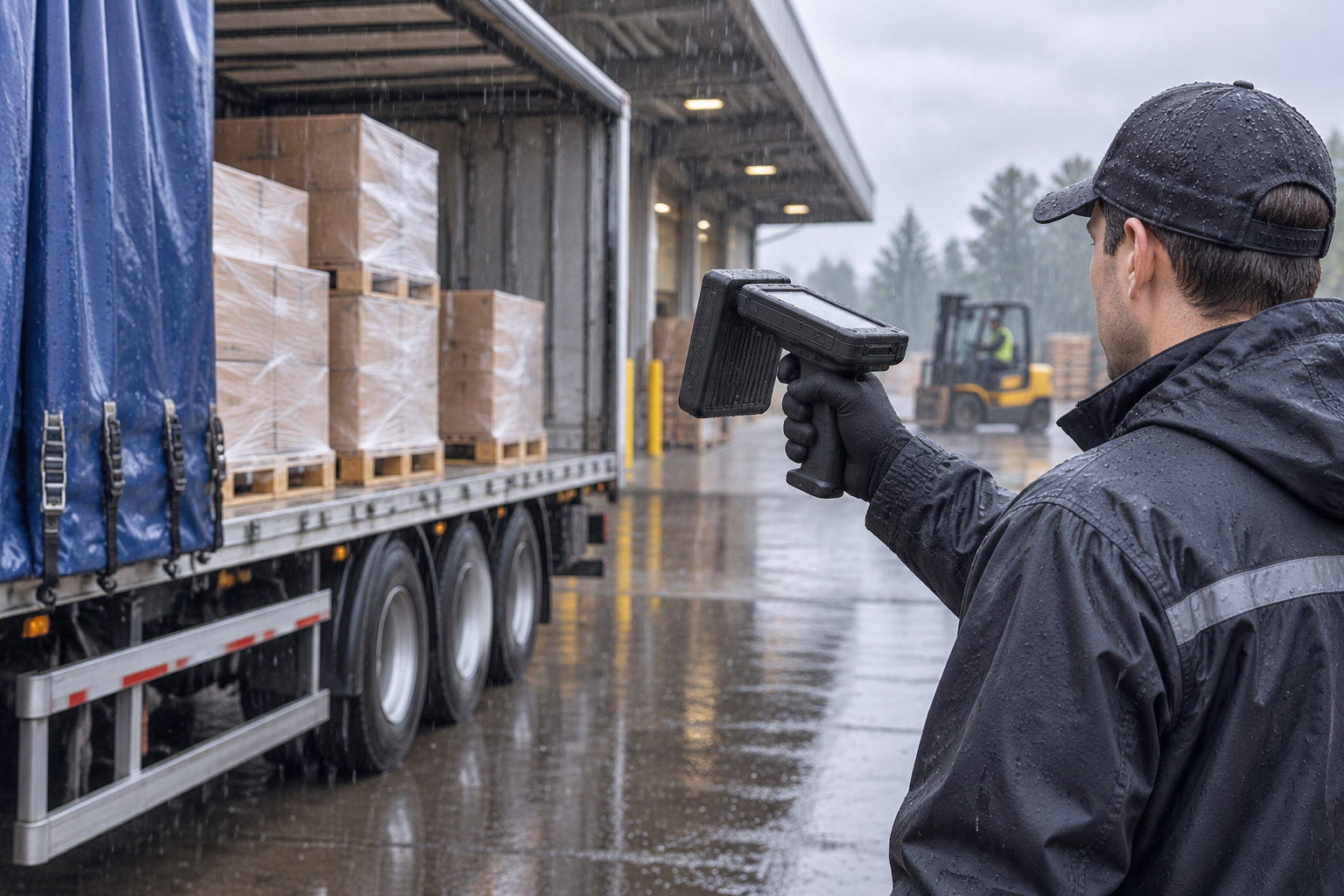
IP65 is dust-tight and protected against water jets, which covers rain, spray and wash-down of the housing. IP67 adds temporary immersion, and matters if a device can fall into a tank, drain or puddle. A covered dock or indoor warehouse is served by IP65; food processing, wet floors and open yards in heavy weather call for the IP67-rated uTouch2-C instead.
Yes, and it is one of the strongest features of this device: a free Java SDK with sample code for Android Studio, covering the UHF reader, the 2D imager, NFC and the PSAM. OEM and ODM are supported with customised baseband or software. Tell us what the app needs to do and we will confirm what the SDK exposes before you commit to the platform.
Check the published list against your operator: LTE bands 1, 2, 3, 4, 7, 17, 20, 38, 39, 40 and 41, WCDMA at 850, 1900 and 2100 MHz, and quad-band GSM. There is no band 5, 8, 12, 13, 28 or 71, so rural routes and North American networks should be confirmed before you specify.
Four things: what you are reading, which tag or label you intend to use, whether metal or liquid is involved, and how many devices with which accessories. Those four answers set the reader configuration, the accessory kit and the spares quantity — and they are the same four questions we would ask on a call.
We will confirm the reader IC and its sensitivity, measure read distance against your own labels, check the PSAM module against your scheme, and send a sample with the SDK so your developer can test before you commit.
Copyright © ©Copyright 2024 Greatest IoT Technology Co., Ltd all rights reserved - Privacy policy