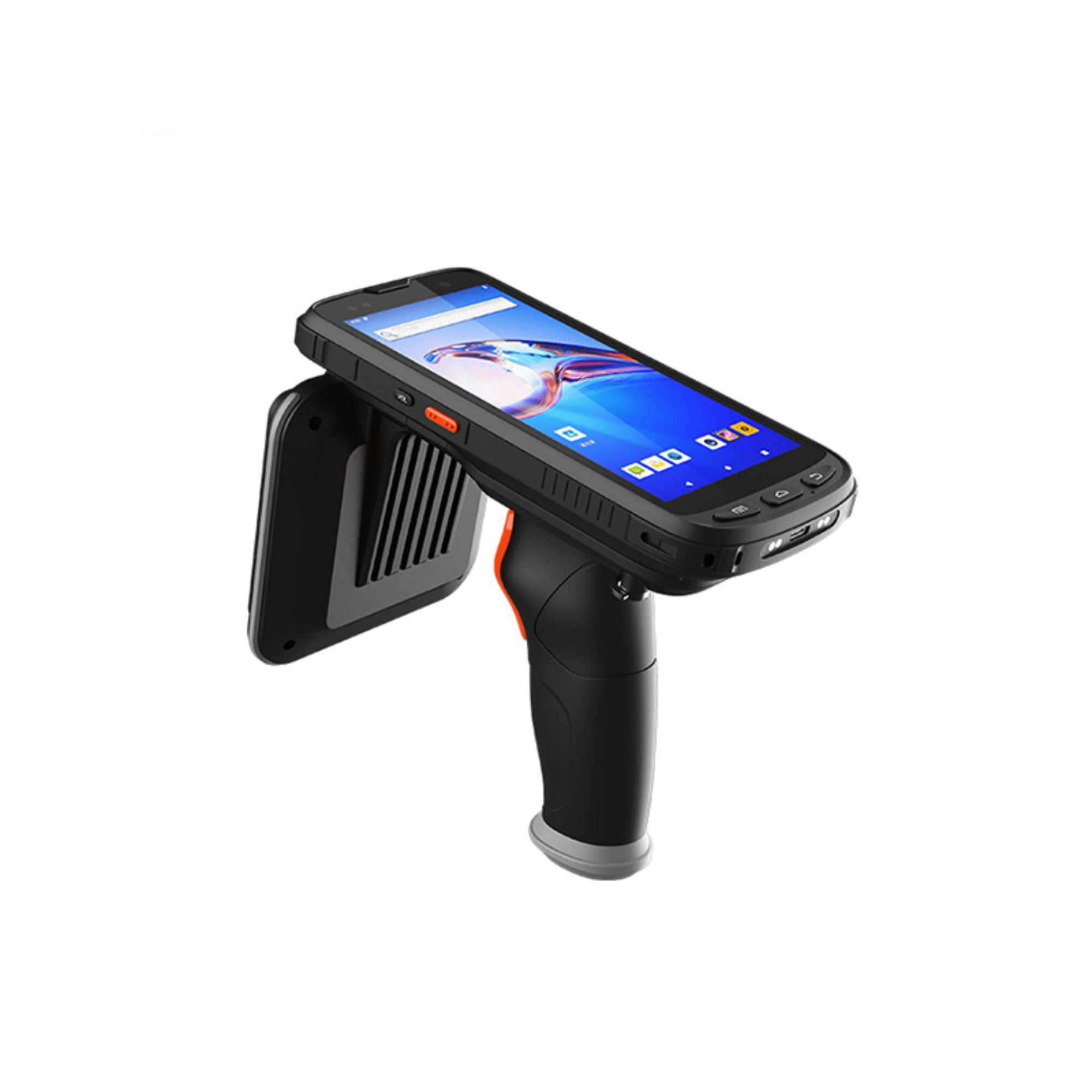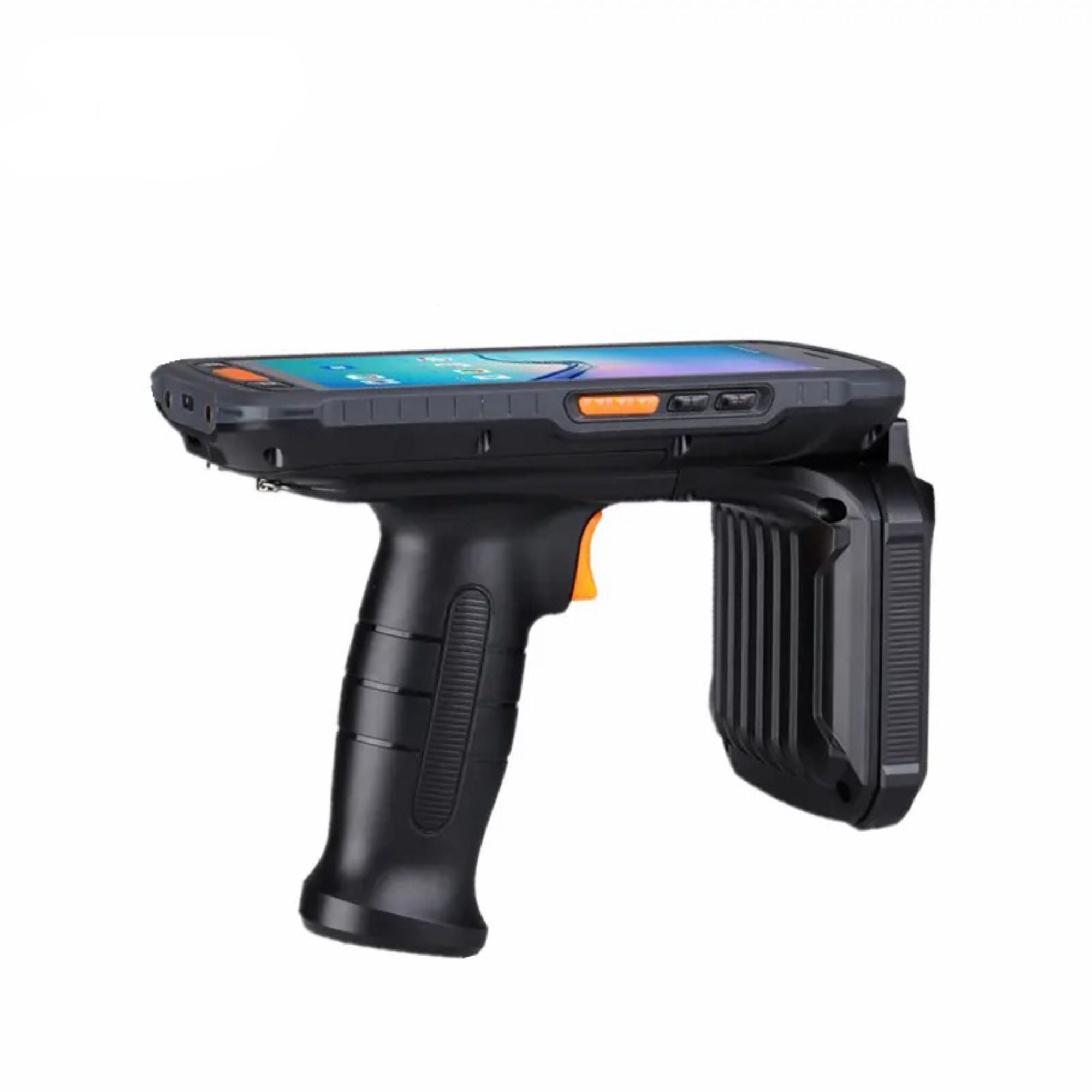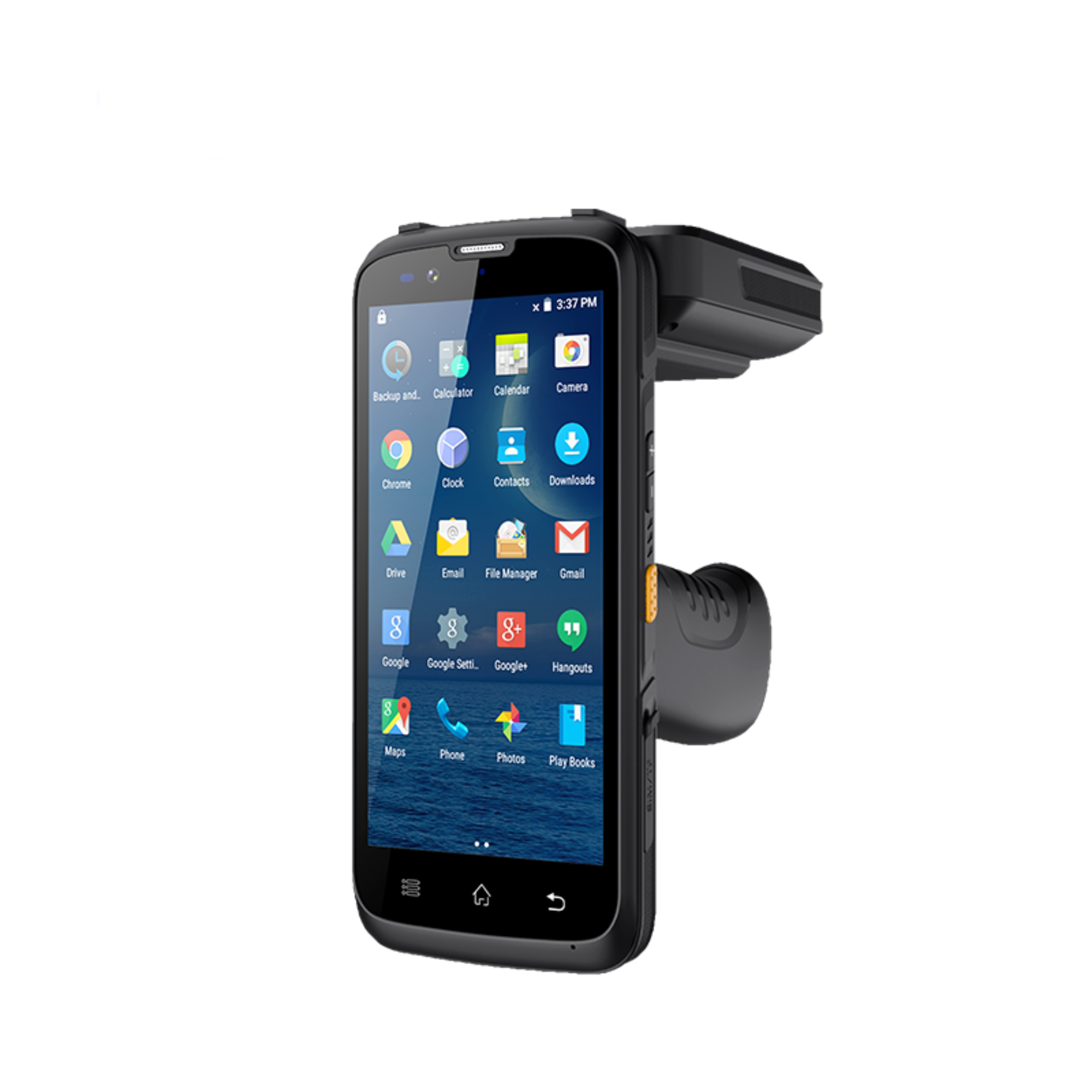

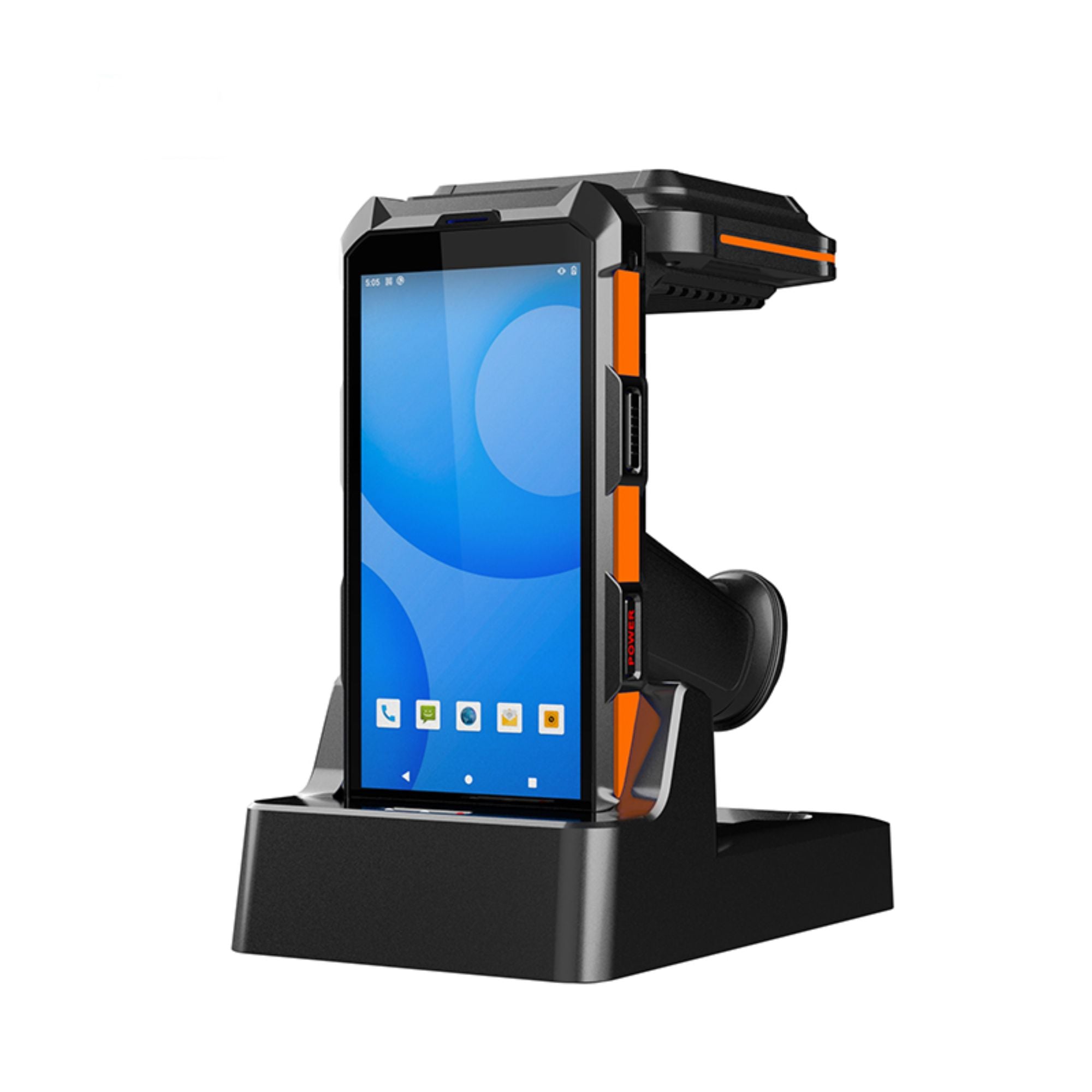
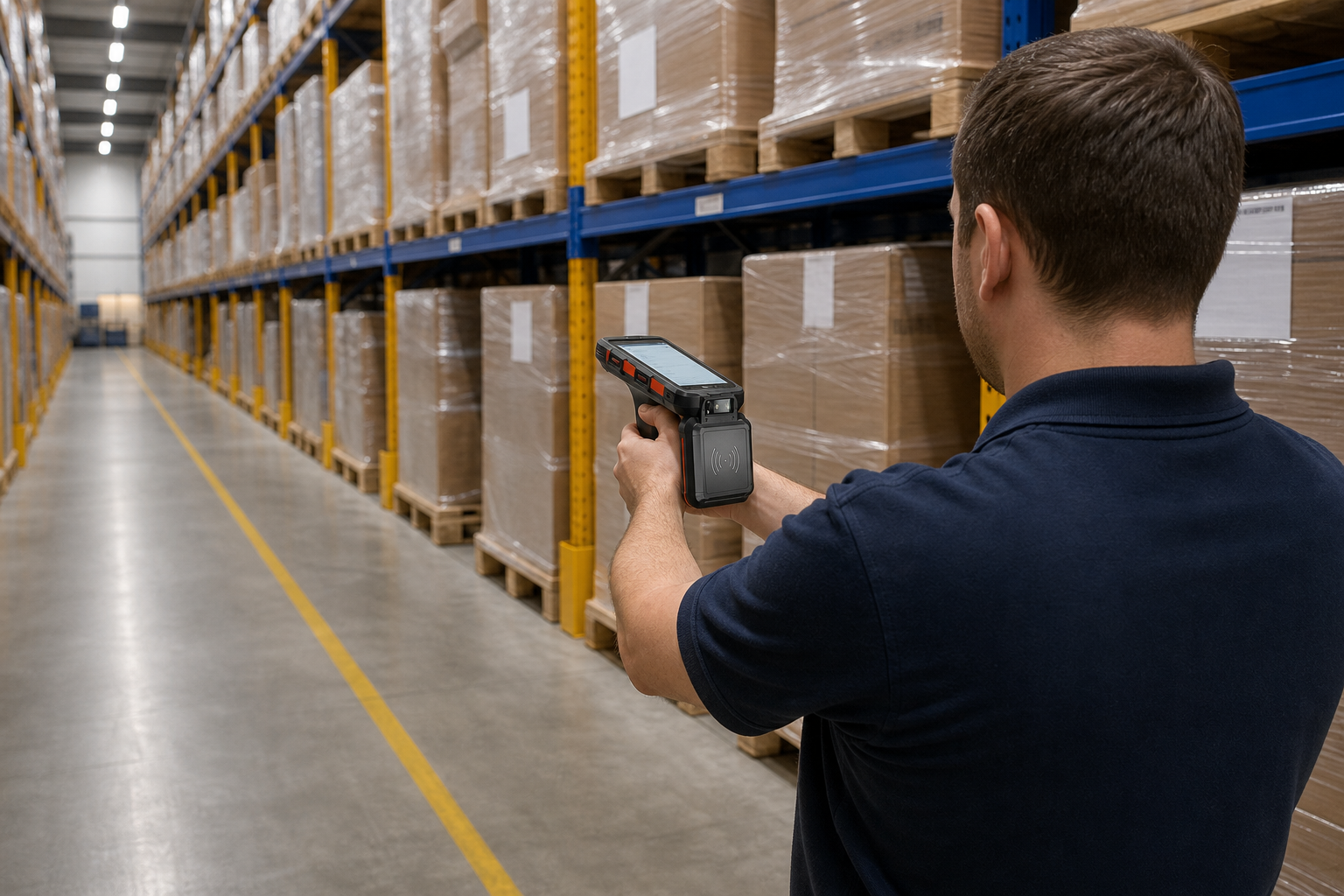
The C6100 is a 5.5-inch Android handheld built around an Impinj UHF reader and a circular 4 dBi antenna. Specified without its add-ons it is a 20.4 mm slab that sits in a cradle for counter work. Add the UHF module and the pistol grip and it becomes a gun-format reader rated at 18 m — roughly the length of four pallet positions.
The number that decides the project
Four distances from one reader. Which row your project lands on is decided by the tag, not by the terminal.
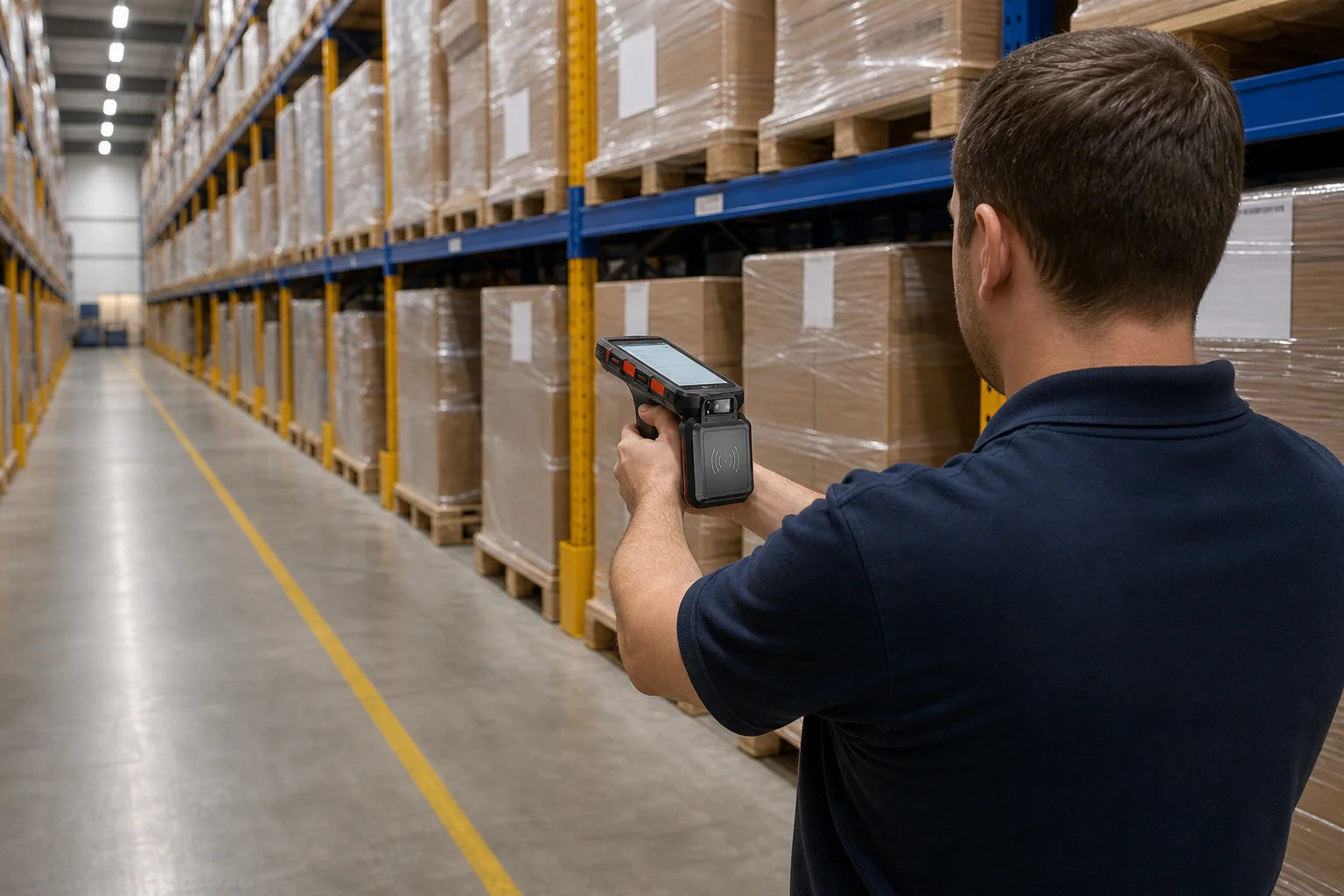
The working distance this class of reader is bought for: reading pallet faces from the aisle floor instead of walking to each one.
Before you order
UHF RFID does not have one global band. This unit is built for 865–868 MHz or 920–925 MHz. North America runs at 902–928 MHz, and that is a different radio, not a setting. If you are buying for the United States, Canada or anywhere else on the FCC allocation, say so at the enquiry stage.
Same reader, three regional allocations. Frequency is a hardware choice, so it has to be settled before the order, not after.
In the hand, and in the cold
A long-range handheld is carried for a whole shift, so the body figures matter as much as the radio. Two of them are worth reading carefully.
| PARAMETER | VALUE | WHY IT MATTERS |
| Body | 171 × 81 × 20.4 mm ± 2 mm without pistol grip and UHF module |
Slim enough to sit in a cradle on a counter and still be the same device you fit a grip to. Check the fitted depth before you buy a holster. |
| Weight | 600 g net, including battery and wrist strap | Mid-range for this class. Lighter than a full-size gun-format reader, heavier than a phone terminal. |
| Battery | 7,500 mAh, 3.8 V lithium polymer, rechargeable | 28.5 Wh, which is well under the 100 Wh air-freight threshold, so it ships as lithium-ion contained in equipmen |
| Display | 5.5 in TFT-LCD, 720 × 1440, capacitive touch, LED backlight | Portrait 720 × 1440 is a phone-shaped screen, so Android apps built for a handset fit without rework. |
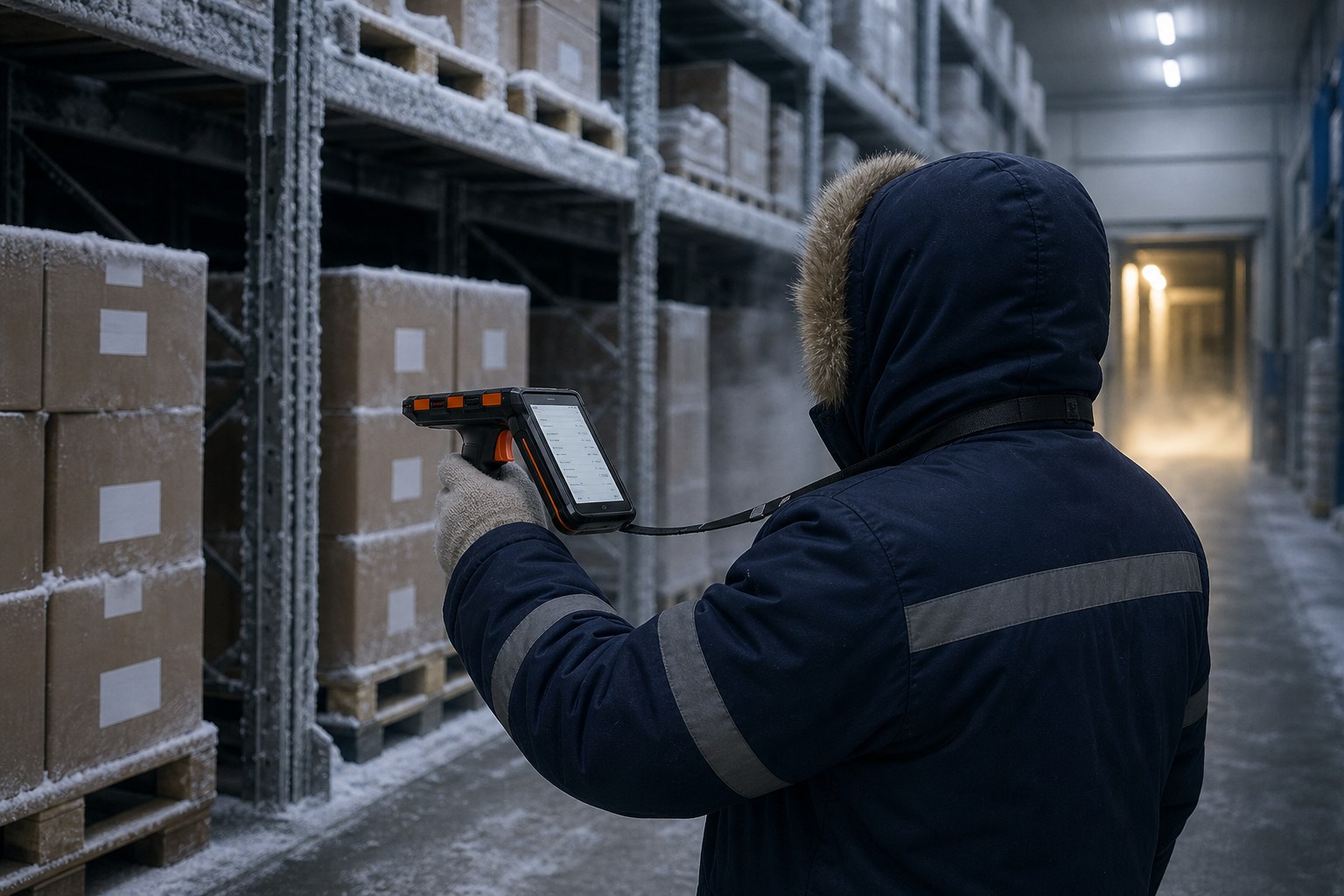
| Operating temperature | −20 °C to +50 °C | The −20 °C floor is what makes freezer work possible, with the caveat below about the battery. |
| Sealing | IP65 | Dust-tight and protected against water jets. Not rated for immersion. |
| Drop | 1.5 m to concrete, across the full operating temperature range | The temperature qualifier is the useful part: a cold-soaked plastic shell breaks at a drop height it would survive warm. |
| ESD | ±15 kV air discharge, ±8 kV direct discharge | Enough for a warehouse floor. Not an intrinsic-safety rating for hazardous atmospheres. |
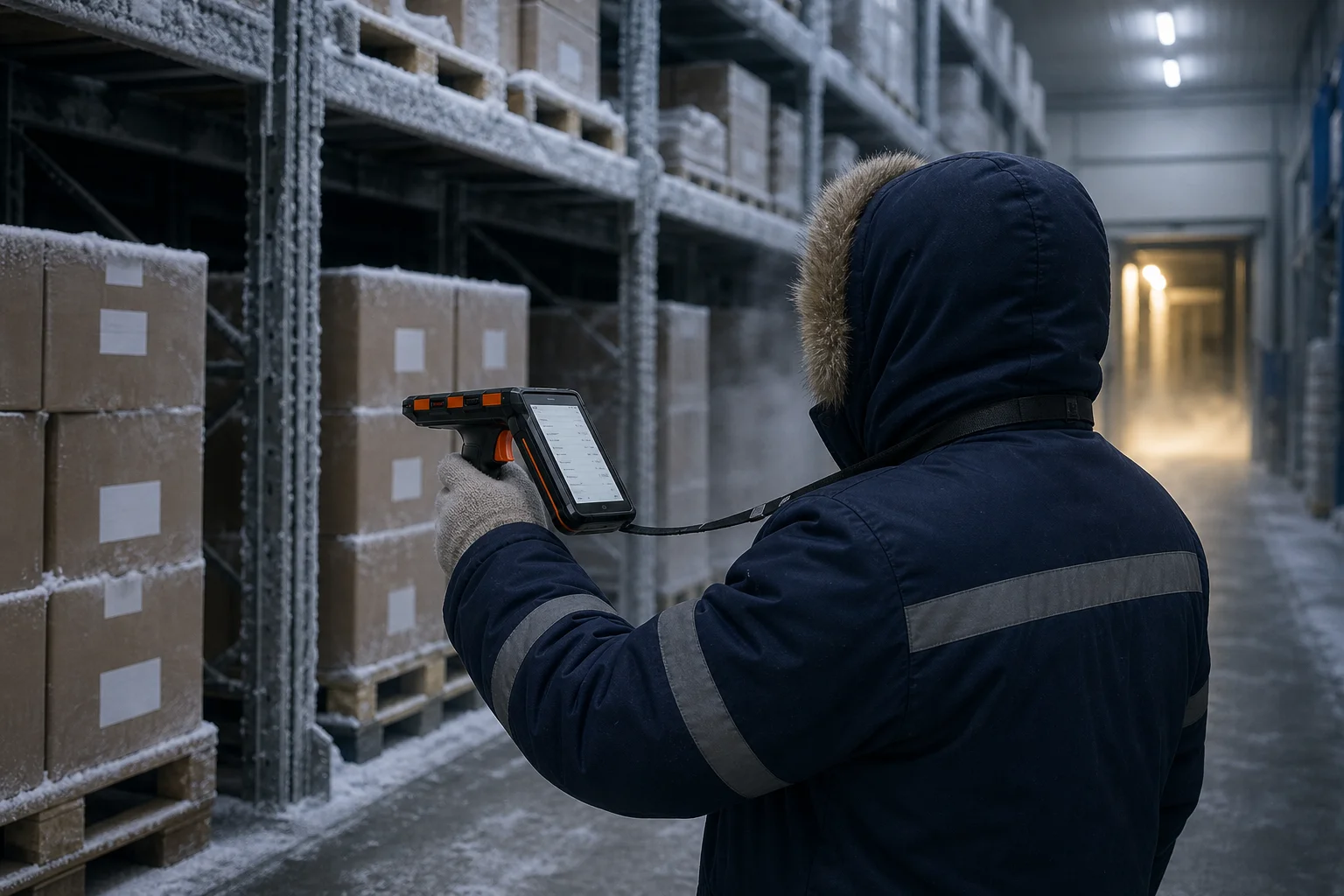
The −20 °C rating in use. The device survives the aisle; the battery is the part to plan around.
Specification
| PARAMETER | VALUE |
| PHYSICAL | |
| Dimensions | 171 × 81 × 20.4 mm ± 2 mm, excluding the pistol grip and UHF antenna module |
| Weight | 600 g net, including battery and wrist strap |
| Display | 5.5 in TFT-LCD, 720 × 1440, capacitive touch, LED backlight |
| Expansion | 2 × PSAM, 2 × SIM, 1 × TF (microSD up to 256 GB) |
| Battery | Rechargeable lithium-ion polymer, 3.8 V, 7,500 mAh — 28.5 Wh |
| Keypad | Physical keys including scan trigger and F1 to F4 function keys |
| PERFORMANCE | |
| CPU | Cortex-A73, 2.0 GHz, octa-core |
| Operating system | Android 10.0 |
| Memory | 4 GB RAM / 64 GB ROM; a 3 GB / 32 GB variant is available on request |
| USER ENVIRONMENT | |
| Operating temperature | −20 °C to +50 °C |
| Storage temperature | −20 °C to +70 °C |
| Humidity | 5 %RH to 95 %RH, non-condensing |
| Drop | 1.5 m to concrete, across the full operating temperature range |
| Sealing | IP65 — dust-tight and protected against water jets. Not rated for immersion |
| ESD | ±15 kV air discharge, ±8 kV direct discharge |
| DATA COMMUNICATION | |
| Cellular | TDD-LTE Band 38, 39, 40, 41; FDD-LTE Band 1, 2, 3, 4, 7, 17, 20; WCDMA 850/1900/2100 MHz; GSM/GPRS/EDGE 850/900/1800/1900 MHz |
| Wi-Fi | 2.4 GHz and 5 GHz, IEEE 802.11 a/b/g/n/ac |
| Bluetooth | Bluetooth 2.1 + EDR, 3.0 + HS and 4.2 |
| GPS | GPS with embedded A-GPS, 5 m accuracy |
| RFID | |
| UHF frequency | 865–868 MHz or 920–925 MHz — two regional variants. Ask about 902–928 MHz for North America |
| UHF protocol | EPC Class 1 Gen 2 / ISO 18000-6C |
| UHF reader IC | Impinj |
| UHF antenna | Circular polarisation, 4 dBi |
| UHF read range | Up to 18 m, tag and environment dependent — see the range section above |
| NFC frequency | 13.56 MHz |
| NFC protocol | ISO 14443A and ISO 15693, NFC-IP1, NFC-IP2 |
| NFC read and write range | 2 cm to 5 cm |
| DATA CAPTURE | |
| 2D imager | Honeywell N6703 2D scan engine (optional) |
| Symbologies | PDF417, MicroPDF417, Composite, RSS, TLC-39, Data Matrix, QR, Micro QR, Aztec, MaxiCode and postal codes |
| Camera | Rear 13 MP, front 5 MP, auto-focus with LED flash |
| SECURITY | |
| PSAM | ISO 7816, 2 slots maximum. Baud rates 9600 to 115200 — confirm the rate you need with us |
| DEVELOPMENT | |
| SDK | Handheld wireless software development kit |
| Language | Java |
| IDE | Android Studio or Eclipse |
| ACCESSORIES | |
| Standard | 1 × power supply, 1 × lithium polymer battery, 1 × Type-C cable |
Not only a UHF reader
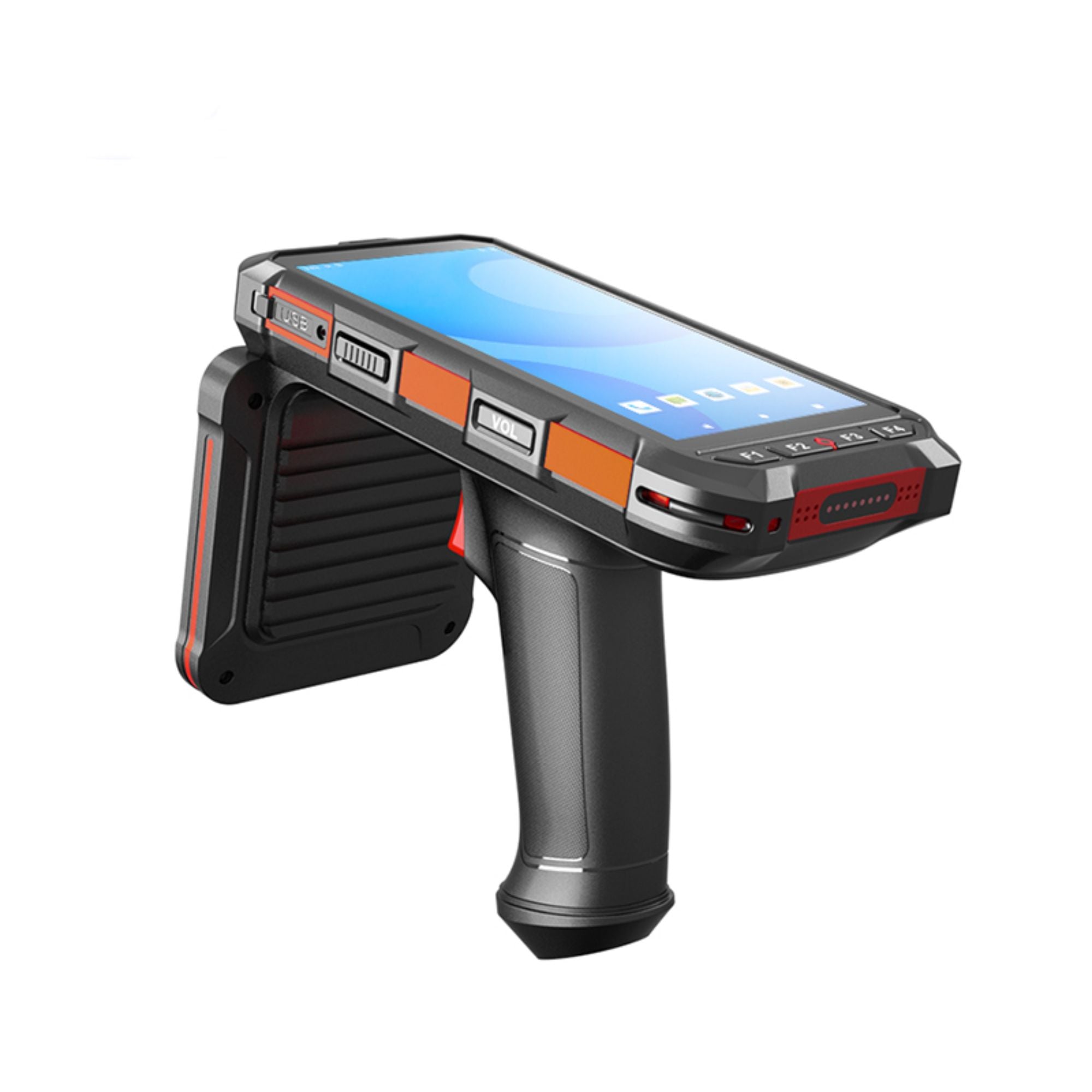
The control surface: volume keys, four programmable function keys, USB, and the speaker that makes a read audible over a warehouse.
Choosing between our handhelds
We sell four UHF handhelds and they overlap enough that buyers ask this question every week. The differences below are the ones that decide a project, taken only from what each product page already states.
| MODEL | UHF RANGE | BODY | BATTERY | ANDROID | FREQUENCY |
|
C6100 this page |
18 m, tag dependent | 171 × 81 × 20.4 mm, 600 g | 7,500 mAh | 10 | 865–868 or 920–928 MHz |
| BX6100 | Up to 20 m, tag dependent | 166 × 79 × 31 mm, 600 g | 9,000 mAh | 10 | 865–868 or 920–928 MHz |
| V9000S | 10 to 20 m, tag size dependent | 170 × 78 × 23.3 mm, 585 g | 12 h use, 3–4 h charge | 11 | 865–868, 920–928 MHz |
| HC720S | 5-10M | 178 × 83 × 17 mm, 580 g | 10,000 mAh removable, ~8 h | 12 | 865–868 or 920–928 MHz |
Deploying a fleet of them
One device is a purchase; two hundred devices is a lifecycle commitment. These are the points that come up in every fleet review.
| TOPIC | WHAT YOU GET |
| Development | Java SDK with sample code, Android Studio or Eclipse. The UHF, NFC, imager and camera APIs are documented in the kit, so your team integrates against one library rather than four. |
| Security hardware | 2 × PSAM slots to ISO 7816 alongside 2 × SIM slots. A PSAM holds the keys for payment, ticketing or a secure ID scheme, and it keeps them out of the Android file system — which is why terminals in this class carry the slot at all. |
| Network | 4G LTE with 2.4 and 5 GHz Wi-Fi and Bluetooth 4.2 for a belt printer or a ring scanner. Dual-band Wi-Fi is worth checking against your access points: a busy 2.4 GHz aisle is where pick rates die. |
| Android version | Android 10.0. It was released in 2019, so the question to ask is not which version, but which security patch level the shipped image carries and how long the manufacturer will keep publishing updates for it. Ask us in writing and keep the answer with the purchase order. |
| Device management | Standard Android enterprise enrolment, so an existing MDM can lock the device to one app, push config and wipe a lost unit. Confirm your MDM vendor supports Android 10 on rugged hardware before standardising. |
| Battery service | The pack is user-replaceable, which is what keeps a fleet alive past year three. Ask for the spare pack part number at the same time as the device order, not later. |
The cradle lets a shift-and-charge rotation work without opening the device or hunting for a cable.
Questions we are asked
It is a real figure for a matched tag in open conditions. It is not what you will get on metal racking or a liquid-filled drum. Passive UHF range scales with the square root of the power that reaches the tag, so a tag that is 6 dB less sensitive halves the distance, and a circular reader antenna gives up roughly half its power to a linearly polarised tag. Send us your tag and the surface it goes on, and we will measure the pair.
Writing needs a stronger field at the tag than reading does, so a reader that reads at 18 m writes at a shorter distance. Any single read/write figure you see on a datasheet is a read figure. Ask us for both if your process writes tags as well as reads them.
The pack is 7,500 mAh at 3.8 V, which is 28.5 Wh. Runtime is a different question: it depends on duty cycle, because continuous UHF transmission drains a pack far faster than barcode work. We quote the manufacturer figure with its test conditions rather than a slogan, and we recommend a spare pack for freezer work.
The stated operating range is −20 °C to +50 °C, so the terminal is rated for it. Plan around the battery: lithium cells accept charge slowly when cold and some protection circuits refuse to charge at all until the pack warms. Charge at room temperature, and carry a spare rather than charging in the aisle.
Yes. 13.56 MHz to ISO 14443A and ISO 15693, NFC-IP1 and NFC-IP2, with a 2 to 5 cm range. The short NFC range is useful rather than limiting: it is what makes a tap a deliberate act, which is why guard checkpoints and asset seals use it.
Copyright © ©Copyright 2024 Greatest IoT Technology Co., Ltd all rights reserved - Privacy policy