News

News

Home >  News

RFID Waste Bin Tag: Identification, Billing, and Collection Verification

2026-10-27

What Is an RFID Waste Bin Tag?

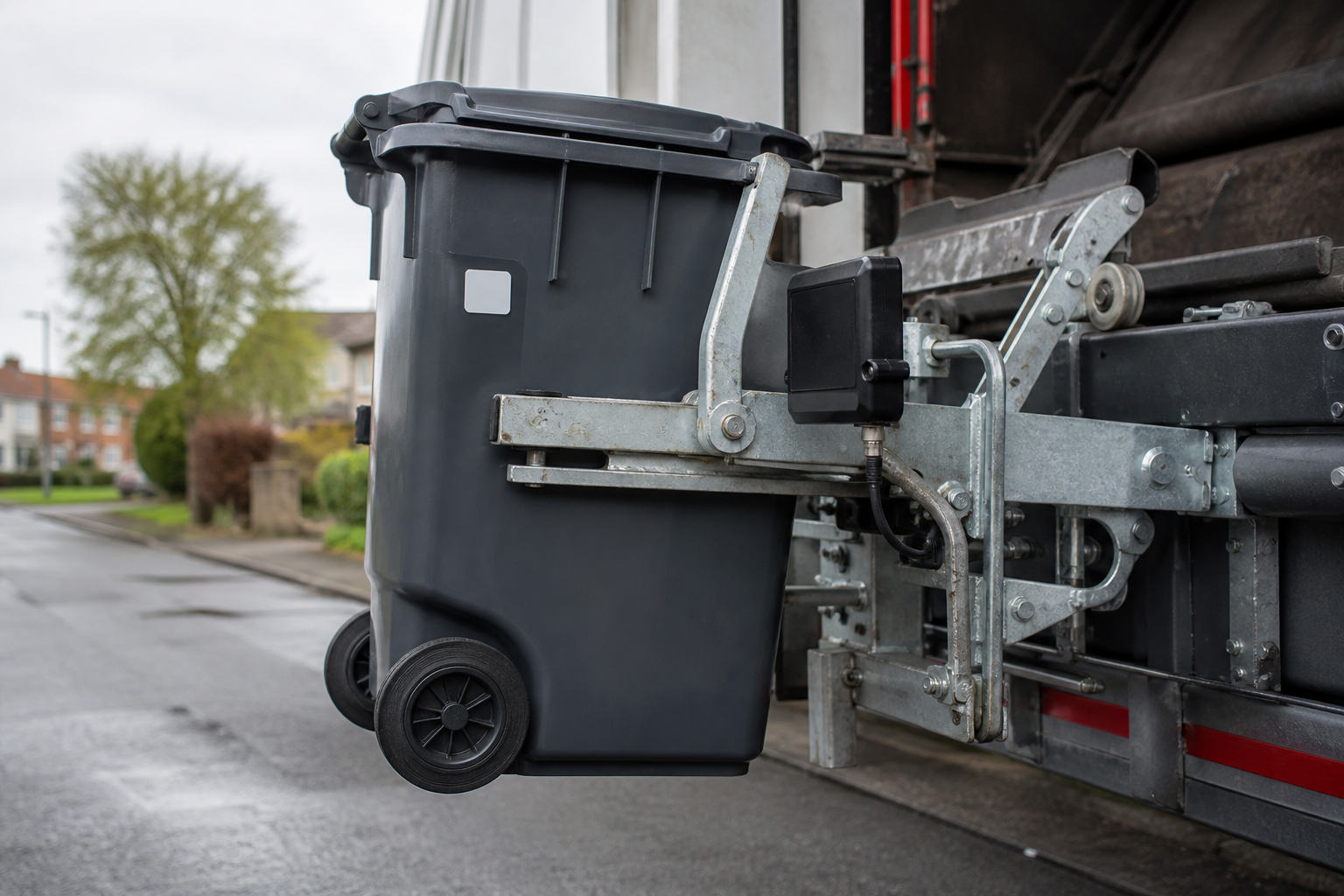
An RFID waste bin tag is a rugged, sealed transponder permanently fixed to a waste container so collection equipment can identify that specific bin automatically — usually the moment the bin is lifted. The tag carries a unique identifier; a reader mounted on the refuse collection vehicle's lifting mechanism reads it at pick-up, and the on-board system logs bin ID, time, location, and often weight.

The purpose is not inventory counting. It is evidence: proof that a specific container was serviced, evidence for charging a specific household or business, and a data trail that resolves disputes about missed collections.
img-mvqew5mt-afdd2ae3.png

How It Works in the Field

  1. Each bin receives a unique tag ID during manufacture, distribution, or a retrofit programme, mapped in a register to an address, account, or route.
  2. A reader is mounted on the collection vehicle — typically on the lifting frame, aimed at the tag's mounting position.
  3. As the bin is lifted, the tag is read without line of sight and without the crew doing anything.
  4. The on-board computer logs the event, frequently combined with weight from a lifting-scale system.
  5. The data is uploaded and reconciled against routes, accounts, and billing rules.

Because the read happens inside the lift cycle, the read window is short and the geometry is fixed. That is good for reliability — but it also means the tag's mounting position, orientation, and read range must be matched to the lift design, not chosen arbitrarily.

Choosing the Frequency

The three practical options behave very differently on a wheelie bin.

Option Typical read range Strengths Limitations
LF (125 / 134.2 kHz) Centimetres — supplier documentation for screw-type bin tags commonly quotes roughly 10–15 cm Excellent tolerance of water, dirt, ice, and non-metal bin walls; very robust in the lift geometry Very short range; requires well-aligned reader antenna mounting
HF (13.56 MHz) A few centimetres Standardised, widely available chips, good for controlled short-range reads Shortest usable range in many mounting positions; less forgiving of misalignment
UHF (840–960 MHz) Metres — supplier documentation for the same tag family often quotes around 2–3 m Longer range, faster reads, more tolerance of mounting position; supports reading at distance Detuned by metal bins unless an anti-metal layer is used; performance varies with bin material and nearby objects

Tag Construction and Mounting

Mounting method How it works Best for Watch-outs
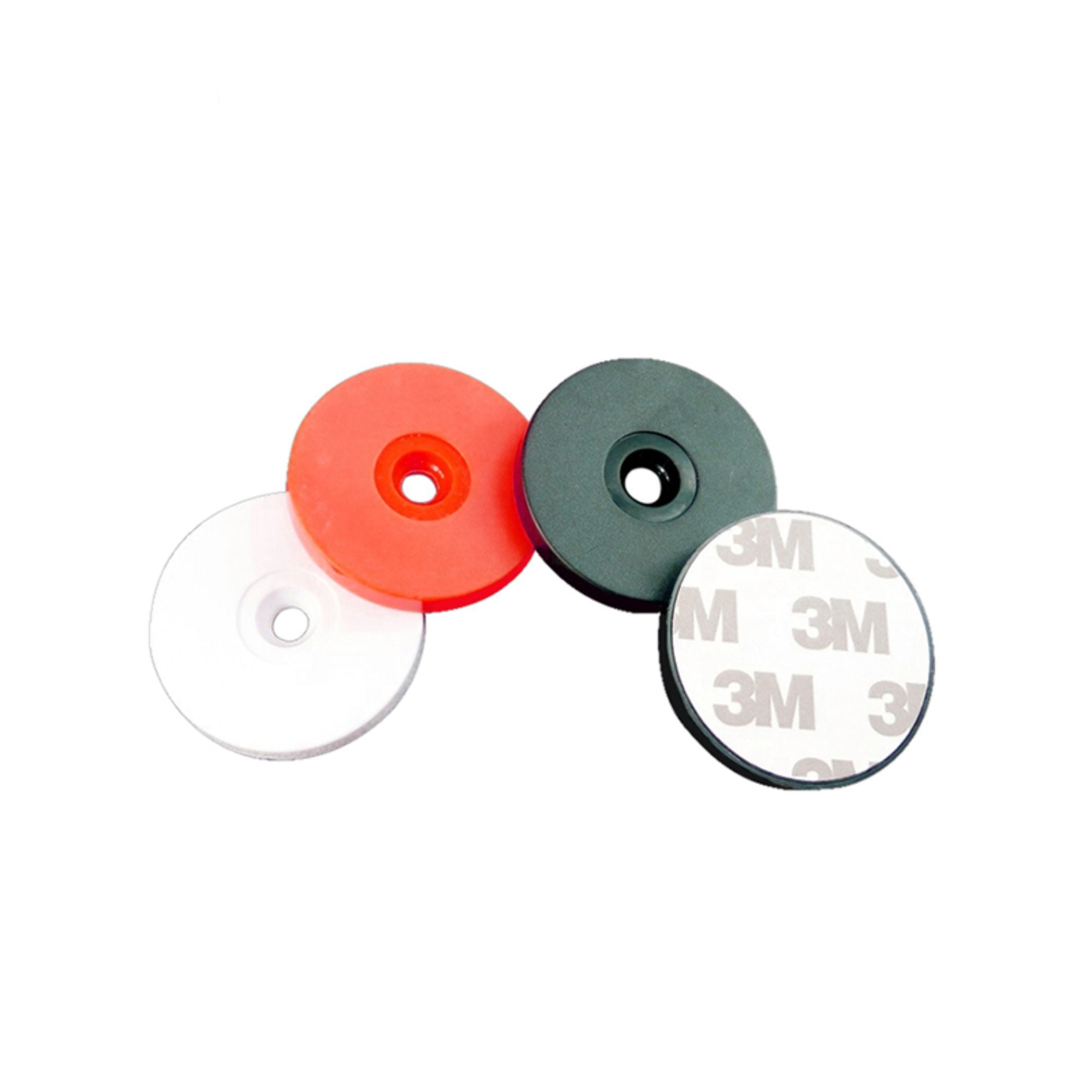
Screw-fixed hard tag Sealed ABS tag fastened through the bin wall or a moulded boss, often with a tamper-resistant screw head Retrofit programmes and mixed bin fleets Screw head must resist casual removal; sealing around the fastener matters
Moulded-in tag Transponder encapsulated during bin manufacture New bin production at volume Requires coordination with the bin maker; harder to replace later
Riveted tag Permanent mechanical fixing High-theft or high-abuse areas Removal destroys the tag by design — plan re-tagging cost
Adhesive tag High-tack adhesive label or disc Low-cost retrofit, smooth surfaces Ribbed or contaminated surfaces reduce adhesion; lifespan is shorter
Cable-tie or strap tag Tag body looped onto a handle or bar Fast pilot deployments Vulnerable to damage and removal; orientation varies

What a bin tag has to survive

  • Weather — UV, rain, frost, and repeated wet/dry cycling
  • Wash-down and decontamination — including chemical cleaners and disinfectants
  • Temperature extremes — both ambient and wash-related
  • Mechanical abuse — impact during lifting, dropping, and compaction-adjacent handling
  • Contamination — mud, grease, and mineral oil on the tag face
  • Attempted removal — which is why tamper-resistant fasteners and tamper-evident construction matter for billing applications

    What the Data Enables

    • Verified collection — proof of service per bin, per address, per time, which is the fastest way to settle "you missed my bin" disputes
    • Pay-as-you-throw and weight-based charging — bin ID plus lift weight, reconciled to an account
    • Container asset registers — how many bins exist, where, and in what condition, including bins that are missing or duplicated
    • Route and productivity analysis — stops per hour, lift counts, exceptions per route
    • Contamination and sorting programmes — linking a specific container to an inspection result
    • Maintenance planning — damaged bins identified by repeated read exceptions rather than by complaint

    Note the dependency: every one of these outcomes requires that the bin-to-account mapping stays accurate. Most failed programmes are not RF failures — they are register failures, where a bin was replaced, moved, or re-issued and the database was not updated.

Recommended Products

Related Search

GET IN TOUCH

Copyright © ©Copyright 2024 Greatest IoT Technology Co., Ltd all rights reserved  -  Privacy policy