News

News

Home >  News

RFID Key Fob: A Practical Guide to Access Control Credentials, Frequencies, and Chip Security

2026-10-19

What Is an RFID Key Fob?

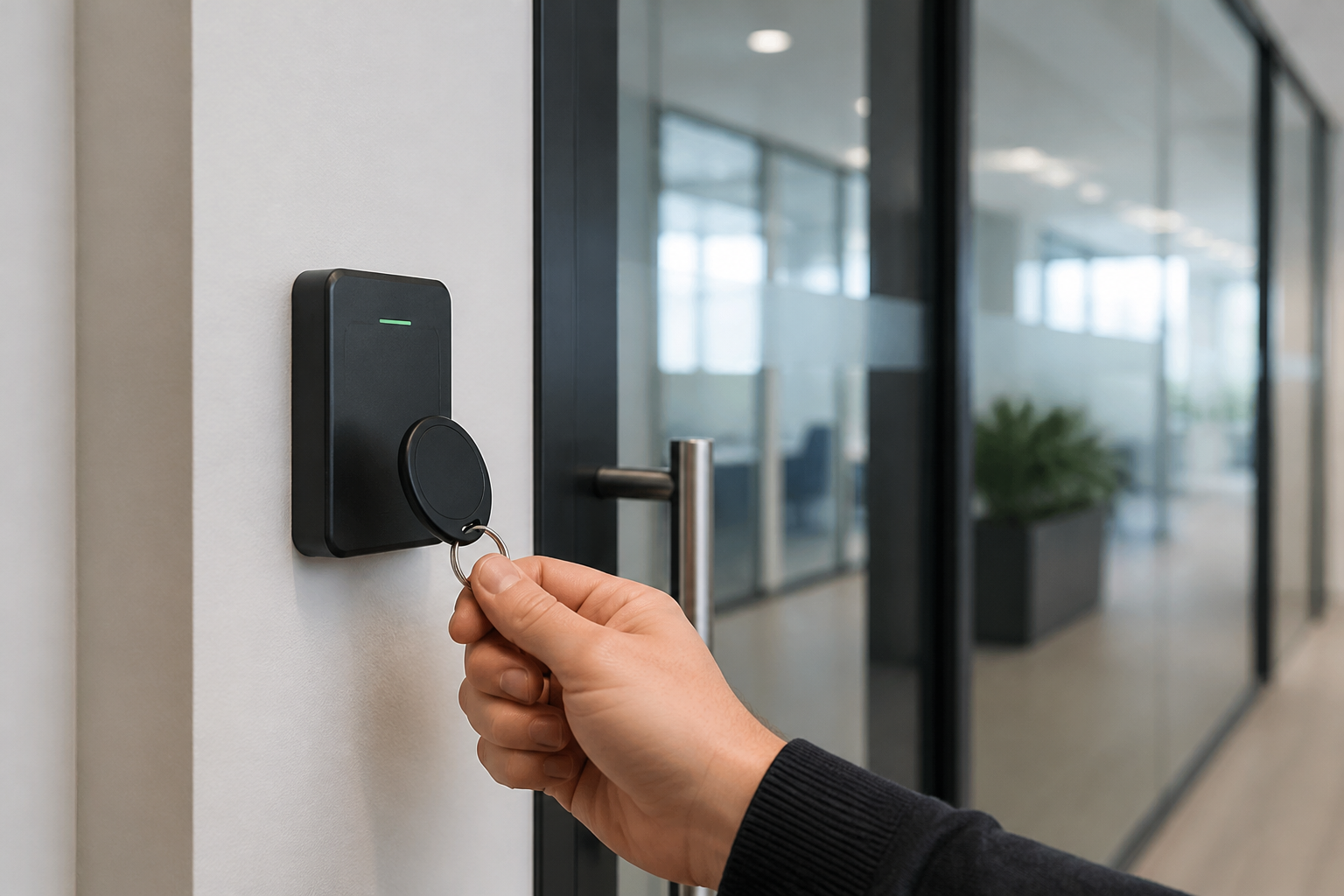
An RFID key fob is a small, sealed, passive credential that carries a chip and antenna inside a plastic body, and is presented to a reader to unlock a door, gate, locker, or terminal. It needs no battery. The reader's electromagnetic field powers the chip, the chip returns an identifier or an authenticated response, and the access controller decides whether to release the lock.

Key fobs matter because they are the cheapest, most durable credential format in most access-control deployments: there is no card to bend, no magnetic stripe to wear out, and no screen to break. A fob typically survives a keyring, a pocket, and daily handling for years.

The important point for buyers is this: the plastic shell is not the product decision — the chip, the frequency, and the security model are. Two fobs that look identical can differ by a factor of ten in security.

The Three Frequency Bands (and Why One Is Obsolete)

Frequency determines which reader ecosystem a fob can join. A 13.56 MHz reader physically cannot communicate with a 125 kHz fob, so the choice locks you into a supply chain.

Property 125 kHz (LF) 13.56 MHz (HF) 860–960 MHz (UHF)
Typical read range 1–10 cm 1–10 cm (up to ~1 m with large antenna) 3–15 m; up to 20 m at high gain
On-tag cryptography None AES-128, 3DES, ECC Optional (Gen2v2 and later)
Security posture Weak — plaintext UID, trivially cloned Strong with modern chips Weak without Gen2v2 crypto suites
Best fit Maintaining legacy systems Modern building and enterprise access Vehicle gates, yard and perimeter access

Modern access-control readers operate at 13.56 MHz using ISO/IEC 14443-compliant credentials, with MIFARE DESFire EV2/EV3 and AES-128 mutual authentication as the secure default. Legacy 125 kHz systems transmit UIDs in plaintext and can be cloned with inexpensive commodity tools, so they should be maintained rather than extended into new builds.

Practical takeaway: specify 13.56 MHz, ISO/IEC 14443 Type A, unless you are adding fobs to an existing 125 kHz estate.

Which Chip Should the Fob Carry?

The chip decides what security the deployment can actually achieve. The table below summarizes the common families and their standing.

Chip family Frequency Cryptography Security verdict Typical use
EM4100 / EM4102 125 kHz None (plain UID) Broken Legacy LF access
HID ProxCard II 125 kHz None Broken Legacy offices, campuses
MIFARE Classic 1K/4K 13.56 MHz CRYPTO1 (proprietary) Broken since 2008 Older building access, hotel keys
MIFARE Ultralight C / EV1 13.56 MHz 3DES or password Low–medium Transit tickets, hotel cards
NTAG 424 DNA 13.56 MHz AES-128 + SUN Strong Tap-to-authenticate, IoT pairing
MIFARE DESFire EV2 13.56 MHz AES-128, CMAC, Proximity Check Strong Enterprise access, transit
MIFARE DESFire EV3 13.56 MHz AES-128, Transaction Timer, SUN Current standard Enterprise access, government ID
HID Seos 13.56 MHz AES-128 diversified Strong Enterprise physical and logical access

Where RFID Key Fobs Are Used

  • Office and commercial buildings — employee credentials, multi-tenant lobbies, server rooms
  • Hotels and short-stay properties — reusable guest fobs with per-stay validity windows
  • Gyms, clubs, and leisure facilities — member check-in, locker allocation, attendance logs
  • Residential and gated communities — pedestrian gates, parking barriers, elevator floor permissions
  • Industrial and logistics sites — personnel gates, restricted zones, contractor time windows
  • Campus and institutional — staff access, equipment cabinets, laboratory doors
  • Time and attendance — tap-based clock-in where the same credential doubles as the access token

In practice, most buyers deploy one credential type across several of these uses, which is why the reader standard matters more than the fob appearance.

Recommended Products

Related Search

GET IN TOUCH

Copyright © ©Copyright 2024 Greatest IoT Technology Co., Ltd all rights reserved  -  Privacy policy